
Begin With a Land Transaction, Not a Family Crest
DL 25 is the Duchy of Lancaster Deeds Series L. A surviving deed can name people who granted land, received an interest, witnessed an act or authenticated it with a seal. These are historically significant roles, but they are not interchangeable with father, son, husband or owner for life. The National Archives lists the broad DL 25 series from about 1100 to 1979, while a major group of its digitized seals is much earlier. Always inspect the date and item description.
The National Archives land and deeds guide explains that many deeds were removed from their original bundles and regrouped by the Crown office in which they were found. Such archival arrangement can separate a conveyance from related accounts or litigation. A DL 25 reference tells you where a deed is now preserved; it does not prove the deed concerns a property presently owned by the Duchy.
Begin with a historical place name and a specific legal question. Did someone convey a tenement, confirm a rent or act as a witness? Copy the land description, variant spellings, deed date and parties’ actual legal capacities. Place a seal claim in its own column rather than treating heraldic imagery as a substitute for a recorded link between generations. A shared surname and similar device do not establish a family line.
Select the Deed, Seal Image and Related Series
The official seals research guide identifies more than 3,000 digitized images of approximately 2,500 seals from DL 25 and DL 26, mostly personal seals but also other types, dating largely from the twelfth to eighteenth centuries. The image collection is a means of locating a surviving seal, not a name index of every person in the Duchy. Search both the deed and seal records for the place and name.
DL 26 is a neighboring Duchy deeds series, and DL 27 is another group listed in the land guide; neither should be shown as the mandatory next volume after DL 25. Search them only if the property, parties or historical catalogue description make the connection plausible. The same person may appear under a title, a patronymic or a localized spelling. Record each form literally, then decide whether the dates and roles permit the identities to be joined.
A document may have a seal impression, a detached seal or a broken attachment with no legible legend. Description and image are different levels of evidence. Compare the surviving device and legend with the written parties and explicit sealing clause; note uncertainty when a seal cannot be attributed. Modern digital images are not all to scale and can suppress relief details. Do not reconstruct a missing name from a decorative motif alone.

Separate Grantor, Grantee, Witness and Sealer
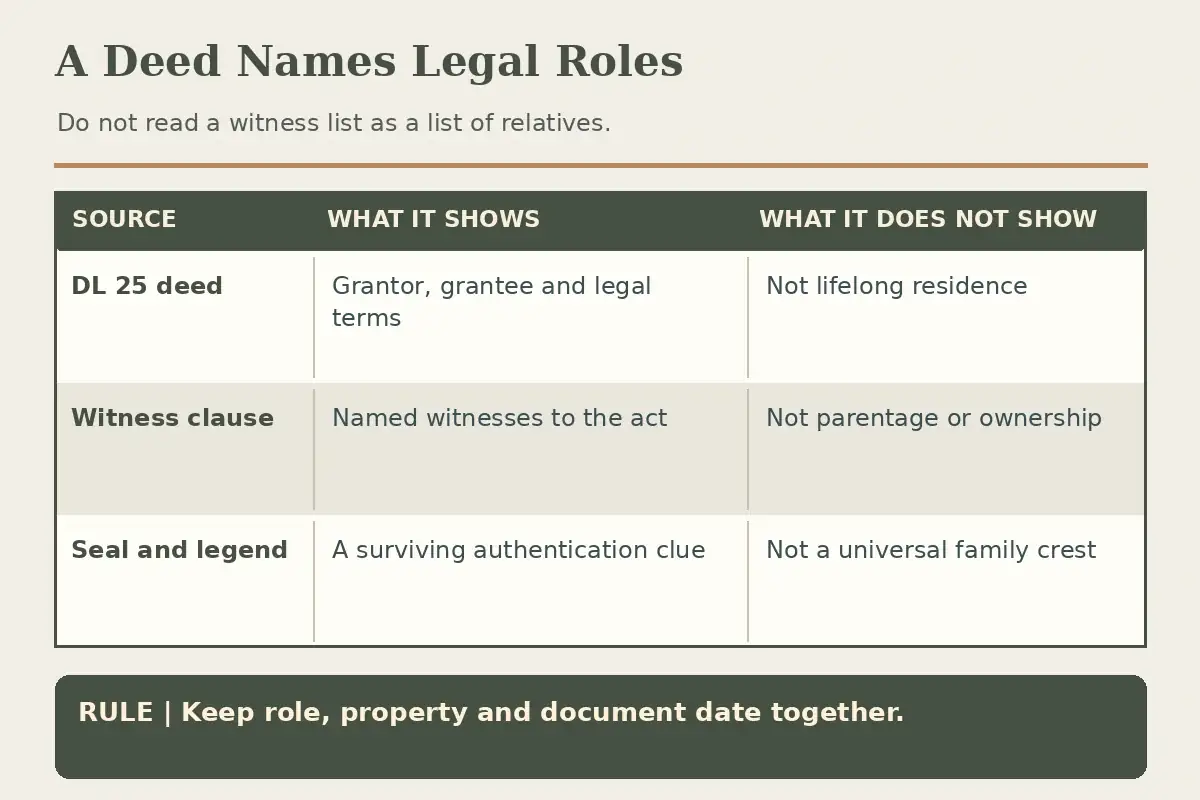
Make an evidence table with columns DOCUMENT DATE, PERSON AS WRITTEN, ROLE, PROPERTY, SEAL CLAIM, WHAT THE DEED SHOWS and WHAT REMAINS UNKNOWN. The grantor conveys or confirms the specified interest under the document’s conditions. The grantee receives the named interest. A witness records participation in authentication, not necessarily ownership or residence. A seal authenticates the act as represented in the text, not an entire lineage.
Property terminology matters. A perpetual rent, a right of entry, a life interest and full ownership are not equivalent. Even when a deed names “heirs,” it does not necessarily identify individual children. Read the legal term and transaction before drawing conclusions about succession. For medieval dates, keep the original regnal or feast-day wording and the editorial conversion side by side instead of silently treating a suggested year as an exact modern date.
A seal that depicts a shield may belong to a named holder or to an institutional office; it is not evidence that every modern person using the surname has the same arms. If the seal legend differs from the written party, record the difference and investigate reassignment or a second individual. The practical result is a source-specific statement about the transaction and authenticated name, plus a list of family questions still requiring other evidence.
Move From a Deed to a Documented Property History
Identify the exact DL 25 piece or item and copy the property bounds as written, including neighbors, roads, waters and field names. Search for another deed with the same property description, but beware reused place names. A second document from a different date may show transfer or dispute; do not turn it into continuous residence between the two dates. A local manor court roll or tax record, where surviving, might serve a distinct purpose.
An archival calendar, transcript or seal photograph can help locate and read a deed, yet neither should be mistaken for the whole original. Inspect any endorsement on the reverse, later filing note and evidence of missing attachments. Record the language read and whether an abbreviation was expanded by an editor. If access is limited to an image, state that openly, and avoid pretending to have inspected the physical wax or parchment texture.
The research chain works only when the evidence actually connects: deed → identified property → independently dated local entry. Where a name changes between documents, compare role, associates and land boundaries. A genealogical parent-child relationship needs explicit kinship words or a sufficiently strong independent chain; a repeated witness signature is not enough. The accompanying graphics show alternative routes and evidentiary limits rather than a guaranteed succession.

More House and Local History Guides
How We Research Authenticity and Family Claims
We start with the item description, photograph or original deed; record the date, property and legal persons; then test seal attribution and independent land records. Teaching illustrations in this article represent the form of seals and deeds only. They are not reproductions of an archival DL 25 item, and the shapes are not purported authentic coats of arms for any person.
To make a finding reproducible, retain the full series and item locator, seal image source, transcription decisions and repository. Keep a dated record of what you did not inspect. Do not claim a place’s boundaries match a modern map without cartographic evidence. When a medieval deed mentions a relative, read the exact grammatical relationship; a title of respect or common family designation may be misinterpreted when translated loosely.
Our affiliate disclosure is available before any subscription or copying decision. The useful outcome is often modest: a named party performed a specified legal act at a specified property, while kinship and continuing occupation remain research questions. That is stronger than attaching a fictional pedigree to a handsome seal.
The Duchy of Lancaster Deeds Series L, whose overall catalogue span is broader than the period of the digitized seal images.
No. The series extends into much later periods; check the date of the individual item.
No. A witness attests or participates in a transaction, not automatically as a relative.
The National Archives seal guide links digitized DL 25 and DL 26 images and a seal catalogue.
Read the precise rights, parties and conditions in the deed, then test transfers using independent records.