
Locate a Common Pleas Case by Term and Year
CP 40 is the chief plea-roll series of the English Court of Common Pleas. It preserves formal entries in civil lawsuits, including disputes involving debt and property, but it is not a modern name-search database containing a narrative trial transcript. A reliable search starts with the date or likely law term, the county, and parties’ names. The National Archives guide explains that descriptions of most rolls identify term and year rather than the litigants.
Four named law terms were Hilary, Easter, Trinity and Michaelmas. A document dated within a calendar year may belong to a legal term labeled by regnal year; record both systems when present. The Court of Common Pleas plea rolls span the later thirteenth century through the nineteenth, but this article focuses on the CP 60 finding-aid period, particularly the missing docket series of 1770–1790. Do not assume a modern year-of-birth search is the right route.
Write down a testable question: Did two named parties have a case in a particular term? Do not begin by assuming a case’s result. A summons, declaration, pleading and later judgment can have different procedural meanings. The survival of an entry is evidence that a recorded stage occurred; a claim pleaded by a litigant is not a demonstrated historical fact, even when copied into a formal court roll.
Use CP 60 Only Where Docket Rolls Survive
CP 60 docket rolls were associated with the prothonotaries and can point to rotuli in CP 40. The archive identifies a long run from 1509 to 1859, but it is not continuous: up to 1770 three prothonotary docket groups require checking for each term; there are no surviving dockets for 1770–1790; from 1791 a single run resumes. Search advice must change at those boundaries instead of using an imagined one-click index.
For a case dated 1650, search all three relevant surviving prothonotary dockets for the term, not just the first apparent match. The archive notes that even the individual dockets contain gaps. For a case around 1780, plan a roll-first strategy: identify the CP 40 term, inspect county headings and follow the relevant rotuli manually or with specialized images when available. The absence of a CP 60 docket in this interval is a documented survival gap, not a negative result about the parties.
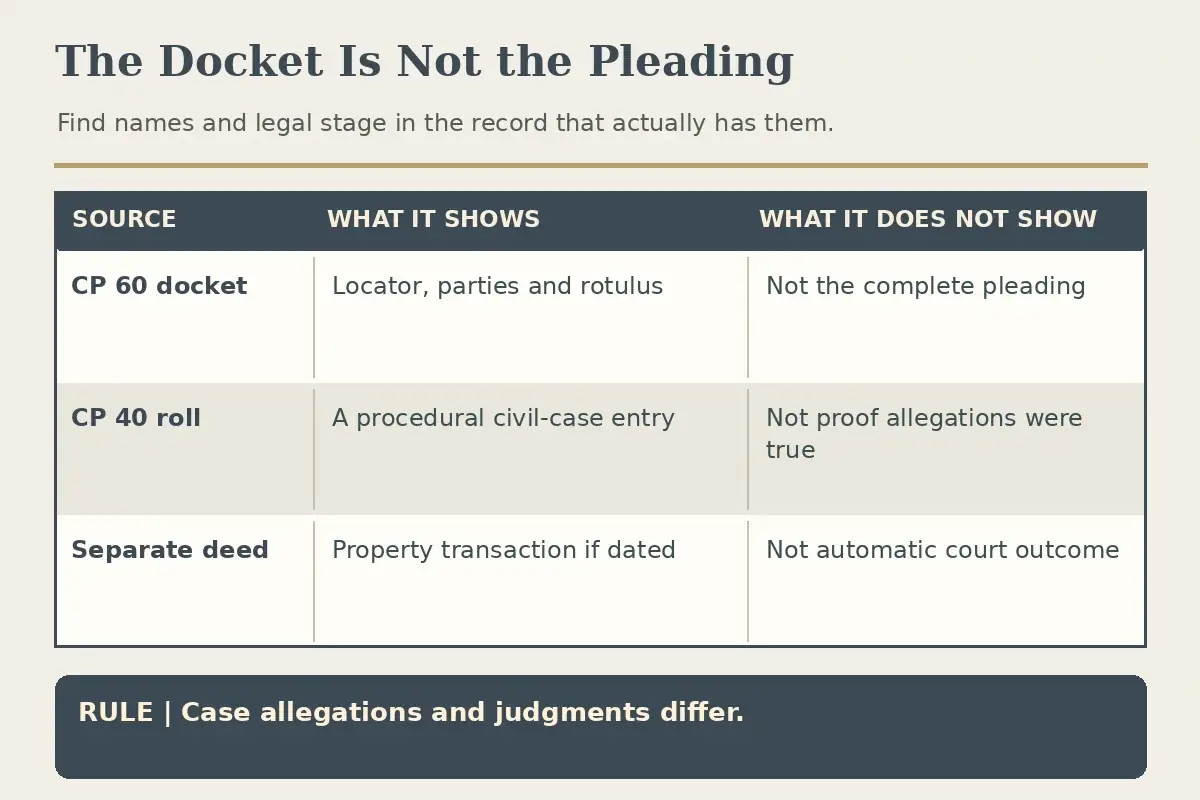
From 1791 onward, the reconstituted docket sequence can save substantial time. An entry may supply the county, the plaintiff and defendant, the attorney and the type of entry, with a rotulus reference. Copy the exact rotulus number and the CP 40 term before moving to the plea roll. A docket reference is a locator, not the original record of what was pleaded or decided.

Read the Pleading Without Converting It Into Proof
CP 40 rolls contain formulaic pleadings and process, not necessarily what lawyers and judges said aloud. The National Archives emphasizes that even later court records are procedural texts shaped by legal convention. Distinguish the plaintiff’s allegation, the defendant’s answer, procedural appearances and any actual determination recorded. If the entry ends at an interim step, the result may be somewhere else or not recoverable from surviving material.
Build columns CASE TERM, COUNTY, CP 40 PIECE, ROTULUS, PARTIES, PROCEDURAL STAGE, ALLEGATION, RESULT ACTUALLY RECORDED and NEXT SOURCE. Spellings may be Latinized or abbreviated, and repeated names are common across large counties. Do not attribute a land dispute to an ancestor solely because surname and county match; test occupation, manor, address, associates and chronology against independent documents.
For older cases, the clerk may be identified on the rotulus; this tells us about record production rather than the litigants’ lives. The guide notes that rotuli acquired numbers from 1290 and often clerks’ surnames from 1305. These details are useful for locating and citing an entry. They do not turn a docket roll into evidence that a legal claim was true, and a case disappearing from subsequent terms should not automatically be labeled a victory or settlement.
Reconstruct the Case Without Guessing an Outcome
First choose the correct term and CP 40 reference. Second, apply the CP 60 date gate: pre-1770 multiple dockets where surviving; 1770–1790 none; from 1791 a single series. Third inspect the roll, record the exact rotulus and check adjacent terms for continuation. If you find a judgment, identify which issue it resolves. A judgment about a procedural matter may not answer the larger historical allegation.
Specialized images of some rolls are available via the Anglo-American Legal Tradition project, as noted by The National Archives; this does not mean every roll is digitized or personally indexed. When browsing, locate the relevant county heading and term. If the law term is uncertain, compare neighboring terms and regnal-year equivalents, and document the full window consulted. A failed narrow search for a surname is not evidence that no case existed.
Test a genealogy claim with external records: a separate deed can corroborate a property description; a parish register may help distinguish namesakes. An official court record is primary evidence of litigation, not necessarily firsthand evidence of the underlying transaction that a party alleged. Draw an arrow between the court entry and another source only if they actually share identifiable people, property and dates.

More Records and Archives Guides
How We Research a Missing Civil Docket
We use a date-aware method rather than asserting CP 60 exists for every year. The evidence graphics keep CP 40 roll content, CP 60 locating information and independent identity tests separate. Their stylized court documents are original teaching illustrations, not photographs of a specific authentic plea roll or of an actual litigant.
Our research log cites repository, CP 40 piece, term, year, rotulus, side if relevant, and the method used to find it. We record whether a CP 60 docket, a digital image or the original roll was consulted. The difference matters: a docket may give names and a locator without showing the full pleading. Conflicting dates and name spellings are retained as evidence rather than polished away.
We disclose commercial relationships at affiliate disclosure. Begin with the official National Archives guide before assuming paid databases cover the relevant centuries. A useful result may be a documented civil pleading with no recoverable judgment; the absence of dockets for 1770–1790 is a known access obstacle, not a reason to invent one.
The main series of Common Pleas plea rolls, arranged by legal term and year rather than a comprehensive personal-name index.
Docket rolls that can point to CP 40 rotuli, with arrangement and survival changing by period.
The National Archives states that no docket rolls survive for that interval.
No. Separate the claim, the procedural action and any actual ruling.
Record the CP 40 piece, legal term and date, rotulus and side, plus repository and viewing medium.