
The Indian Census Rolls, 1885–1940 (NARA M595), record many individuals and families counted by federal Indian agents, usually by agency and year. The National Archives overview provides the jurisdiction list and explains missing years. A name on a federal administrative roll is not, by itself, proof of tribal citizenship, current enrollment eligibility or ancestry outside that specific recorded context. Tribes determine their own citizenship and membership rules.
Locate the Federal Agency Before a Broad Name Search
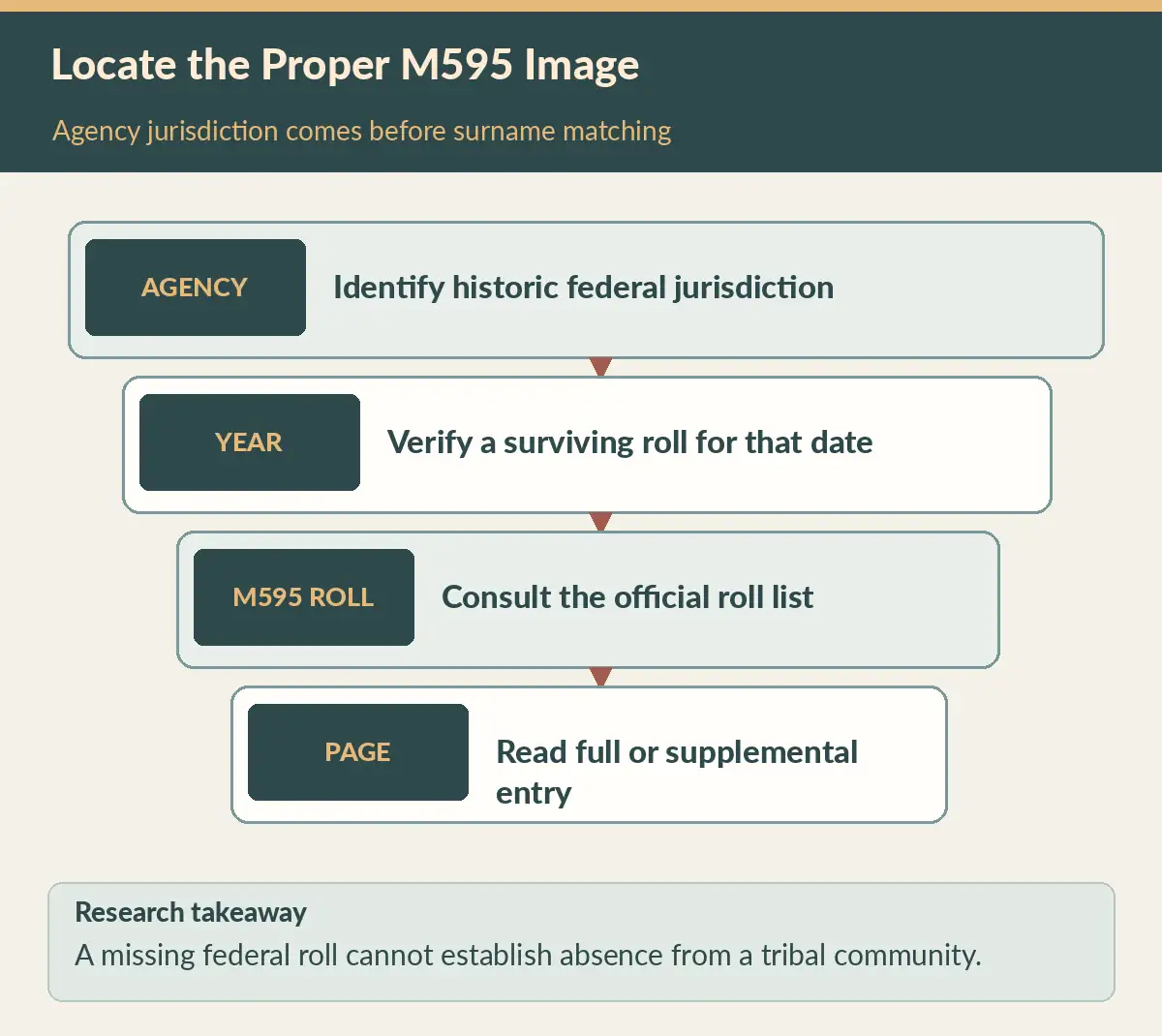
These were annual records submitted under the Bureau of Indian Affairs system, not a unified census of all Indigenous peoples living in the United States. NARA’s microfilm publication M595 contains 692 rolls arranged primarily by agency or other federal jurisdiction and year. Knowing a family’s associated reservation, federally administered agency, band or locality can dramatically improve the search.
Search historic administrative names and boundary changes rather than relying exclusively on a modern reservation name. Tribal communities whose records were not administered by the federal government may be absent. Do not turn an unsuccessful statewide surname search into a conclusion about whether a family was Indigenous or belonged to a nation.
Understand Why the 1885–1940 Range Has Gaps
The 1884 federal legislation and later administrative practice led agents to submit population rolls beginning in 1885, but these were not created uniformly for every group each year. Some entries were lost, some years were never prepared, and coverage depends on the jurisdiction.
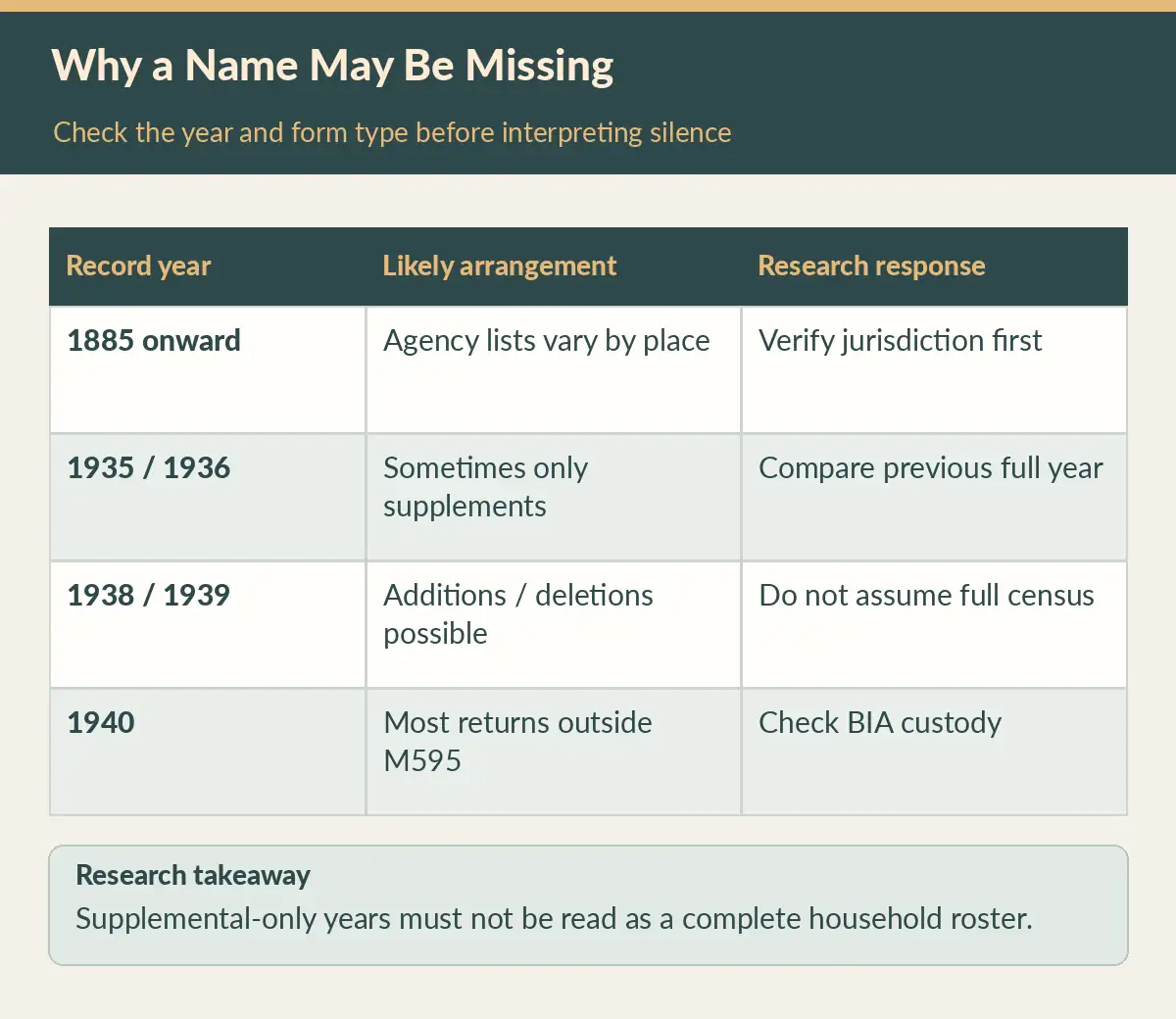
The NARA chronology explains that for 1935, 1936, 1938 and 1939 some administrations prepared only supplemental lists of additions and deletions rather than complete new enumerations. Most 1940 returns remained with the Bureau of Indian Affairs and are outside the M595 film. Before marking a person “missing,” identify which kind of roll actually exists.
Read the Agency-and-Year Microfilm Guide
The NARA M595 descriptive pamphlet lists agencies and corresponding microfilm rolls with their years. Begin there when an index returns several people with the same name.
Select the correct agency and available year, and retain the agency heading on the original manuscript image. A single agency may administer several groups or places, so the agency label alone may be insufficient as a statement of nation or community affiliation. Note whether a school, agency or reservation is explicitly identified, and resist transferring later federal classifications back to an earlier roll where the structure differed.
Compare Names and Household Columns Cautiously
Entries can give Indigenous-language and English names, age or birth date, sex, family or household relationship, agency number and sometimes marital status or residence. The headings changed over time; transcribe the exact columns present on the sheet you saw, not a modern index’s standardized labels.
Age may change inconsistently and spelling may differ between years. A recorded relationship to a head of family is a piece of evidence needing corroboration, not proof of biological parentage in every case. Records created by federal agents reflect specific government purposes and may not preserve how an individual or community defined its own family relations.
Use Roll Numbers as Leads, Not Permanent IDs
Agents sometimes used roll numbers, prior-year numbers or reservation-specific numbering conventions to help reconcile lists. When comparing successive years, record the number as shown in that year and note whether it is a serial order, a previous-roll reference or an agency-specific identifier.
Do not assume a matching number on two unrelated agencies refers to one person. When names changed or moved between jurisdictions, independent geographic and family evidence is necessary to establish a link. If an entry seems to disappear from a supplemental list, verify whether that document includes only changes rather than every continuing resident.
Handle the 1930s Supplemental-Only Years
A 1939 list consisting of additions and deletions is not interchangeable with the complete 1930 or 1931 agency census. A person present in an earlier full roll may be absent from a later supplement because no change was recorded. Conversely, a name on an additions sheet should not be back-dated into an earlier full roll without verification.
Use a year-by-year table indicating full return, supplement, missing or unavailable copy; record changes and their original stated reasons. Distinguish an administrative deletion from death or migration unless the handwritten note explicitly gives that event and another source confirms it. This prevents a particularly harmful form of false negative family-history evidence.
Distinguish Federal Roll Entries From Tribal Citizenship
A BIA roll was made for a federal administrative purpose. It does not replace a tribal government’s citizenship or enrollment system, nor does it authorize an outsider to decide someone’s national identity.
The NARA research guide warns that people outside federal supervision may never appear in M595. A historical recorded “blood degree” is a federal-era administrative statement, not genetic proof, cultural belonging or proof of eligibility in the present. Respect sovereign tribal criteria and individual and family privacy when interpreting or sharing genealogical findings, especially where living descendants could be identifiable.
Test Two Namesakes Against a Real Place
Imagine two people named Joseph Williams on rolls from different agencies in 1910. One is listed with a certain household group and the other with a different town and age. Compare the manuscript agency, year, family members, recorded name variants and independent vital or community evidence before making the two entries one person.
A probable name translation should be treated as a hypothesis unless historical documents make the connection. Repeated agency codes may narrow a candidate but cannot prove a family connection across distinct sovereign nations. If a photograph or family story is used, preserve the source and permission to share it.

How We Research Federal Indian Census Evidence
We establish agency jurisdiction and exact year, verify survival using the M595 roll list and read the original page alongside any name index. We record original terms without converting federal classifications into a modern identity judgment.
We compare the full and supplemental returns separately, seek family or community evidence independently and describe unresolved conflicts. We never assert that an entry proves enrollment, tribal citizenship or a particular contemporary legal status. The affiliate disclosure governs site relationships and does not affect the cultural or evidentiary authority of community sources or federal records.
More Records and Archives Guides
Cite the Agency, Year and Actual Roll
For each entry cite the federally recorded agency or jurisdiction, year, M595 roll number, image or page, person’s name as written and repository or digitized platform. Note whether it is a full census or a supplement listing additions or deletions.
If comparing multiple years, cite each record separately rather than giving only a single collection link. Include an explanation of any historical naming or jurisdiction changes and an explicit note when agency coverage is uncertain. The NARA roll table is a finding aid; an actual family claim should rest on inspected entries and appropriate independent evidence.
No. It chiefly concerns families under specific federal agencies; coverage and years vary.
No. Tribal nations set their own citizenship and enrollment criteria.
Some 1930s rolls were only supplements of additions and deletions, not full enumerations.
No. Fields and completion practices changed by agency and date.
Use the original agency or jurisdiction, year and microfilm roll, not just a modern state name.