
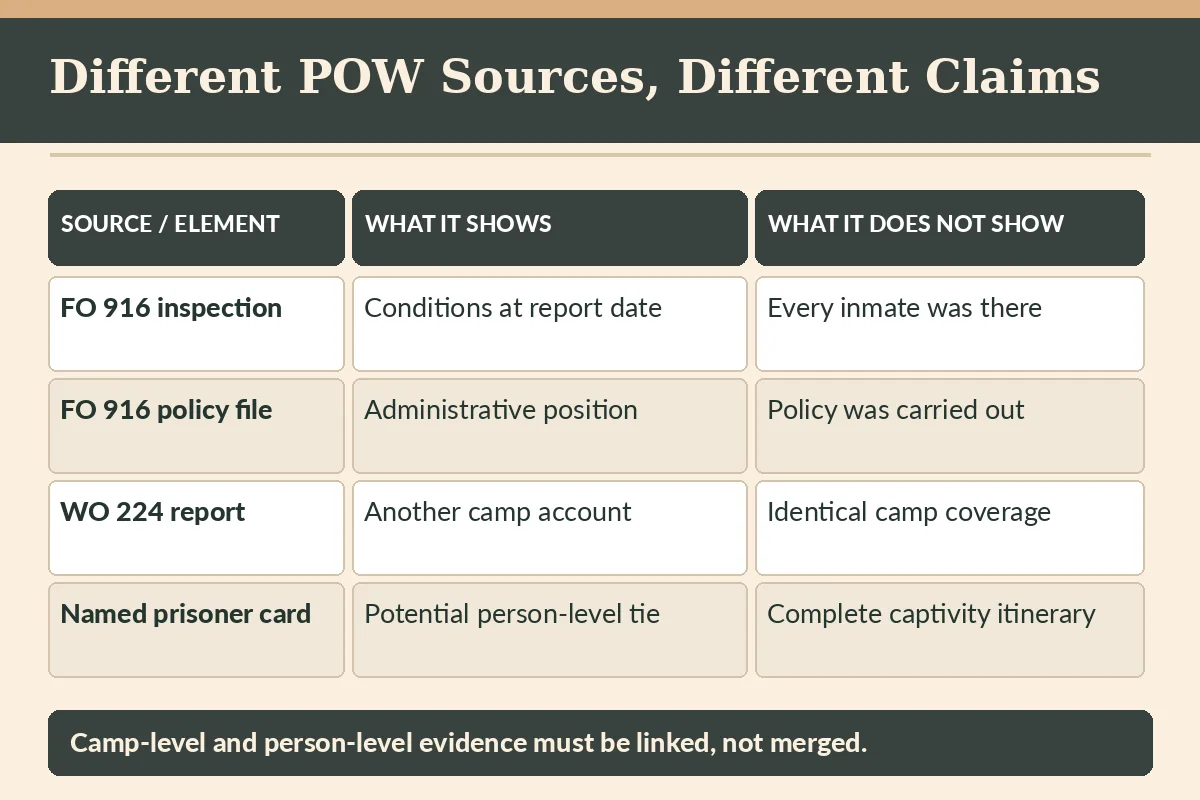
Foreign Office files in FO 916 include correspondence and reports about prisoners of war and internees during and after the Second World War. The National Archives points researchers to FO 916 for inspections of prisoner-of-war camps, and describes the collection more generally as registered files of the Prisoners of War Department for 1939–1948. An inspection report can describe a camp at a particular time. It does not automatically name all people confined there or prove that a specific prisoner was present on the inspection date.
Start with a well-defined camp question: where was this establishment, under what authority did it operate, and what is the date of the report? Camp names, numbers, functions and administrative oversight could change. Some records concern enemy prisoners held by Britain, while other files address British prisoners overseas or civilian internees. Establish which population a piece describes before importing names or conditions into a family account.
Identify a camp and its administrative scope
Search the Discovery catalogue using a camp name, location, number, country and terms such as ‘inspection,’ ‘prisoners of war’ or ‘internment.’ Filter by relevant dates and FO 916 when an apparent result appears. Record the full piece number and the description’s subject. Because cataloguing is not uniform across every file, a negative name search does not establish that a camp or a person’s file never existed.
Keep two separate columns: the historical name in the document and the modern place identification you propose. Compare a camp number with geographic clues and the authority responsible. A prison camp, hospital, transit facility and civilian internment site are not interchangeable merely because they served the same general area. When boundaries or wartime country names differ from today’s maps, quote the historical term alongside a qualified modern equivalent.

Read a dated inspection without overstating it
An inspection may record accommodation, food, sanitation, medical provision, labor, correspondence or complaints, depending on the inspection’s purpose. It describes what inspectors observed, were told, or were authorized to report, not necessarily the daily experience of every person. Note the inspection date, compiler, intended audience and any annexes. A favorable or critical finding can be important context without becoming proof of one prisoner’s diet, medical history or treatment.
Compare reports written at different dates carefully. A camp might expand, move or change populations between visits, and administrative recommendations might not have been carried out. If a report recommends improvements, label that as a recommendation unless a later record documents implementation. Distinguish a fact observed firsthand from an assertion attributed to a camp commandant. This keeps inspection evidence useful without extending it beyond its purpose.
Find individual evidence outside general files
The National Archives warns that it does not hold comprehensive individual rosters of all Second World War prisoners, detainees or displaced persons. FO 916 files may contain particular lists, but the presence of an administrative collection must not be advertised as a name-indexed register. For an individual, a camp report is best treated as background pending a separate record, such as a personal card, casualty record, repatriation file or correspondence tying that person to the site.
Where family correspondence names a camp, compare the date of the letter, postmark and any prisoner number with the administrative report. A later memoir may use a name remembered from another period. A list attached to FO 916 could provide names in one context, but readers must check the list’s date and coverage before treating it as a full roll. An absent name is not negative proof without evidence that the list was intended to be exhaustive.
Compare camp names, transfers, and dates
Build a camp timeline containing opening or use dates supported by documents, inspections, policy changes and independently dated evidence of transfers. Preserve uncertainty in spelling and camp numbering. Compare FO 916 with WO 224 where appropriate, because the Archives names both series in its guide to Second World War prisoner camp reports. This is a comparison of potentially complementary records, not a mandatory chronological sequence or a promise that both exist for every camp.
A strong historical statement might say that an FO 916 inspection describes health provisions at one named camp in a named month. A much stronger and different statement is that a particular person was confined there at that time. The second requires an identifying item. Avoid maps that pin every camp mention to a modern point with false precision; document whether location is established by the report, a historical map or a later researcher.

Consider an example: a family letter says a soldier spent winter in Camp A, while a report describes Camp A’s accommodation in spring. The report provides context and a possible research lead but does not prove the soldier was still present at the later inspection. A dated prisoner card, repatriation record or another contemporaneous letter may close the gap. If it cannot be closed, state that the report is contextual evidence only.
Some files involve captivity, displacement or serious mistreatment and require respectful handling. Do not replace historical labels silently, but explain discriminatory or bureaucratic terminology instead of adopting it as the article’s own language. Avoid identifying living or recently living individuals from sensitive files without checking access limits and privacy considerations. Research claims should be reproducible from references, not built from extrapolated camp-wide statistics.
More Place and Jurisdiction Guides
How We Research Second World War Camp Files
Our series identification follows The National Archives’ guide to prisoners in British hands, its British prisoners guide and its internment guide. These establish FO 916 research routes but do not substantiate a claim that a given inmate appears in a specific piece.
We verify the camp name, administrative jurisdiction, report date and document type before drawing conclusions. Inspection observations, policy statements and prisoner identity each occupy separate evidence fields. Record which sources were unavailable and avoid turning an unsearched file into a negative finding. The site’s affiliate disclosure explains editorial and commercial relationships; this article does not imply any particular affiliate is approved.
Foreign Office registered files concerning prisoner-of-war and internee matters, including some inspection reports, from roughly 1939–1948.
No. They are chiefly administrative sources; any attached names must be interpreted within the list’s actual coverage.
Not without an individual identifier and matching date from the report or another source.
The Archives names WO 224 alongside FO 916 for some POW camp reports; its coverage is not identical.
No. Look for a later implementation or follow-up record.