
The German record cards in WO 416 can identify British and Commonwealth prisoners of war held by German authorities during the Second World War, as well as some civilian internees and records of allied air casualties. Start with a documented name, birth detail and military identity; then compare the actual card rather than treating a search result as proof of a complete captivity history. The series is not a universal list of everyone captured. Some individual records remain closed, so lawful access is a research step, not an obstacle to bypass.
The National Archives distinguishes the German-created WO 416 cards from British administrative POW lists and the separate WO 208 escape and evasion reports. Its guides state that records for people born less than 100 years ago may remain closed. An open catalogue description and an accessible image are different things; another person with a matching surname is not automatically the person sought.
Recognize the type of German record before searching
WO 416 is built from German records acquired after the war, not from a British wartime census of all missing service personnel. Its cards were created for administrative purposes and vary in format, information and completeness. A prisoner card may be useful for identification, but a civilian internee or a deceased airman should not be silently reclassified as an ordinary Army prisoner. Start the research log with the exact type indicated in the record description.
Ask one question at a time: does a card belong to the named individual, does it identify a detention setting, or does it support a particular event date? These are different claims. A surname match is only a candidate. Gather a documented date of birth, service number, rank, unit or distinctive place detail beforehand. Mark missing fields as not recorded rather than guessing what the original clerk intended.

Build an identity test across several fields
Search WO 416 by surname and forename while allowing known spelling variants and initials. Record each candidate reference before filtering. A card headed with a similar surname may belong to someone in a different service, with a different birthday or in a different national contingent. If a catalogue entry provides only a name, do not promote it from possible match to confirmed person without further evidence.
Create separate columns for information printed on the card and information supplied later by your research. Compare service number, unit, birth place and birth date when available. If a detail conflicts, preserve it and test for transcription error, administrative error or a genuine namesake. Resist “repairing” contradictions by imagining transfers or changing a birth year without a source.
Distinguish recorded detention from the whole captivity story
A German card can record a stage in the administrative treatment of a captured person. It may not record every camp, illness, march, transfer or eventual liberation. Some cards were re-used or annotated, and a later note is not necessarily contemporaneous with the original event. Write down precisely which field establishes each claimed date and whether the date records capture, registration or something else.
To extend a timeline, compare the card with independently created British or Commonwealth service records and the appropriate printed prisoner list. Escape-and-evasion papers in WO 208 address a different question and should not be assumed to exist for every person. If those sources disagree, keep the conflict visible and identify what a surviving original might decide.

Use lawful access routes for restricted people
The National Archives warns that some WO 416 records remain closed for individuals born less than 100 years ago. The institution publishes separate routes for living and deceased people. The living-person route requires proof of identity and consent where applicable. The deceased-person process requires evidence of death. These are current access rules, not evidence about a prisoner’s historical experience.
Before making a request, collect the exact reference if one exists and the minimum reliable identity details. Follow the archival instructions for supporting documents and request scope; do not attempt to obtain someone else’s private information by misrepresenting your relationship. A closure notice is neither a negative historical finding nor proof that a file is significant. Record the status without guessing its contents.
Separate civilian internment from a military rank
The same German-origin archive includes several hundred records of captured allied civilians. A civilian may have been detained while traveling or living abroad, and should not acquire a fictional regiment because their card appears among POW records. Compare nationality, occupation, residence and location information with civil documentation where available. A civilian classification also does not establish the full legal basis for detention.
For British-based enemy-alien internment policy, other Home Office records provide a different research context and should not be conflated with German captivity cards. Keep the direction of detention and administrative authority explicit. If a person crossed the boundary between military and civilian roles, locate a dated independent document supporting the transition instead of treating the categories as interchangeable.
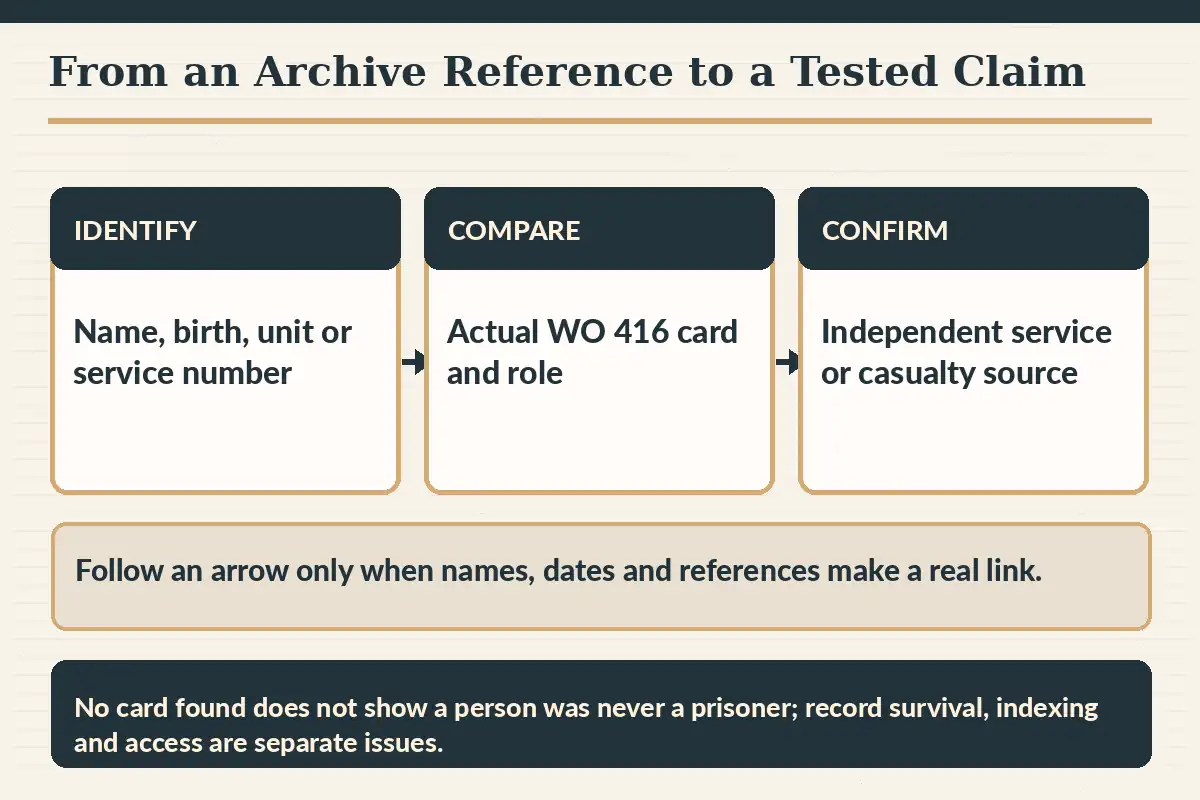
Write a restrained, reproducible POW conclusion
A useful conclusion identifies the exact WO 416 reference, the verified name match, original card fields, uncertain dates, and the separate evidence used for identity. Cite the catalogue entry as a description if the image was unavailable. If you viewed a copy, distinguish transcription from the original wording and preserve ambiguous handwriting with a question mark or explanatory note.
Conclude only what the record supports: for example, that a card was created for a person whose service number matches independent Army material. Do not claim a full captivity itinerary from a solitary card. Treat an absent entry or closed file as a limitation on the present search. Document the next lawful record request or independent comparison that could change the conclusion.
Build a traceable evidence worksheet
Start a claim-specific ledger with the full archive reference, repository, record level, historical creator, date, geographic scope, exact name and role, and whether you saw the original or a description. For each relevant field copy the literal evidence and add a separate inference column. First identify the person and record status; WO 416 may include POWs, civilians and deceased airmen, with some files closed. If an index is incomplete, the right conclusion is that the search is incomplete, not that an event could not have occurred. Save every no-result search with its terms and coverage.
Compare with a record created independently of the first whenever possible. No card found does not show a person was never a prisoner; record survival, indexing and access are separate issues. If two websites repeat one archival description, they are not two independent witnesses. Work with genuine conflicts rather than silently changing dates, spelling or personal identity until an ancestor fits. A good final sentence states what was directly documented, what remains an interpretation, and one specific record that could change the result.
More Records and Archives Guides
How We Research and Check These Records
We checked official archival guidance on 2026-11-03. The National Archives lists German WO 416 cards separately from British WWII prisoner registers and escape-and-evasion papers, and warns that not all cards are open. This verifies the described source route; it does not assert that a particular family member appears in the series.
We checked official archival guidance on 2026-11-03. The official internees guide confirms that WO 416 includes cards for several hundred allied civilians alongside mainly military prisoners. This verifies the described source route; it does not assert that a particular family member appears in the series.
We checked official archival guidance on 2026-11-03. The published WO 416 procedure for living individuals requires identity evidence and consent for requests concerning someone else. This verifies the described source route; it does not assert that a particular family member appears in the series.
We checked official archival guidance on 2026-11-03. The published WO 416 procedure for deceased individuals requires proof of death before the appropriate search and release process. This verifies the described source route; it does not assert that a particular family member appears in the series.
The images are original explanatory illustrations, not archival facsimiles. No paid endorsement or affiliate arrangement is implied. See our affiliate disclosure.
No. WO 416 is a surviving set of German records, not a complete British prisoner census.
Yes. The National Archives identifies several hundred civilian records within the series.
Not necessarily. Identify each recorded event and compare it with independent captivity records.
Follow The National Archives’ living-person process, including identity and any required consent.
Try variants and other POW sources; absence from one series is not proof of no captivity.