
Start With the Officer’s Warrant Number
For an ancestor in the London Metropolitan Police, search The National Archives’ MEPO 4 personnel series and capture the warrant number whenever it appears. The number is a practical bridge between joining, attestation and leaving registers: it can distinguish two officers with the same name even when their occupations look identical in a census. Begin with a roughly dated family record and do not assume a modern police website contains these historical originals.
The National Archives research guide explains that many names can be searched in Discovery, but the underlying catalogue index is incomplete. If a surname returns no hit, browse the relevant volume by period and register type. A negative name search alone is not evidence that the officer did not serve.
Separate the Four MEPO 4 Personnel Sources
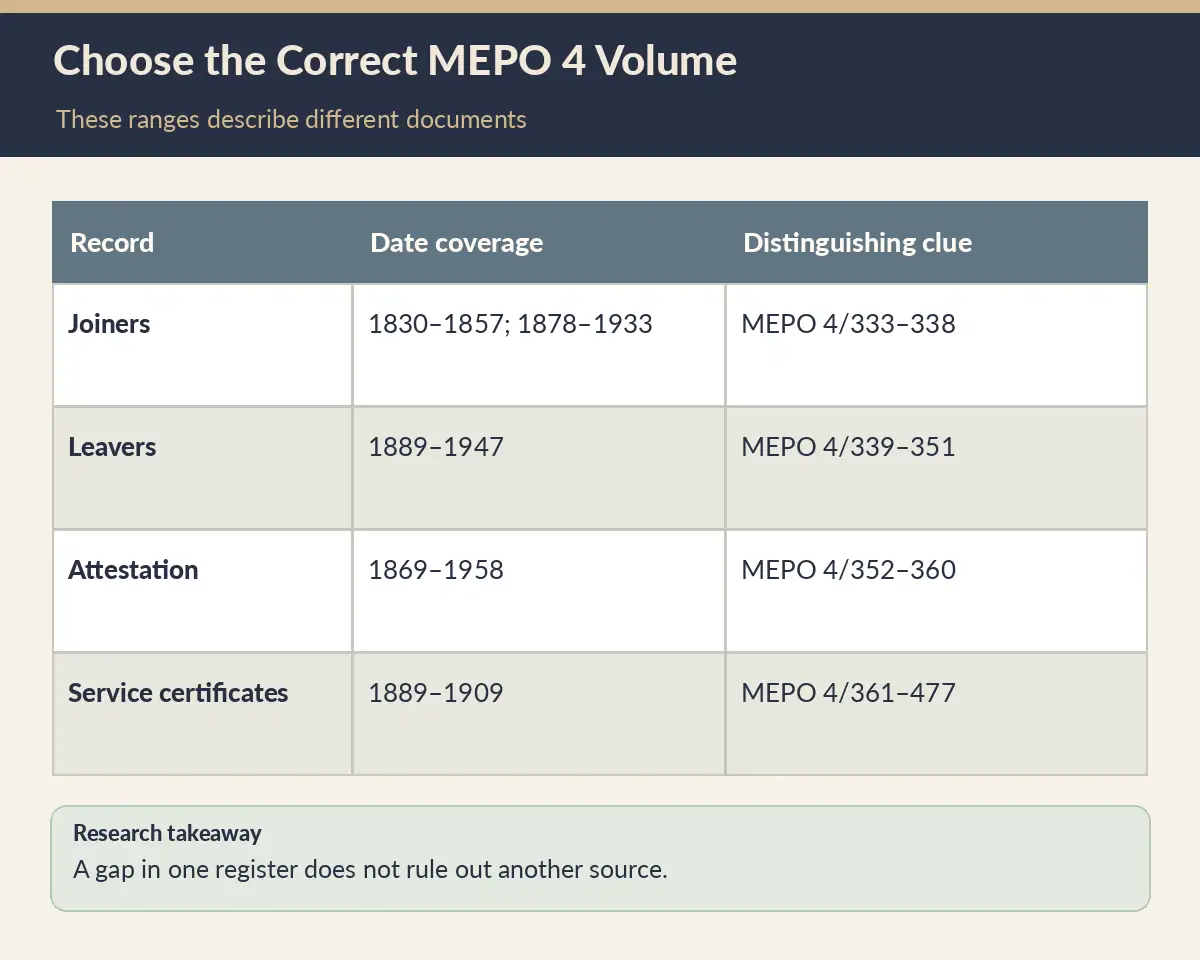
Joiner registers in MEPO 4/333–338 span 1830–1857 and 1878–1933, with a genuine chronological break in that particular set. Leaver registers in MEPO 4/339–351 cover 1889–1947. Attestation ledgers in MEPO 4/352–360 cover 1869–1958; certificates of service in MEPO 4/361–477 cover 1889–1909. These are not four sections of one continuous personnel file.
Select the record according to the question. To test an approximate starting year, inspect a joiner or attestation ledger. To understand an exit, use a leaver entry. For an eligible late nineteenth-century officer, a certificate of service may provide richer physical and employment details. Write the series, piece and event date independently; a document created later can describe an earlier part of a career.
Use Discovery Even When a Name Is Missing
Discovery has detailed individual descriptions for some MEPO 4 entries, but the Archives warns that catalogue names came from a pre-transfer index that was not complete. Start with the person’s full known name, initials and a plausible year. Then browse volumes based on joining or leaving date and search inside the scan. Do not equate missing catalogue text with a missing original line.
The example leavers entry MEPO 4/348/95 shows how names, warrant numbers, joining and departure dates and last divisions can be grouped on a page. It proves how that specific catalogue item is structured, not that every MEPO entry always contains all those fields. Capture the actual text and image location of your candidate.

Read Rank, Division, and Departure Codes Precisely
A police division is an organizational assignment at a particular time, not necessarily the officer’s residence. A rank appearing in a leaver register may reflect the end of service rather than the rank held at appointment. Record date and administrative context together. TNA lists abbreviations such as RP for resignation permitted and RR for required to resign; use the official glossary before paraphrasing any such notation.
An administrative code is not proof of a crime or disciplinary finding. If family tradition describes a dismissal, investigate what the contemporaneous record actually says. A leaver page may identify a departure without explaining the underlying circumstances. Supplement it with permitted and relevant archival sources rather than inventing a narrative about conduct. Keep the register’s exact wording in the transcript.
Identify When Certificates of Service Exist
Certificates of service for 1889–1909, MEPO 4/361–477, are particularly useful because they may contain birth date, physical description, prior trade, employer, residence, marital status, family-count information, and posting or promotion dates. These fields offer strong identity tests when several men share a name. Yet TNA’s coverage is bounded: an earlier officer will not automatically have this specific certificate.
Build a match grid with year of birth, trade, former employer and division; add the warrant number and exact certificate reference. A shared trade and surname are only circumstantial similarities, while a consistent warrant number across separate personnel entries is stronger institutional identification. Do not assume listed children or marital status independently proves each child’s name or parentage.
Treat Police Pensions as a Separate Archive Route
MEPO 21 holds Metropolitan Police pension records rather than the basic MEPO 4 joining and leaving registers. The National Archives guide describes online search for pension registers for 1852–1932, while later records require different browsing and some are closed. Pension material may offer additional dates and relatives, but it is not a universal endpoint for every officer recorded in the force.
Do not conclude a person was pensioned because a long period separates two MEPO 4 dates. Find an actual pension reference or state the status remains unknown. For later twentieth-century entries, read the official closure guidance before making any access request; respecting restrictions is part of competent archival research. A surviving enlistment record does not create a right to see every related file.
Test a Difficult Same-Name Officer
Imagine two fictional George Wilsons appearing around 1900. A borough directory mentions a constable, while Discovery offers a George Wilson in a leaver register and another in an attestation volume. Their names do not join the records. First compare the warrant numbers. If they differ, treat them as separate officer candidates until another explanation is documented.
Next compare dates, divisions, a census occupation and any eligible service certificate. If no common number is available, use a contradiction table instead of matching solely by place. Write down the exact entries you rejected and why. A useful research result can be a clearly excluded candidate, because that prevents a mistaken family narrative from spreading into copied trees.
Cite Each Personnel Event and Preserve Search Gaps
Cite The National Archives, the MEPO 4 reference, the register type, the officer’s name and warrant number, relevant event and image or item detail. Include the catalogue link when helpful, but do not let a URL replace the original reference. A good note states whether you viewed a record image, a detailed catalogue description or a secondary transcription.
Keep unsuccessful searches with the date range and volume examined. A useful next step is the earliest known family address, a dated pension reference or the officer’s pre-service occupation. Those independently derived details can distinguish a candidate without assuming continuity that the records do not demonstrate. Absence from a partly indexed catalogue should remain labeled an incomplete search.

More Records and Archives Guides
How We Research Metropolitan Police Records
We begin with a documented person and approximate year, then choose MEPO 4 joiners, leavers, attestation or certificates by source coverage. We check the actual image when available, record the warrant number and compare another personnel entry. If the name index misses the candidate, we browse the date-appropriate registers rather than reporting no service. MEPO 21 is considered only as a separate question.
We compare independent household evidence before asserting family identity, and preserve unexplained changes of division, status or date. See the affiliate disclosure for our editorial transparency. No source requires an invented paid route: the useful output is a person-specific warrant-number ledger with reproducible archival citations.
Some descriptions are name searchable in Discovery, but the Archives states the catalogue index is incomplete.
It is a personnel identifier that can link service entries and help separate officers with similar names.
No. Pension records are in the distinct MEPO 21 series, with separate coverage and access rules.
MEPO 4 service certificates for 1889–1909 can contain physical and biographical details.
No. Read the administrative abbreviation in context; a departure code alone is not a criminal finding.