
London’s historic debtors’ prisons generated several kinds of paperwork, and their survival is uneven. PRIS 10 holds miscellaneous books associated with the King’s Bench, Fleet, Marshalsea and later Queen’s prisons. A discovered entry can be important evidence of a prison action; it is not automatically a verdict, formal bankruptcy, proven duration of detention or full legal narrative. Correct identification begins with institution, date and type of record.
A public database may unite separate prison collections under a familiar label. Your archive citation must still distinguish a Fleet discharge from a Marshalsea commitment and identify the actual book. Work backward from the named institution and the year, inspect what the record is designed to capture, and use court and household material for claims the prison book cannot answer. Similar names in a busy London institution need especially careful comparison.
Which London Prisons Appear in PRIS 10?
PRIS 10 is a miscellany associated with London’s older central prisons rather than a modern criminal conviction database. The National Archives describes it as covering the King’s or Queen’s Bench, Fleet, Marshalsea and Queen’s Prisons, broadly 1697–1862. These institutions were closely associated with civil debt procedures, but the guide also warns that they could hold a smaller number of people confined for other reasons. An appearance in prison records does not automatically establish bankruptcy, a specific offense or a criminal sentence.
The prison name matters because administrative titles and institutions changed over time. Before selecting a volume, copy the name exactly as it appears in a contemporary newspaper or document. Fleet and Marshalsea are distinct, and a King’s Bench or later Queen’s Prison reference must be placed in its correct period. A broad database label such as “London debtor” is only a search aid, not a faithful quotation from the source.
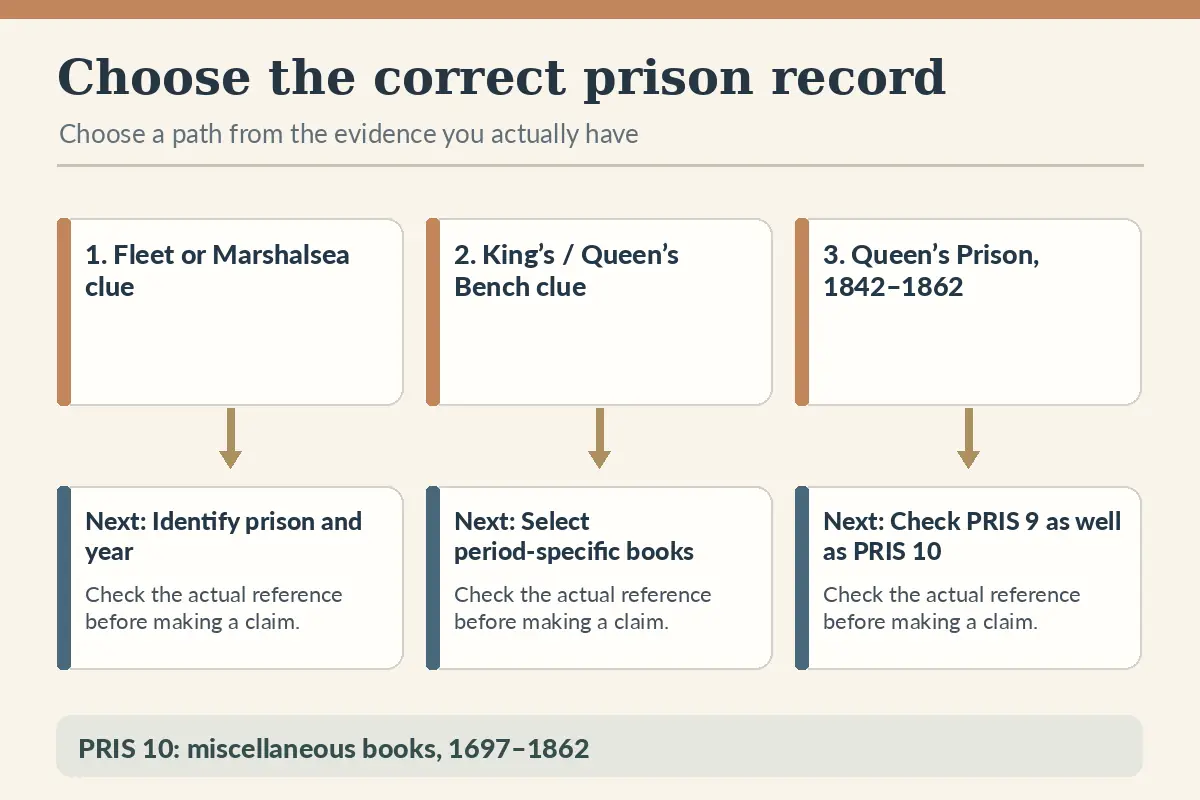
Match the Institutional Period to a Volume
Use three starting coordinates: name of institution, approximate date and event type. An admission or commitment, a transfer, a discharge and an internal administrative note are not interchangeable. The National Archives lists PRIS 9 separately for Queen’s Prison miscellaneous records in 1842–1862; a searcher interested in a particular Queen’s Prison issue may need both descriptions. Do not infer from PRIS 10’s inclusive dates that every prison has continuous coverage across all of them.
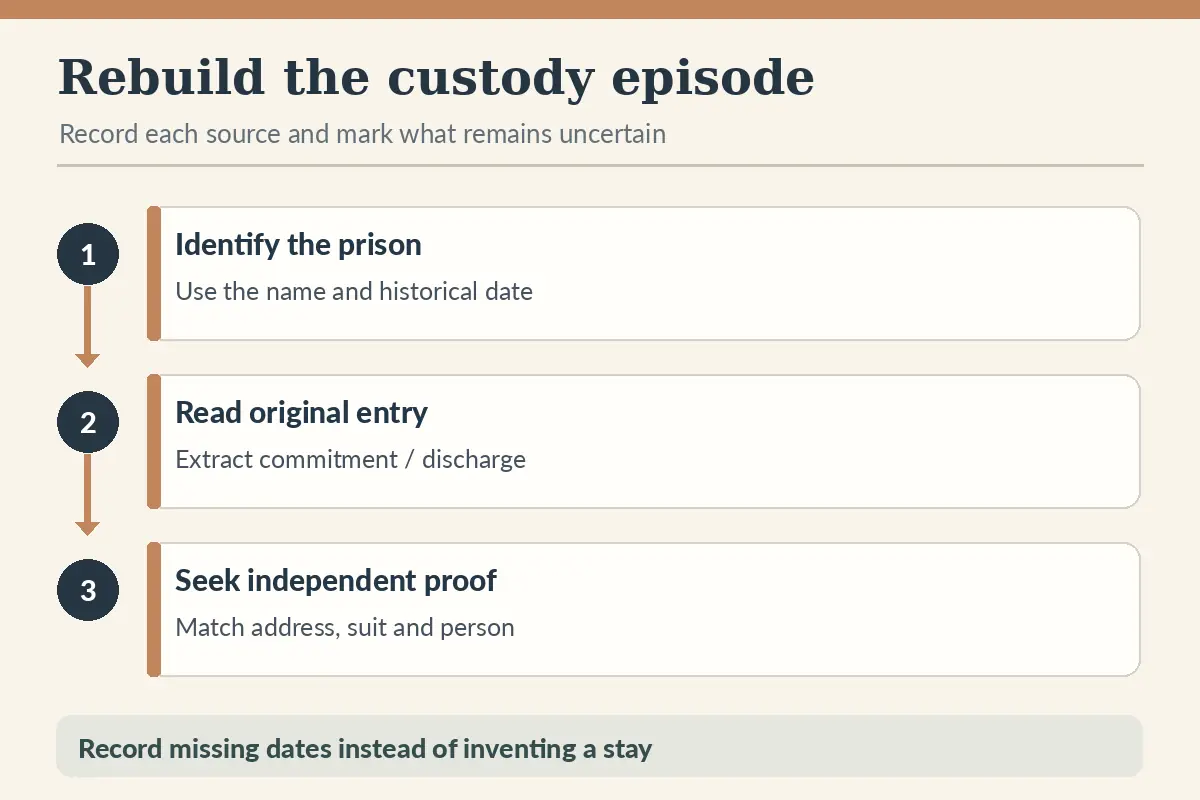
If a relative allegedly lived in a debtors’ prison for years, reconstruct the sequence from independently dated clues first. Search a close date range, then inspect nearby entries for annotations, duplicate names and the prison context. A missing page or volume is a coverage problem, not a proof of freedom. Record the reference and date span of each unsuccessfully searched unit so that the same search can be repeated or expanded later.
Separate Commitment, Custody and Discharge
A commitment entry may document that a person was received under an order, whereas a discharge entry records a later action. Neither, by itself, tells the complete legal circumstances, explains every move or proves where that person resided after release. The evidentiary question should be written beside each transcription: “Is this the first confinement?”, “Does this entry specify the grounds?”, or “Is the listed date the court’s order or the prison’s action?”
When you use a digitized index, preserve the name of the original volume and its archival reference. Commercial datasets may combine records from more than one London prison. A search hit labelled “debtor” can merge an original register field with a modern collection title. Only the image can show whether the actual document says commitment, discharge, payment or something else. Quote unfamiliar abbreviations cautiously and do not fill them in by intuition.

Cross-Check a Debt Case Beyond the Prison
Prison administration and the legal dispute that brought someone into custody are different documentary streams. The record may identify an entry and an order but not the full suit, creditor or debt. If the question involves insolvency, the National Archives guide to bankrupts and insolvent debtors can direct you toward the correct court or procedure. A debtors’ prison admission is not equivalent to a formal declaration of bankruptcy.
Compare address, occupation, spouse and dates in newspapers, tax records or court material where they survive. These details are especially important when two people share a common name. A prisoner’s address at commitment is not guaranteed to be the same as a later household address. If a later court record supplies a discharge or settlement, identify whether it concerns the same proceeding and person rather than merging all matching surnames in London.
A Sample Prisoner-Identity Timeline
Consider a fictional Thomas Reed reported in the Fleet in 1836. A database search returns a similar name in a PRIS 10 discharge document dated 1838. The first question is whether the source is indeed a Fleet record and whether the names, occupations and dates can belong to one individual. A prison appearance in a newspaper may refer to a distinct Thomas Reed. Document every candidate before writing a single narrative.
If the original discharge book shows a date, describe it as the action recorded in that book. Do not invent the length of confinement by assuming the newspaper article represented first admission. Find a commitment record, legal order or second contemporaneous source if duration matters. A strong result might be “a discharge for Thomas Reed appears in this Fleet volume”; the complete identity, legal case and length of custody can remain open questions.
More Records and Archives Guides
How We Research Historic Debt Imprisonment
We locate the correct prison before using a name index, because PRIS 10 groups materials that differ by institution and function. We check descriptions of the individual books, inspect actual headings and date spans, and separate dates entered into registers from dates reported by other sources. An empty search is logged against the books examined, not presented as proof that a person was never jailed.
Our first references are the National Archives guide to prison management records and guide to bankrupts and insolvent debtors. The research note preserves the prison’s historical name, document title, archival reference, quoted action and the independent clue used to link it to a family.
Editorial disclosure: Our reference links point to archival catalogues and research guidance, not paid endorsements. Read our affiliate disclosure. When a third-party scan requires a subscription or an archive record requires a copy order, check the access terms before paying; a search snippet alone is not the original document.
No. It holds miscellaneous prison records; debt imprisonment and legal bankruptcy are different statuses.
Not without a reliable commitment or admission date for the same episode.
No. Search them as distinct institutions and identify the source volume before interpreting a database match.
Some related Queen’s Prison miscellaneous books are in PRIS 9 for 1842–1862; the series need to be distinguished.
Inspect the linked original or request the record, then verify the institution, action and identity.