
Te Henui Cemetery is a historic New Plymouth burial ground, but a matching name in an online cemetery database is a lead to an administrative record, not a complete family tree. Start at the current New Plymouth District Council cemetery search, select Te Henui, and copy every detail of the returned entry. Then test the date and location against a register, memorial or independent historical document. The council warns that transferred data can contain errors or omissions, so a blank search must remain an unresolved result rather than proof that the person was never buried there.
Find Te Henui in the current council cemetery portal
Use the official New Plymouth District Council cemetery search. Enter the deceased person’s name and specify Te Henui if you know the ground. Do not reuse screenshots or search instructions from the older council website, because the present service runs through a dedicated cemetery portal. Make a note of the exact cemetery selected, every spelling used, the entry details and your search date. For a very common surname, search with fuller forenames and independently known time periods.
The portal covers council-controlled burials and cremations within the district; it is not a comprehensive list of every grave or cemetery in Taranaki. If the person is missing, try wider name variants, married names, middle names and an alternative cemetery before declaring the search exhausted. The portal tells users that additional information may be on file and invites requests for assistance. Always distinguish “not displayed online” from “not held by the council” in a research log.
Establish which New Plymouth cemetery is intended
The council’s cemetery information describes several separate sites in and around New Plymouth. Te Henui is an older, heritage-rich cemetery, not a general label for all burials in the city. Nearby or later burials may instead be recorded at Awanui, Inglewood, Waitara or another district site. Verify the actual cemetery name on an obituary or funeral notice before interpreting a search result with a familiar locality label.
For place-based searches, write two fields: residence at death and place of burial. A person residing in New Plymouth could be interred elsewhere, and someone buried at Te Henui need not have lived beside the cemetery. Historical newspaper notices can provide a funeral destination, but a planned funeral service is not proof that an interment occurred exactly as advertised. A municipal register or other contemporary record is needed to confirm that event.

Read plot information without assuming relatives shared a grave
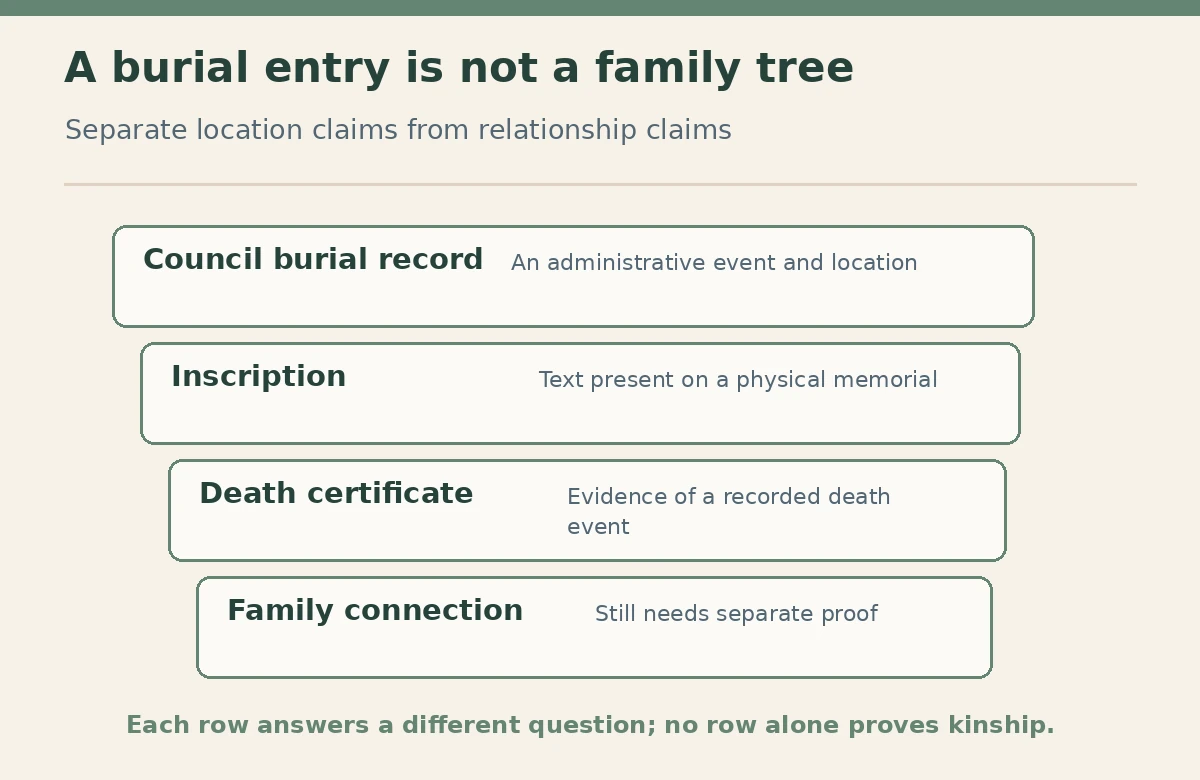
Copy the cemetery name, location reference, name, event date and the precise field labels visible in the search result. Use a blank value marker for information the entry does not provide. A repeated surname or neighboring marker can help form a research question, but does not prove a biological connection. One family may own a plot used by several branches, while unrelated people may appear close together in the cemetery layout.
When an inscription or memorial photograph is available elsewhere, record it as a separate source: physical marker, date photographed, exact legible wording and any obscured lines. Inscriptions may commemorate people buried in other locations. A grave-register entry and an inscription need to be reconciled rather than merged into a single invented record. If the map reference is not readily interpretable, ask the council how the site numbering works instead of plotting an estimated location.
Reconcile the online transcription with council source material
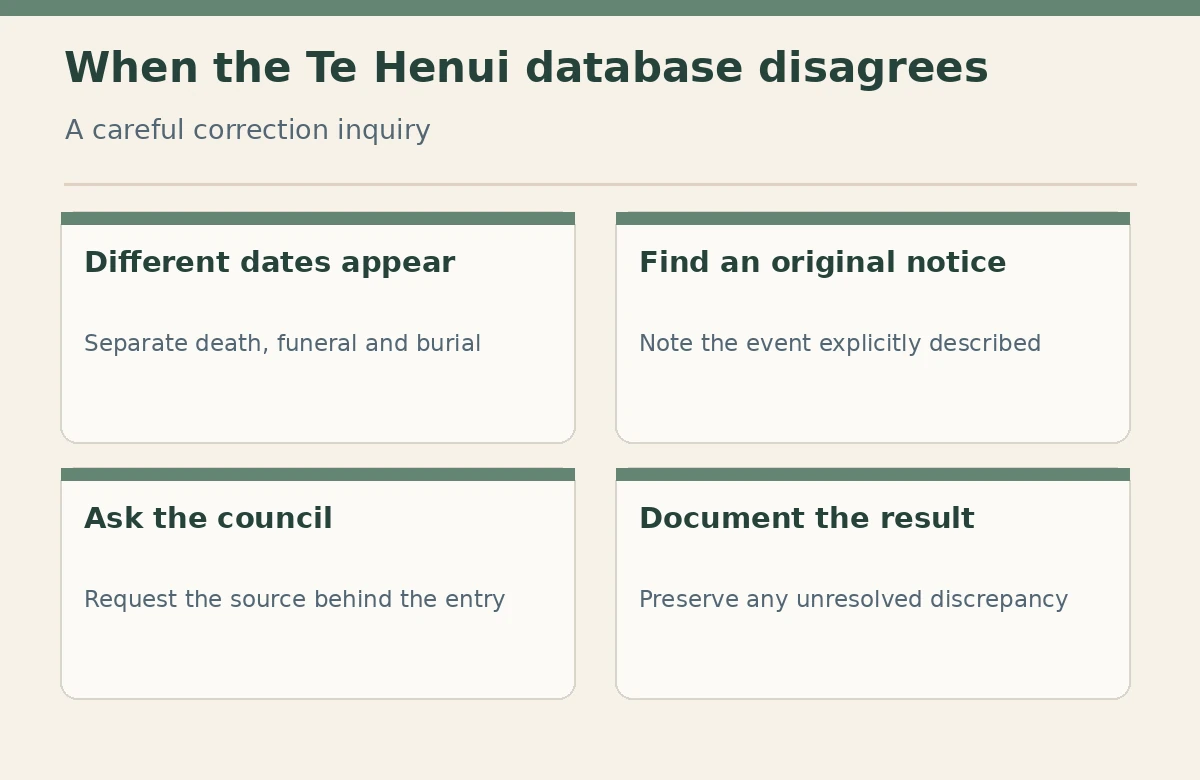
The present cemetery portal warns that details may be incorrect or incomplete and asks researchers to contact the council to correct records. This is an unusually useful editorial caution: a name search can fail even when a council-held burial document exists. Treat the database as a transcription or digital representation whose completeness must be assessed. Preserve both the displayed entry and the source of a later correction, with the date each was obtained. Our guide “Taruheru Cemetery Records” covers a related question.
For a likely entry that conflicts with a contemporary source, send a concise request listing the deceased person, cemetery, relevant year, location information and the conflicting detail. Ask whether an older burial register or other council record can clarify it. The council may have information beyond what is shown publicly. Avoid asking staff to generate an entire genealogy; a single well-documented discrepancy is easier to verify and protects living people’s private details.
Use war-grave lists as a selective cross-check only
The New Zealand War Graves Project has a Te Henui-specific page. It is useful when a candidate may be commemorated in military-grave records, but such a specialist list is not an inventory of the whole cemetery. Compare its details with the council entry and, where needed, original military service or death documentation. Being listed in a war-grave database does not prove that a person served in a particular battle without separate service evidence.
Conversely, failure to find a known relative in the war-grave list says nothing about ordinary civilian burial. Keep specialized datasets in their own evidence column. If they show different spellings, ask whether initials, commemorative conventions or administrative corrections might explain the variation. The goal is not to force perfect agreement but to identify exactly which fact each organization recorded.
Document a Te Henui burial with a reliable evidence trail
A reproducible Te Henui burial citation should name New Plymouth District Council, the current portal, search name and filters, cemetery, displayed date, location code and date accessed. Add a separate citation for a burial register copy or historic image if one is acquired. Keep the person-identification argument short: why this entry matches the ancestor and which still-unknown facts could overturn the match.
In a hypothetical namesake case, two people called Mary Wilson appear in records from different decades. A shared surname and district are too weak to choose one. Compare a death notice and independent household history for each; if neither aligns conclusively, retain both as candidates. The source trail will still be valuable when a municipal correction or newly digitized cemetery page becomes available. It also guards against reintroducing a transcription error into future family trees.
More Records and Archives Guides
How We Research Te Henui Cemetery Records
We compared the named repository’s current description of its holdings or online search with the other institutional guides cited here, then checked what each source can directly establish. Our examples are hypothetical and never represent an identified real person. A database hit, original record and later inference are treated as different evidence levels. Coverage, copying arrangements and privacy policies can change: verify them at the relevant institution. We have not asserted paid endorsements or affiliate relationships. See our affiliate disclosure.
No. Council operates several grounds; select the correct cemetery rather than assuming every city burial is Te Henui.
No. The official portal notes errors and omissions and says additional information may be held.
No. Compare any suspected relationship with civil, church or other independent evidence.
Check whether the cemetery field is a burial or service date, then ask the council about a source register.
No. Specialist war-grave lists have narrower scope than the council’s overall cemetery records.