
To find a Glasgow ancestor in Poor Law records, identify which relief parish handled the application, then use Glasgow City Archives’ D-HEW collections and staff indexes to locate the surviving application or register. The archives preserve more than a million relief applications, but the record may mix an applicant’s statements, official investigation and the parish’s decision. The Glasgow City Archives overview separates city, Barony and Govan record ranges. A dated claim that someone was a spouse, parent or native of an Irish county is valuable but must be tested; the register does not automatically verify every relationship named in it.
Identify Glasgow, Barony, or Govan Before Searching a Surname
Under Scottish Poor Law administration, relief was handled through local parishes or boards rather than by a single universal Glasgow office. Glasgow City Archives lists Glasgow material from 1851 to 1948, Barony from 1861 to 1898 and Govan from 1876 to 1930, with additional West of Scotland holdings sometimes beginning around 1845. These are collection coverage descriptions, not promises of a complete file for each resident. Barony became part of the Glasgow parish system after its nineteenth-century boundary change; Govan later became part of the city. Record a historical address, relevant year and parish or district before running a name search. If an ancestor moved between parishes, a separate relief application may have been made elsewhere. A modern Glasgow address alone cannot establish which administrative body investigated the person.

Use the D-HEW Catalogue and Historic Application Indexes
The D-HEW collection description details surviving registers, separate indexes and the way historical application series were organized. Its notes explain that Glasgow parish applications from 1851–1898 are held in D-HEW10, historically divided into districts; Barony surviving general registers occur in D-HEW13–15, with relevant indexes referenced under D-HEW23. Record each reference exactly rather than citing only the name of the archive. The archivists say many early-1930s Glasgow application names have been electronically indexed, but this is not a public promise that every register or later case is searchable online. Ask for a source or staff search using the full name, address and estimated application date. An archive catalogue entry locates a series; it does not demonstrate that a particular ancestor appears on a surviving page.
Understand What an Application May Say About a Family
Poor Relief inspectors gathered detailed testimony to determine need and legal settlement. An application could record an age, birthplace, prior residences, marital history, children, claimed parents or dependents, occupation and health circumstances. Such details can point to a pre-1855 Scottish church entry or a village in Ireland that other surviving sources obscure. But read who supplied each fact and why it was collected. An applicant describing a spouse’s absence may be asserting desertion, not presenting a court finding. A clerk may have summarized a complex family story into a few words. A parent named in the file can be a research lead without being a formally proven parent. Preserve qualifying words, corrections and dates of later reviews; avoid quoting stigmatizing official character judgments as unbiased biographical facts.

Separate Application, Decision, Payment, and Poorhouse Stay
The act of applying for relief does not necessarily prove assistance was granted, and receiving outdoor support does not mean the person lived in a poorhouse. Glasgow City Archives’ archivist Q&A distinguishes relief obtained while remaining at home from residency in an institution. Build a four-column evidence worksheet: claim or application date, official decision, support received, and any separately documented poorhouse entry or discharge. Check whether the register includes updates after the initial application, such as a transfer to another parish or death reported at a later date. Never equate an admission date with a family member’s birth, or infer an exact move from the date the investigator completed a note. The file is an administrative sequence with distinct stages and potentially different informants.
Check Access Rules and Respect Sensitive Historical Testimony
Glasgow City Archives currently describes access restrictions of 75 years for adult Poor Law applications and 100 years for children’s records. Recent material and private details may therefore be restricted even when a catalogue description is visible. Check the current archive policy before requesting copying or publishing extracts. Many recorded circumstances include illness, disability, unemployment, abandonment and other hardships; explain the context without blaming the applicant. Avoid disclosing facts about living relatives inferred from a late case. If the original is closed, do not treat a catalogued file as something you have read, and never try to bypass a restriction. Ask archive staff whether an open register or aggregate document answers the non-sensitive historical question. The City Archives access page distinguishes its onsite indexes from the online collection descriptions.
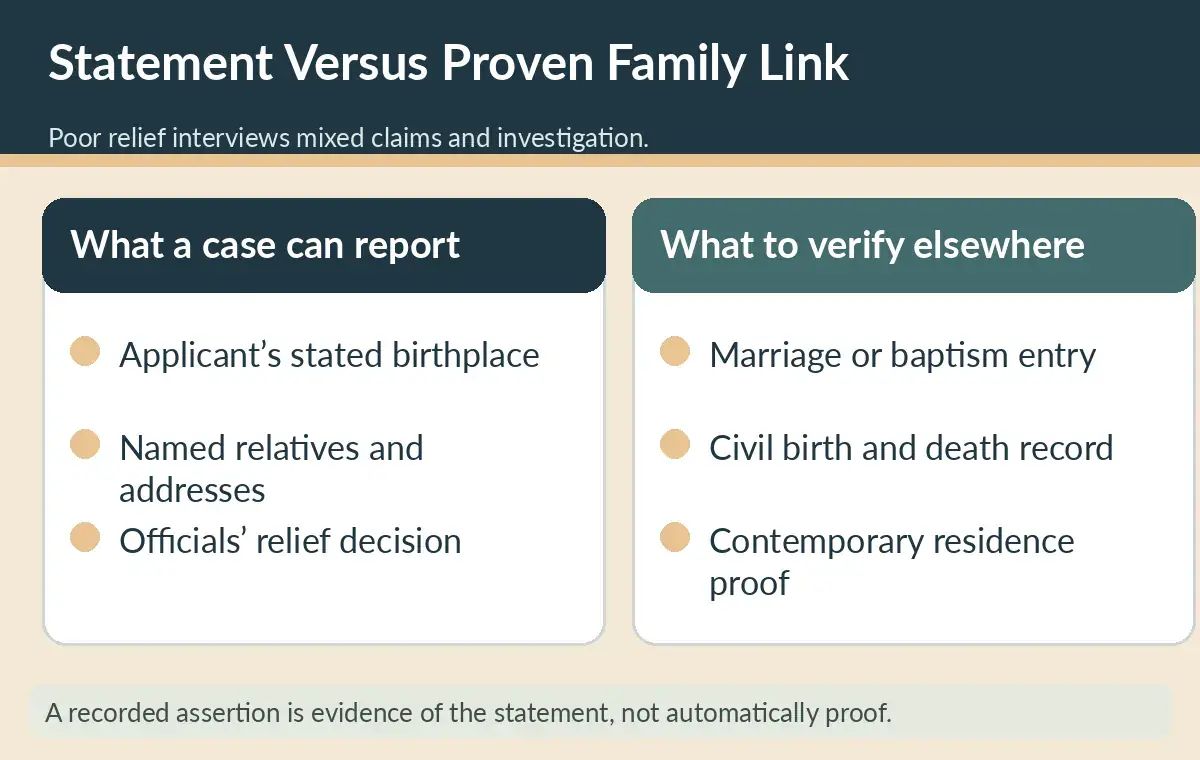
Test a Reported Birthplace with Independent Scottish or Irish Records
For a fictional Glasgow applicant named Catherine Kelly, suppose a form claims birth in County Mayo and gives two children’s names. The claim narrows a geographical search but cannot identify a Mayo parish by itself. Create separate rows for the applicant’s own words, details stated by the inspector, and corroborating records such as a marriage entry, census image or baptism. Dates of ages may be estimates, and maiden names can be omitted or recorded in a different spelling. Compare people in the same household, addresses, occupation and later movement to distinguish another Catherine Kelly. If an Irish parish baptism is found, note whether the parent names and timeline actually agree. The useful conclusion is often a documented hypothesis about origin, not a fully connected family tree. For policy transparency see our affiliate disclosure; we have no archive partnership.
Cite the Whole File and Any Unresolved Gap
A reproducible Glasgow citation identifies the poor-law authority, collection or series such as D-HEW, application or register number, date, page or entry and the original repository. If you only viewed an index or catalogue card, identify it as such. Keep a search log for alternate names, districts, rejected candidates and years the relevant series did not survive. Where Barony has only some registers, an unindexed name is not negative proof of no application. A decision about a reported relationship should name which independent evidence might change the conclusion. This careful citation allows another genealogist to examine the same document and understand why you accepted or withheld a family connection without disguising contradictory testimony.
More Records and Archives Guides
How We Research This Collection
We checked Glasgow Life collection descriptions, the archivist Q&A, current access policy and the D-HEW catalogue. The guidance distinguishes reported applicant evidence from the legal decision and notes the 75-/100-year restrictions. Hypothetical names and relationships are illustrative rather than archive findings.
Glasgow City Archives lists Glasgow parish records from 1851, Barony from 1861 and Govan from 1876, with other western Scottish holdings sometimes earlier.
Yes. Glasgow, Barony and Govan were different administering bodies with different surviving dates and catalogue references.
It is a Glasgow City Archives collection for historical health and welfare records with Poor Law register and index series.
No. Relief could be provided while a person remained at home and application was not equivalent to admission.
No. Many indexes are onsite and restrictions may apply: the archive specifies 75 years for adults and 100 years for children.