
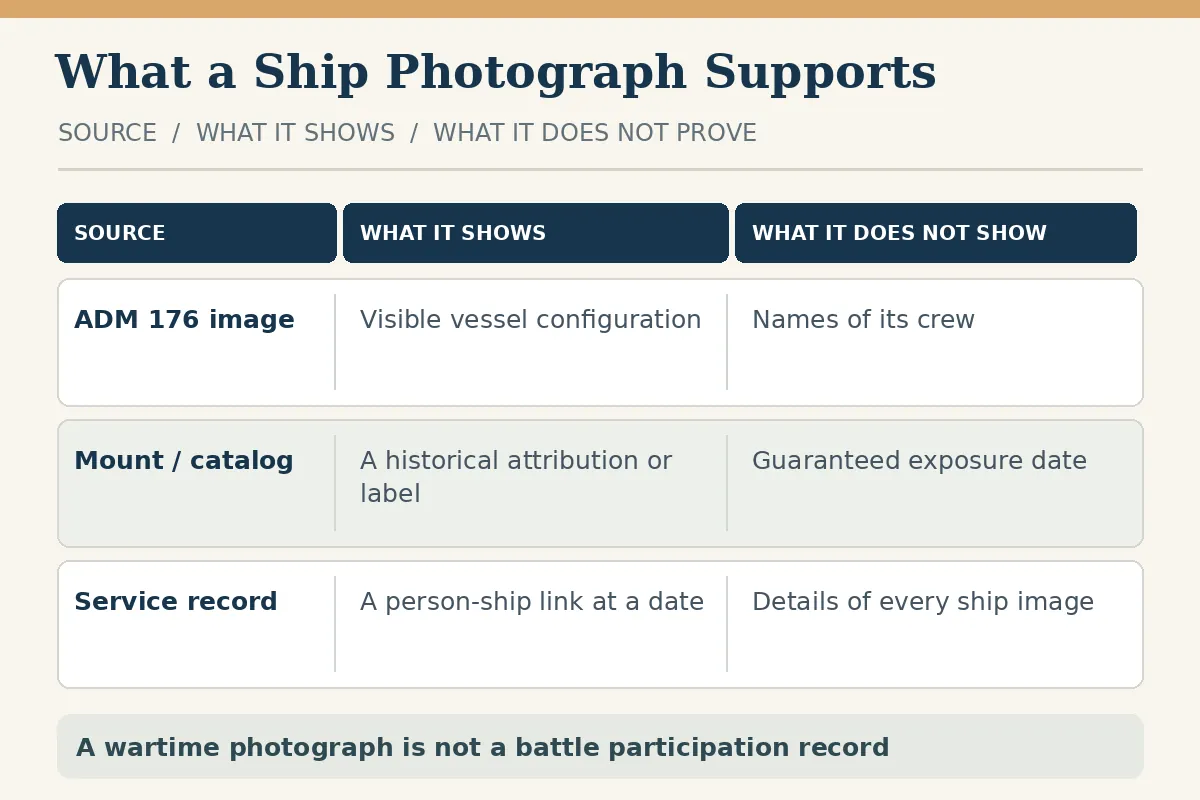
A historic photograph of a Royal Navy ship can answer what the vessel looked like at a particular stage of its career, but it cannot establish who served aboard. ADM 176 contains Naval Construction Department photographs of Royal Navy ships afloat and in dry dock, dated 1854–1945. The National Archives describes 782 mounted photographs followed by 359 unmounted images, arranged within sequences by ship name. These are ship-focused images, not nominal crew lists or comprehensive service histories.
Begin with an exact ship name and a date range, then test the physical details and archival description before assigning the image to a specific vessel. Royal Navy names were reused, and a ship’s appearance could change dramatically after refitting. The photograph’s printing, mounting and accession history may differ from the moment of exposure. This guide keeps the photo identification problem distinct from a family question about an ancestor’s naval service.
Find the Ship Name and Narrow the Date
Search for the vessel by name within ADM 176 and inspect the catalog references and descriptions. The National Archives’ First World War naval operations guide explicitly suggests this name-based route. Where two ships bore the same name in different periods, use launch date, type, dimensions, naval list entry or documented service period to distinguish them. Do not assume the first search result represents the ship mentioned in a family letter without checking chronology.
If the catalog entry only describes a set of photographs, record the original reference and determine what is actually available for viewing. The National Archives says the broader photographic holdings are mostly not online, so a digital thumbnail is not guaranteed. A partial catalog description cannot substitute for a close view of the image. Keep a list of unexamined references as leads, separate from photographs you have inspected and identified with reasonable confidence.

Read Mounted and Unmounted Evidence Correctly
The physical format can matter. Mounted cards may carry labels, handwritten names or annotations added by a photographer, departmental compiler or later archivist; an unmounted print might lack that context. The official photographic guide records the distinction between the first 782 mounted and remaining 359 unmounted photographs in ADM 176. It does not follow that every caption was made at the time of exposure. Note whether the source of the ship name and date is the photograph, a mount or the modern catalog.
Keep a provenance table listing the image, any caption or back inscription, the people responsible for the label if known, and the date of each attribution. If a photo is marked with a ship name but its visible features conflict with a contemporary plan, investigate rather than silently correcting the caption. A later copy can reproduce an earlier photograph, so the print date, image date and catalog date should remain separate when they cannot be equated.
Match Hull, Masts and Dockyard Context
Identify visible features that could distinguish vessels: number and placement of funnels, mast arrangement, bow and stern shape, gun positions, superstructure and any changes consistent with known refits. A dry-dock setting can be particularly revealing because hull form or propeller arrangements may be visible. Avoid assigning a precise model or year from a single generic detail. Compare several features against an independently dated naval plan or another reliably identified image.
The background may show a dockyard, harbor building or crane, but a visual resemblance alone rarely proves an exact location. Record which architectural features match and whether the naval vessel was known to have entered that dock at the relevant time. The photograph may be a technical record of construction or alterations rather than a picture of a celebrated deployment. Nothing about the hull tells you the names of sailors present on the day it was photographed.
Separate a Vessel Portrait from Service Proof
Family albums often contain a photograph of a warship annotated with an ancestor’s name. That association is a valuable lead but not confirmation of service. To test it, look for a separately created service record, an official crew-related document, naval list, personnel entry or other contemporaneous source identifying the individual and ship on a relevant date. If the person served on a different ship of the same name or only later in the vessel’s life, retain that distinction.
An image dated during a war does not prove its subject participated in a particular battle, nor that everyone serving aboard appears in the picture. Even a crew group photograph is not a complete nominal roll unless the names are independently supported. The result of research might be an accurately identified ship and an unresolved family association. That is more useful than a confident but unsourced caption claiming your ancestor was on deck.
Worked Example: Two Ships with the Same Name
Suppose a family note mentions HMS Example, and a catalog search returns a photograph labeled with that name. Before pairing them, inspect the probable date of the note and the appearance of the photographed vessel. A reused name can mask different ships; a changing funnel arrangement might reflect a refit or a completely different vessel. Do not decide between these alternatives from the name alone. Collect one vessel-specific, dated reference to test the identity.
Write the conclusion in layers: “The archive describes this photograph as HMS Example”; “its visible features are consistent with the vessel recorded in year X,” if a corroborating reference actually supports that claim; and finally “the family connection remains unverified.” This staged conclusion is easy to revise when a service entry emerges. An illustrative vessel name is a worked hypothetical, not a real ship identification, and should never be copied into a published citation as an archival find.

More Records and Archives Guides
How We Research Naval Photographs
The official photographs guide supplies the ADM 176 collection context and arrangement. The First World War naval operations guide confirms the ship-name search method, while the Second World War guide points to other visual sources when appropriate. None of these guides gives a blanket guarantee that all historical ship photos can be viewed online.
Our image audit records the exact ADM 176 reference, physical caption evidence, visible identifying features and the independently dated naval source used to verify the vessel. Service claims are sent to a separate people-level search. We report the strength of each link rather than silently collapsing name, photograph, vessel identity and ancestral service into one unsupported statement. If no original image has been inspected, we describe the item only as a catalog lead.
Editorial and access disclosure: archive catalog links are research references rather than paid endorsements. Please read the GenHis affiliate disclosure. Check each archive’s current copying and access conditions before ordering, and do not assume an index result is the full source.
No. Its central purpose is photographs of ships, not a comprehensive roster of serving personnel.
The National Archives lists photographs of Royal Navy ships afloat or in dry dock from 1854–1945.
Yes. The National Archives advises searching ADM 176 by vessel name; inspect date and identity carefully.
No. Verify the person and vessel together using an independently created service source.
Do not assume so. Check the item access notes and arrange appropriate viewing or copies where needed.