
AVIA 30 is listed by The National Archives among records of the Ministry of Aircraft Production containing photographs scattered within files, with a catalogued span of 1936–1947. A workshop picture may help identify aircraft components, machinery or a possible production setting, but it does not prove that a named worker was employed there, that an airframe was delivered or that an aircraft later flew a mission. Treat the photograph as a dated object with a creator and filing context before adding names or service histories.
Find the Photograph Before Naming the Factory
The National Archives photographs guide distinguishes discrete photo collections from photographs mixed among correspondence and technical files. AVIA 30 falls into the latter group. That means a filename or image seen online may be detached from its surrounding record unless the full piece is consulted. Start with the exact catalogue reference, any caption as originally written, file title, dates and department. A photo of a riveting line without a preserved site name is a workshop scene, not automatically a named manufacturer.
The date span 1936–1947 belongs to the listed material, not necessarily to every exposure, aircraft or file. A print might have been made, copied, annotated or filed later than the scene it depicts. Note whether the visible caption is contemporary, on the reverse of the original, typed onto a mount, or supplied by a later archivist. These are different layers of evidence. A photograph can give a relative production stage even when its exposure date remains uncertain.
Extract visible details in neutral language: distinctive roof trusses, gantry cranes, assembly jigs, tail sections, hangar doors, machines, numbered bays or factory markings. Record visibility and confidence separately. Avoid reading imaginary serial numbers from blurred paint, and never identify a worker solely from protective clothing or a face seen in an uncaptioned group. Historic artwork in a modern guide is not a genuine archival photograph unless it is labelled and sourced as one.
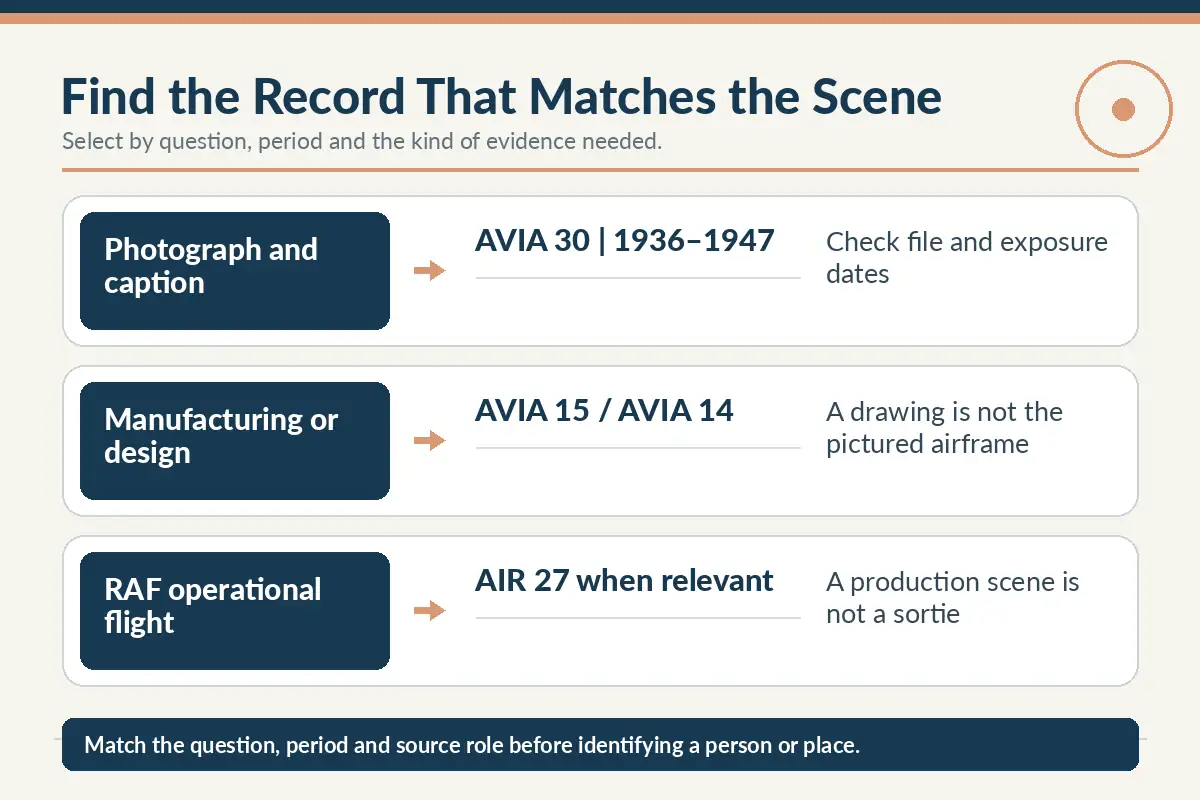
Separate Aircraft Development From Operations
Production imagery is not the same as operational evidence. The National Archives research-and-development guide identifies AVIA 15 as a major source for Ministry of Aircraft Production files, AVIA 14 for detailed plans and drawings, and AIR 10 for many Air Publications. These may help identify a type or a technical change when a photograph offers enough specific clues. None is a universal concordance to AVIA 30 or an automatic record of a particular photograph.
If the question moves from manufacture to actual flights, select a separate operational source. RAF squadron operations record books are in AIR 27; an operational entry may describe a mission or aircraft movement, subject to the detail and accuracy of that unit’s reporting. Do not draw an unconditional arrow from factory photo to flight log. A demonstrator, prototype, test component or incomplete airframe may never enter operational service at all.
A model designation is not a unique aircraft identity. Two aircraft of the same type may have been built at different plants, and a standard technical drawing may depict features absent from a particular production batch. To link a photographed structure to a registered airframe, require serial, delivery, factory or other identifying evidence. If such identifiers are not legible, limit the conclusion to type-family or a cautious visual comparison.

Build a Site and Date Comparison Ledger
Prepare one row for the photo, one for a dated site plan or factory record and one for an independent contemporary source. For each, record stated location, date, physical features, origin and whether the source actually names workers. If a caption says “assembly shop,” try historic company addresses, planning documents or contemporaneous industrial directories before assigning a building. A factory company and a specific factory premises are not interchangeable.
A supposed worker match needs independent person-level documentation. Search dated employment evidence, pay records, trade-union documents, family papers or other relevant local records. Even an official caption naming an individual should be reconciled with identity details when several people share a name. Most images preserve selected people or scenes, not a systematic workforce register. The absence of a face from a photo tells us little about whether someone worked at the site.
As a fictional example, a photograph of wing components labelled only by year is compared with a family story about a relative at an aircraft factory. The year and visible wing shape can generate a research question, but they cannot identify the relative, the plant or a flight. A successful conclusion might simply be that the image documents a certain type of wartime production practice. This is a useful outcome without a forced personal link.

Record Image Provenance and Access Limits
Use Discovery with AVIA 30 and any known topic or location words, then browse the series if filename or personal-name searches fail. The archive’s photographs guide explains that many government images cannot be viewed freely online: the Image Library offers many examples, while other images require a visit or copies. Note the holding institution and any reproduction conditions before putting archival images on a public website. A locally drawn illustration should never impersonate an authentic scan.
When you see the record, capture the front and any caption, reverse, mount or adjacent pages permitted by the archive. These may reveal the photographer, a filing date, distribution or a later correction. Keep transcription separate from what you infer visually. A caption can be useful but is itself a historical claim that might require corroboration. If an image is reused in a publication, identify whether that print adds independent evidence or merely reproduces the same original.
For the final article or family history, state both findings and limitations. “A government file contains a photograph of an aircraft assembly process” is different from “this relative made this aircraft.” Cite the piece, image position, caption and any supporting factory record. Record alternative identifications and the reason one remains preferable; if the evidence does not distinguish them, publish the uncertainty rather than an invented name.
More House and Local History Guides
How We Research Aircraft Production Images
We use the National Archives photographic collections guide for AVIA 30’s series placement and the difference between scattered and discrete photograph holdings. The aircraft research-and-development guide identifies technical and manufacturing comparisons, while the RAF operations guide supports the separate flight-record route.
All pictured historical motifs in our diagrams are editorial illustrations, not certified images from AVIA 30. The examples are hypothetical; no individual worker or aircraft serial is invented. Our affiliate disclosure explains editorial relationships.
The National Archives lists it among Ministry of Aircraft Production records with photographs scattered through files, dated 1936–1947.
No. Read the caption and file context; a manufacturing scene may lack a verified location.
No. Operational service requires separate aircraft and squadron records.
Depending on the question, compare AVIA 15 production files and AVIA 14 drawings rather than treating them as automatic proof.
No. An image may show visitors, contractors or unnamed people; verify identity and employment independently.