
The Henry G. Peabody Collection in National Park Service records is wider than a set of national-park postcards. NARA lists 3,467 photographs, negatives, transparencies, and lantern slides across RG 79 series HPA, HPM, HPP, and HPS, with subject dates from 1890 to 1937. Its locations include national parks and natural areas, cities, harbors, beaches, historic sites, California missions, and places in Canada and Mexico. That range makes it valuable for identifying how a place looked, but the images are not automatically evidence that your relative visited it.
The practical question is whether the described scene matches a specific historic landscape, building, viewpoint, and date—not simply a present-day tourist destination with the same name. This guide builds a medium-and-location checklist that helps compare Peabody images with historical maps and independently documented visitors. Explanatory illustrations on this page do not represent particular archival photographs.
Search Four Peabody Designators Before Choosing a Location
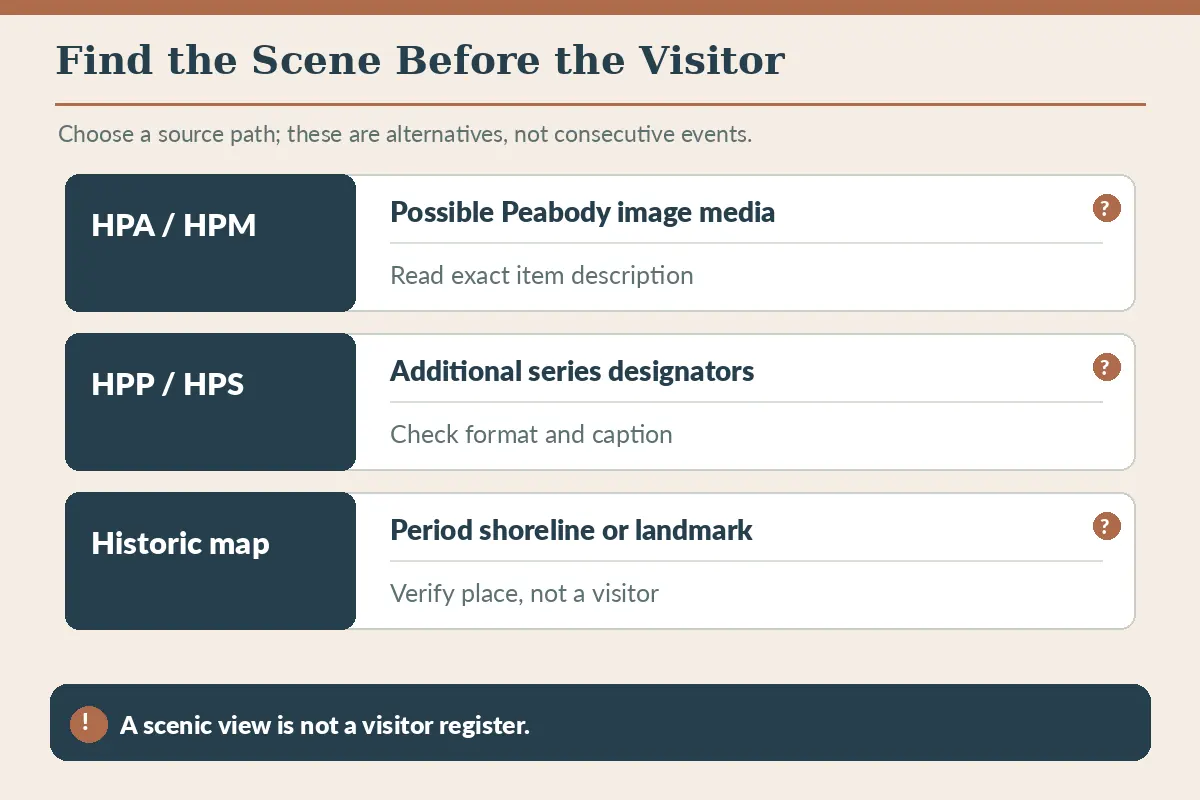
Start with the full National Archives citation: RG 79 and one of HPA, HPM, HPP, or HPS. NARA groups these under one Henry G. Peabody Collection description, but the labels are useful retrieval clues. The description lists photographic prints, negatives, transparencies, and lantern slides; it does not explicitly give a universal one-to-one mapping of each letter to a single format. Never infer that an HPA and an HPS number automatically represent the same exposure. Record the actual format and identifier from the item record or archivist.
Search by location variants as well as the photographer’s name. A canyon, beach, harbor, or mission may have changed administrative status, spelling, or boundaries since the photograph was made. An image labeled a “national park” by a later collector might depict a place before it received that designation. Preserve the wording and date actually attached to the photograph, and use an appropriately dated gazetteer or map for historical context. If a local place name appears only in a secondary reproduction, verify it against the archival catalog.
The 1890–1937 range describes the collection’s subject chronology, not an individual view’s year. Likewise, 3,467 is NARA’s image count, not the number of unique locations, travelers, or surviving visitor records. Multiple photographic media or versions can show the same composition. Treat those repetitions as possible versions of an image rather than distinct visits without supporting metadata.
Match Terrain, Buildings, and Historical Place Names

Choose landmarks that can be checked objectively: a ridge profile, a coastline angle, a mission bell tower, a bridge, or a visible street intersection. Begin with the original viewpoint. Then compare a historical topographic map, period photograph, survey drawing, or architectural record that genuinely covers the date and locality. Avoid using only a modern satellite view; shoreline work, road construction, and changes to vegetation can alter the scene dramatically.
For a California mission, distinguish the photographed structure from later restorations and modern interpretive reconstructions. A ruin, repaired facade, and museum building may look similar from a distance but belong to different historical phases. For harbors and beaches, note whether land reclamation, breakwaters, or railroads changed the waterfront. For a mountain vista, remember that a photographer’s focal length and camera position can compress distances. A visual match is strongest when more than one stable feature agrees with a dated map.
Use a four-field place-match table: archival item/caption, proposed period location, independent map or document, and remaining uncertainty. Include a “later name” field when relevant. Resist declaring a photo to show a family’s home because a comparable building stands there today. To establish a person-level link, find an address, itinerary, letter, diary, guest register, or other record that actually places that person at the site.
Distinguish Scenic Composition From Social History

Peabody’s collection includes scenic and built environments as well as people and communities, but landscape photography is a curated view. Framing can omit residents, labor, displacement, and the effects of tourism on local communities. A photograph of a mission does not document the identity, participation, or consent of Indigenous people associated with the site. In writing about Native communities, seek community-led historical sources and use precise, respectful attribution rather than inventing cultural identities from appearance.
The National Park Service’s custody of a photographic collection does not establish that every pictured scene was within a federally managed park or photographed by park employees. The collection also extends outside the United States. A Canadian or Mexican harbor should not be silently assigned to a U.S. park simply because RG 79 preserves it. Separate creator, collecting institution, geographic subject, and current custodian in the citation.
A lantern slide may have served an educational presentation, while a print might have been displayed or reproduced in a publication. These usages can introduce alternate captions and dates. If a slideshow label differs from the negative envelope, quote both and explain which is contemporary with the original view. Changing labels may be evidence of later interpretation, not evidence that the landscape itself changed at the same moment.
Document the Image and the Ancestor's Independent Trail
For each image record RG 79, the exact HPA/HPM/HPP/HPS code, local item number, caption, format, and archival date. Attach a dated map and a note on the proposed camera location. If the National Archives Catalog does not display a particular negative or slide, use the series reference when asking for access; an image absent online may still be preserved. Avoid stating that all 3,467 items are digitized.
Family-history narratives are stronger when photographs are clearly labeled as context. A scenic image can help readers understand a landscape that appears in a travel letter, but the letter—not the scenery—places a named traveler there. A historic building photograph can illuminate an ancestral town without proving ownership or residence. Add a short limitation sentence to the caption, such as “The image documents the location, not the identity of visitors.” This honest boundary allows the striking visual evidence to support, rather than overtake, the personal record.
More House and Local History Guides
How We Research These Archival Photographs and Claims
The mixed media, four designators, image count, date range, and cross-border subject coverage come from NARA RG 79 still pictures. Format interpretation and catalog citations were checked against NARA’s Still Picture Branch guide; the still-picture research page explains how to request item assistance. We make no claim that a photographed location identifies an ancestor. See the affiliate disclosure.
NARA groups HPA, HPM, HPP, and HPS under the Henry G. Peabody Collection in RG 79.
No. The collection also includes cities, harbors, California missions, and locations in Canada and Mexico.
That is the collection range; use an item-level date or a properly qualified estimate.
No. Require a separately dated itinerary, letter, diary, register, or comparable personal document.
Not solely from the series letters. Check item identifiers and physical-media descriptions for possible versions.