
The National Archives describes 501 photographic prints and negatives in Civil Service Commission series RG 146 FJ, dated 1939–1948. They show a variety of federal jobs in the Washington, DC, area and candidates taking a Civil Service Examination. That makes the collection a useful window into federal work, but a workplace photograph and an examination photograph answer different questions. Neither is an appointment order or a complete list of successful applicants.
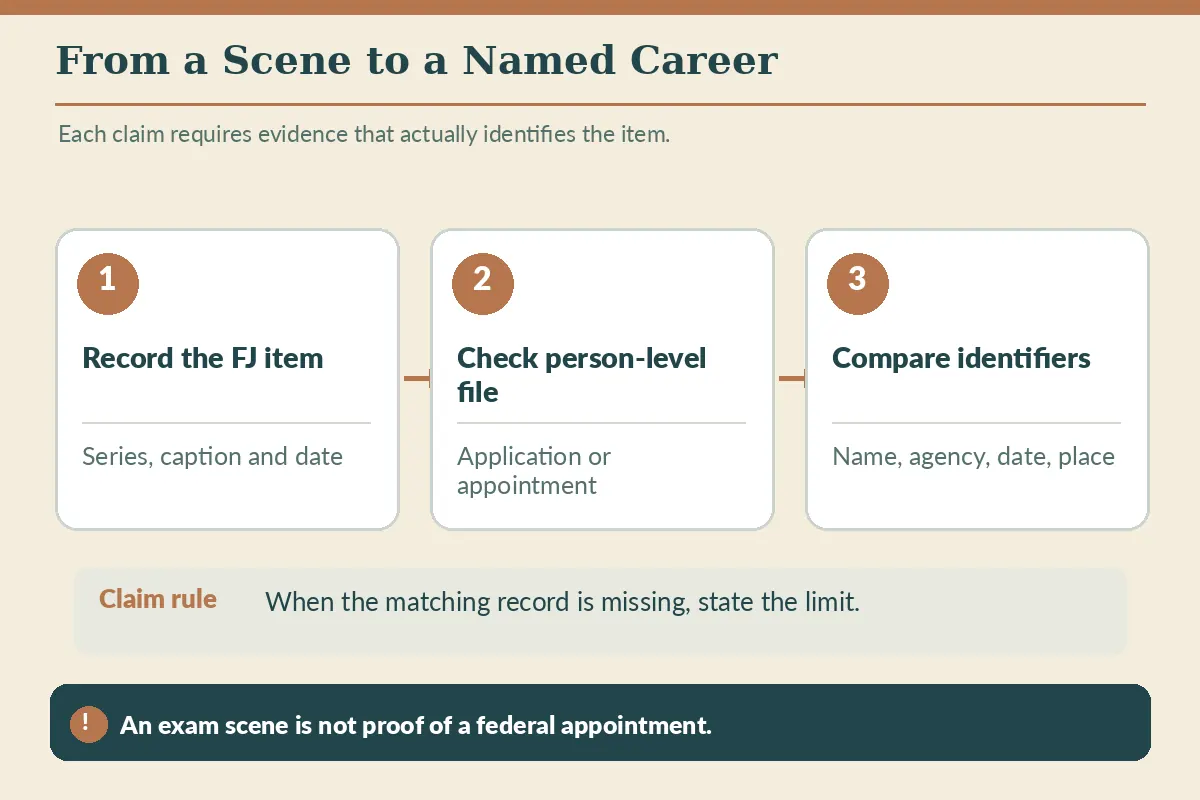
Start by deciding whether the image illustrates an occupation, the examination process, or a specifically captioned individual. Record the archival series and item before matching any face, uniform, or desk to a relative. This guide builds a job-versus-candidate evidence worksheet and explains how to move from a federal photo to the independent employment or application record a family-history claim would require. Any illustrations on this page are interpretive artwork, not facsimiles of NARA photographs.
Choose the Federal Job or Examination Branch Before Searching Names

Search the National Archives Catalog with the phrase “Civil Service Commission” and the FJ series designation, then narrow by occupation, office, date, or examination scene. The 501 figure is an image count attached to the series description, not a count of workers, exams, positions, or applicants. A single occupational scene can contain several unidentified people, while a staged photograph may show a procedure rather than a real test session.
The FJ subject range is 1939–1948. It should not be used to date a specific frame to 1941 or 1945 unless its own caption or item metadata supports that narrower date. Distinguish a negative, matching print, and later reproduction; identical subject matter does not establish two distinct events. Write down the complete catalog identifier, original caption, medium, date expression, and agency affiliation. If you have only a print in a family collection, examine its back for photographer credit or a contemporary filing number rather than interpreting a modern web filename as an original code.
Be careful with the word “candidate.” NARA’s description says that FJ includes people taking the Civil Service Examination. The photograph therefore may support a depiction of a test-taking situation, but it does not by itself identify the person, exam score, eligibility status, or later hiring decision. Likewise, a picture illustrating a typist, mechanic, or laboratory worker is evidence that the occupation was photographed, not proof that a named relative filled that federal job.
Use the Right Administrative Record to Test a Named Federal Career

For an asserted federal employee, first establish the person’s full name, approximate dates, employing bureau, and location from independently documented family records. An official appointment notice, personnel file, payroll item, office directory, or dated correspondence can carry a person-level connection that an illustrative image does not. Personnel files and historic employment records have varying custodians and access rules; use the relevant federal personnel-research guidance rather than promising that every named file is digitized or available without restrictions.
For an examination candidate, separate four successive statuses: appearance in an image; application for a particular examination; placement on a register or certification list; and actual appointment to a position. These stages should not be collapsed into one arrow. An individual might take multiple exams, qualify without appointment, or work under a different hiring route. The image cannot tell you which scenario occurred. Even a legible name tag should be corroborated with a contemporaneous record bearing the same name and more than one identifying detail.
Create a ledger with columns for the FJ item ID, visible occupation or test setting, original captioned identity, other supporting source, and unresolved career claim. When several people share a surname, verify agency, middle initial, dates, and place before treating them as one individual. If your only match is a similar face, leave the identity provisional; apparent resemblance has little weight without documentary context.
Separate FJ From Commission Administration and Later Photo Files
NARA groups three different Civil Service Commission photographic series in the same still-picture section. FJ is the 501-image job and examination set from 1939–1948. MA includes 125 images of Commission activities and personnel from 1938–1954. SP comprises 850 negatives covering Commission activities and personnel in 1966–1972. These are distinct archival descriptions: the presence of an image in the larger record group does not establish that it belongs to FJ.
This distinction matters when you search by a person who may have served in the Commission itself. A photograph of an administrator speaking at an event is not necessarily a photograph of a federal occupation in the FJ sense. Conversely, a worker in an FJ scene is not automatically a Commission employee; the Commission could photograph federal work across agencies while performing personnel-system functions. Identify creator and subject separately in your notes. Search the caption and accession details, not just the record-group label.
A later presentation called “An Inventive Bunch” appears as color slides in series IB, approximately 1977. It is another useful comparison for federal occupational imagery, but not a time extension of FJ. If a website labels a 1970s image “early civil service,” check the actual date and series rather than borrowing FJ’s dates. Federal visual publicity, employment administration, and an individual’s service biography should be cited as separate source layers.
Build a Reproducible Citation and Describe What Remains Unknown
Cite National Archives, RG 146, FJ, exact photograph or negative identifier, original caption, and the item-level date as recorded. Add the National Archives Catalog URL or identifier if an individual item record exists. For your separate personnel evidence, retain its custodian, record series, document date, and exact name spelling. The paired citations are more useful than a free-floating picture caption that merely says “government employee, 1940s.”
Images are commonly selected to show an ideal or representative workplace. They may omit ordinary work conditions, workforce composition, salaries, and barriers to entry. Do not estimate how many people passed an examination by counting desks in a room, or infer occupation from a room when the caption indicates an instructional demonstration. When discussing a possible relative, explain what is visible, what NARA actually identifies, and which person-level documents remain unavailable. A responsible negative result is “I have not yet found an appointment record,” not “the examination applicant was never hired.”
More Genealogy Tool Guides
How We Research These Archival Photographs and Claims
We used NARA’s RG 146 description for the three distinct photographic series, their dates, formats, and FJ image count. NARA’s Still Picture Branch guide supplies citation and series conventions; its research page explains the catalog search. No individual is identified or said to have passed an exam based on an illustrative scene. See the affiliate disclosure.
FJ is a 501-image series of photographic prints and negatives showing federal jobs and examination candidates in the Washington, DC, area, 1939–1948.
No. Passing, certification, and appointment require records that explicitly support each step.
The NARA description specifically emphasizes jobs in the Washington, DC, area; do not assume nationwide coverage.
FJ depicts job varieties and exam candidates; MA documents Commission activities and personnel in 1938–1954.
A resemblance is a clue only; use names, dates, office assignments, and corroborating records before identification.