
The Wallace R. Brode WBC group in NARA RG 167 contains 343 lantern slides of National Bureau of Standards scientific equipment and testing scenes. These are images of laboratories and machinery, not a full set of test results. One archival description gives a 1935–59 span; a separate NARA still-picture guide describes WBC subjects from 1940–54. Neither range proves the date of a particular experiment.
Researchers should preserve the exact slide identifier, caption, and apparatus description, then compare the image to dated NBS publications or laboratory evidence. A collection named for Brode does not mean he took every picture or performed every experiment. The distinction between a slide’s making, an apparatus’s use, and a published finding is the key to reliable scientific and family history.
Recognize the WBC Slide Collection Within RG 167

The National Archives places the Wallace R. Brode slide group, WBC, among RG 167 still pictures from the National Bureau of Standards. Its record-group guide describes 343 lantern slides of scientific equipment and machinery used in tests and gives a 1935–59 description. The Still Picture Branch guide describes WBC material covering 1940–54. These differing descriptive ranges should be recorded as published, not silently collapsed into an invented date for a particular experiment.
A lantern slide is a mounted positive photographic image intended for projection. It may depict an instrument, a staged demonstration, a laboratory, or people at work. It does not automatically contain the test conditions, result table, experiment date, or the identity of a technician. Begin by asking what object the specific frame shows and what external document can name its actual use.
Keep Collection Span, Slide Date, and Career Separate
Wallace Brode served in a senior chemistry role at NBS, but a collection named for him is not a set of pictures personally taken by him. The Library of Congress describes his NBS associate directorship in 1947–58, while the NARA WBC slide-description dates extend beyond or before parts of that tenure. That alone demonstrates why personnel dates and image-subject dates cannot be treated as equivalent.
Record at least four distinct dates when they are known: the exposure or making of the source image, the experiment or equipment’s period of use, the date the slide was prepared for presentation, and the date an archive or collector arranged the material. If only the series-level 1935–59 span is available, give it as an approximate collection context. A later projection of a historical machine can look identical to an original laboratory demonstration.
Distinguish WBC from the RS research slides (1920–50), LBC Briggs material (1933–39 in one RG description), and GS buildings and portraits (1942). All are in the RG 167 still-picture description, but they are not interchangeable slide series. A physics instrument in RS should not acquire a WBC citation merely because Wallace Brode was a scientist.
Describe Machinery Without Claiming a Finding

An image may identify shapes such as a prism, light source, optical bench, gauge, vacuum chamber, or glass apparatus, but a photo seldom supplies a calibration or measurement. Do not name a specific experimental result from the appearance of an instrument. A successful demonstration, a failure test, and a setup before a reading could look almost identical. Ask for the original slide title and any explanatory notes associated with the exact exposure.
A sensible evidence grid has columns for the photograph’s visible apparatus, the wording of its caption, a relevant laboratory report or publication, and the inference not yet established. Technical reports and laboratory notebooks should be compared by date, laboratory section, test subject, and instrument model. An apparatus shown in 1950 is not proof it was used in every subsequent paper published by a scientist in the same organization.
For identifying a person, do not label an anonymous white-coated figure as Brode or one of his colleagues. Seek a named caption and verify the association with a staff list, contemporaneous letter, or authored report. The Library of Congress Brode manuscript collection provides a possible separate research route, but not an instant identification of faces in NARA’s slides.
Build a Reproducible Experiment-Context Trail
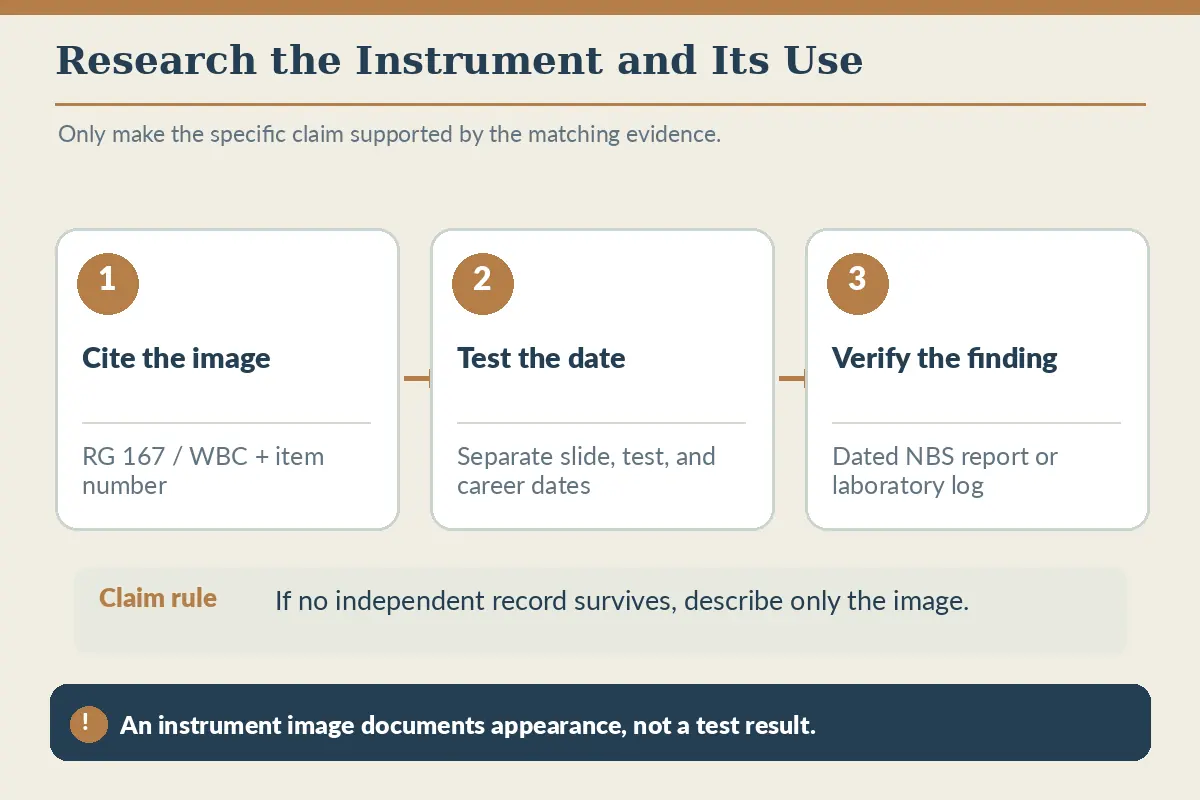
Create a worksheet with repository, RG 167, WBC, item identifier, original caption, visible components, likely laboratory division, image date, and follow-up record. Keep a distinction between “identified object” and “confirmed experiment.” When a caption gives a test label but no result, write “apparatus associated with the named work”; do not convert the label into proof of a measured outcome.
If the instrument appears in an NBS publication, verify the publication’s date, author, technical section, diagrams, and whether the device pictured is actually the same configuration. It might be a later version, a display model, or a different instrument of the same class. Cite the official report for claims about results and keep the image citation for appearance. Conversely, a laboratory report does not prove that a particular unidentified person is shown operating the apparatus.
When a finding aid lists a date span that differs from another authoritative description, preserve both with their exact source citations. Request the item-level metadata before making stronger statements. The difference may reflect covered subjects, material creation, or collection arrangement; without direct evidence, there is no need to guess which one “must” be wrong.
More Genealogy Tool Guides
How We Research NBS Slide Dates and Roles
We read the RG 167 record-group guide beside the NARA Still Picture Branch guide, retaining their differing WBC ranges. We then check the Library of Congress guide to Brode papers for the man’s actual career dates. This three-source comparison guards against false certainty about dates and authorship.
We do not infer a scientific discovery, named operator, or completed test from an uncaptioned laboratory view. Item-level inspection and a dated independent technical record would be needed. The archival links are explanatory sources; see the affiliate disclosure.
WBC is the NARA series designator for the Wallace R. Brode lantern-slide group within RG 167.
They describe the holdings at different levels. Preserve both published ranges and ask about the specific slide before choosing an exposure date.
The association of a collection with Brode does not establish him as the photographer of each item.
No. Seek dated testing logs, laboratory reports, or other primary technical evidence for results.
No. WBC is linked to Brode and LBC to Lyman J. Briggs; cite the correct series for each image.