
The National Archives guide to Record Group 28 explicitly lists a Continental Congress post office department “dead letters book” dated 1777–1788. That is a useful archival lead for studying undeliverable correspondence during the Revolutionary and Confederation eras, but it is not an online surname index and it is not a promise that the original letters survive. Start with the book’s administrative purpose, identify its exact archival description, and inspect the actual entry before connecting it to a family story.
A researcher may hope the book mentions an ancestor who was serving in the army, working as a merchant, or moving between settlements. The safe question is narrower: does a specific entry record a name, location, date, or handling action—and what does its wording actually say? An undelivered item could reflect multiple circumstances; it cannot by itself prove that a person lived at the destination, wrote the contents, or even received notice of the attempted delivery. The evidence chain begins with the federal record, not with a plausible biography.
Choose the Right Dead-Letter Era

The RG 28 guide places the 1777–1788 dead letters book under its Office of the Chief Clerk heading, even though that office was established only in 1818. This is a later archival grouping, not evidence that a Chief Clerk created the book during the Revolution. Elsewhere in the same record group the guide lists miscellaneous records of the Division of Dead Letters for 1897–1930. These are separate described holdings. An inquiry about a 1780 letter should not be silently routed to turn-of-the-century division files because both use the phrase “dead letters.” Write the exact 1777–1788 range in every search or reference request, then check the creating office and series title.
If your target date falls outside 1777–1788, resist using the book as if it had continuous coverage. A later undeliverable letter calls for a different search, while a letter delivered successfully may leave no relevant trace in a dead-letter register at all. The archival guide is a guide to identified holdings, not proof of an exhaustive administrative archive. The more precise your place, recipient, and date range, the easier it is for an archivist to establish whether a particular volume is relevant.
Separate a Register Entry From the Letter Itself

Read the volume as an administrative artifact. For any entry you locate, transcribe the headings, abbreviations, line order, neighboring entries, and any marks that appear to indicate disposition. Do not assume a uniform set of fields from the phrase “dead letters book”; the online record-group guide does not specify the page layout. A surname copied without its column heading may turn a recipient into a sender or confuse a postal clerk’s notation with a statement by the correspondent.
Record your evidence in three columns: the words visible on the page; your interpretation of what postal staff were doing; and matters that remain unproven. A postal notation may establish that an item was noted by an office on a certain occasion if the original entry says so. It does not automatically preserve the envelope, the text of a private letter, a complete address, or the fate of its intended recipient. Photograph or request the page and its immediate context whenever access permits.
Locate the Volume Through the Catalog Hierarchy
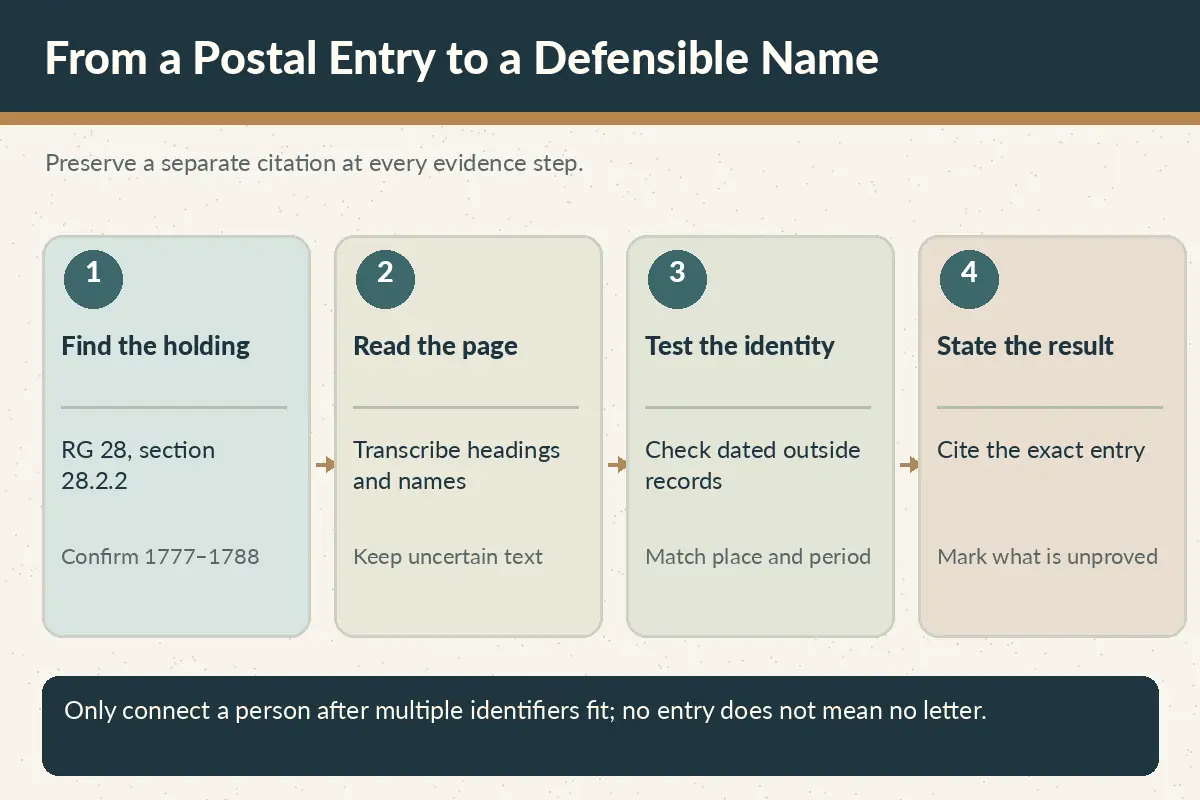
Search the National Archives Catalog by combining “dead letters,” “Continental Congress,” the distinctive years, and RG 28. A record group is an organizing level, not an item number. Move from the record-group description through series and file-unit levels where available, noting exact titles and identifiers instead of treating an image-search result as the whole holding. Search outcomes may reflect an undigitized volume or an administrative description rather than a searchable transcription.
If the book is not available online, the next action is a precise reference inquiry rather than a fabricated download link. Include RG 28, section 28.2.2 (the later Chief Clerk arrangement), 1777–1788, the requested name or place, and the description you found. NARA’s copy-request guidance explains that archival reproductions generally require sufficiently exact citations. Ask staff how the volume can be consulted and what reproduction restrictions, if any, apply to that specific material.
Corroborate Names, Routes, and Family Claims
Build a chronological comparison using independent contemporary material: known letters in a family collection, military service documentation, local tax records, or a dated newspaper notice, as appropriate to the person and location. A similar surname in a postal book is only a candidate until geography, chronology, and other identifiers line up. Spelling variation is normal in eighteenth-century sources, but similarity of spelling does not substitute for evidence that two references concern one individual.
For an example of safe reasoning, suppose an entry identifies a destination town and a person with the same name as an ancestor. You may say the register contains that name and place if the image supports it. You may not say the ancestor moved there, was missing, or died before delivery solely because the letter was classed as undeliverable. Keep an alternative-identities column, note any illegibility, and search the independent source that would actually test residence or military posting.
Make a Citation That Can Be Rechecked
A useful citation goes beyond “Post Office records.” Capture the National Archives as repository, Record Group 28, the office heading and original creator as actually established, volume title, dates, page or folio, entry position, and the catalog identifier or reference information if supplied. Indicate whether you consulted an original, microfilm image, reproduction, or later transcription. This matters when the handwriting is ambiguous or later researchers need to review the surrounding entries.
Set a stop rule before drawing conclusions: if the source has no name, a damaged page, or a missing date, document the limitation instead of filling it from family tradition. The safest final statement may be about the postal system rather than an identified person. A carefully described non-result is still useful, especially when it prevents a modern family tree from recycling a plausible but unsupported account of wartime correspondence.
More Records and Archives Guides
How We Research These Federal Holdings
Our starting authority is the National Archives RG guide, especially section 28.2.2, which supports the specific dates and record categories described above. We then use NARA’s Catalog instructions to distinguish record-group, series, file-unit and item descriptions, and consult its reproduction guidance if an item is not available online. The guide is an inventory, not a complete transcript, digitization guarantee, individual name index or certification of a family connection. Each statement about a named person needs independent support and a traceable document citation. The site’s affiliate disclosure explains our editorial and relationship policy; the public archive links here are not claimed as paid partnerships.
The NARA guide identifies a book, not a surviving collection of every envelope or letter. Inspect the volume description and page before claiming that original correspondence is present.
No. The guide describes later miscellaneous division records separately from the 1777–1788 Continental Congress book.
Not alone. A recorded address or name may show an attempted postal destination; residence requires corroboration.
Do not assume full-name indexing or digitization. The Catalog can describe holdings without providing a page-level transcript.
Specify RG 28, the Continental Congress post office dead letters book, 1777–1788, the later Chief Clerk classification and any exact name or place you are checking.