
The National Archives describes 99 photographs and lantern slides in Record Group 29, series CM, depicting Census Bureau tabulating machines used between 1890 and 1950. These images help explain how large sets of census information were processed, but they are not population schedules and do not list families. The official RG 29 inventory distinguishes CM machinery images from population returns and other Census Bureau records. A family historian must begin with that separation, even when a vintage counting machine is more visually memorable than a schedule page.
The Smithsonian also preserves a separate Census Bureau tabulating machine made in 1920 and later modified for use in the 1930 Census. Its museum object record helps explain technological chronology, but it does not prove that the museum’s specific machine appears in a particular CM negative. This article offers a three-route method: use CM for visual history of tabulation, use census schedules to investigate households, and seek independent staff documentation to research the people operating equipment.
Begin With the CM Images and Their Captions

Search NARA by RG 29 and CM, adding the inventory phrase “tabulating machines” and the broad date span 1890–1950. Ask for image identifiers and any captions that give a narrower year, room, model or office. A photograph of one device cannot stand for the complete technology used in every census across six decades. Distinguish the date of the object, the date of the image and the later date of its reproduction.
If a machine is shown next to desks, punched cards or personnel, describe only features visible or confirmed by the caption. Do not supply a model number from resemblance alone; equipment changed and older apparatus could remain in service. Create a worksheet with object description, visible label, source date, series code and level of certainty. Keep a digital image’s search-page URL and caption evidence, not only the image file copied from a results list.
Use the Smithsonian Machine as a Distinct Source
The Smithsonian’s National Museum of American History identifies a Census Bureau tabulating machine made in 1920. It records that the machine was used for the 1920 Census and, after modification, for the 1930 Census. These are object-specific statements supported by a museum accession record. They illustrate why a device’s date of manufacture and the dates of its documented use can differ. This single machine is not a substitute inventory of the 99 CM still pictures.
When a photograph appears to show similar equipment, compare maker or bureau marks, counters, card handling, cabinet details and any printed number only if those details are actually visible. The Smithsonian museum record describes punched cards and counting machinery, not the identities or responses of individuals whose information may have been processed. Keep the museum item’s catalog number separate from NARA’s CM identifiers. Two institutional records are independent sources, but they should not be fused into one imagined object without matching evidence.
Find Family Names in Schedules Instead

The RG 29 guide separately lists decennial population schedules. If the research question is a person’s household, the correct route is the census return for the relevant date and jurisdiction, not a photograph of the machines that processed statistics. Search by name, location, enumeration district and other identifiers using an appropriate census finding aid. Names can be misread, misindexed or absent, and machine operations do not eliminate those archival limitations.
The schedule is a historical record of information reported and recorded under the instructions of its census, not an infallible statement of identity or family relationship. Compare ages, occupations and household arrangements with independent sources before drawing strong kinship conclusions. A statistical tabulation might aggregate households, but aggregate outputs do not generally allow reconstruction of a particular household’s response. Keep the visual technology history and personal genealogy as two linked but distinct research questions.
Research Bureau Staff Through Staff Records
A Bureau employee may appear beside a CM machine without being named in the photograph. A person shown touching a device could be a worker, trainer, visitor or demonstrator. Do not convert the image into proof of employment or a particular job title. Look for independently named staff directories, employment files, civil service records, payroll or contemporary captions as appropriate and accessible. Bureau employment over many decades may be documented differently at different dates.
If an ancestor said they worked on the 1920 census, a museum object’s 1920 date is not personal evidence for that claim. Compare the person’s residence, employer and job role in independent records before describing a connection to tabulation. Even a named payroll line might prove only employment over a defined period, not operation of the specific machine pictured. Maintain a person-to-source ledger and avoid assigning faces to an unlabeled office group.
Record Technological Claims With Their Own Sources
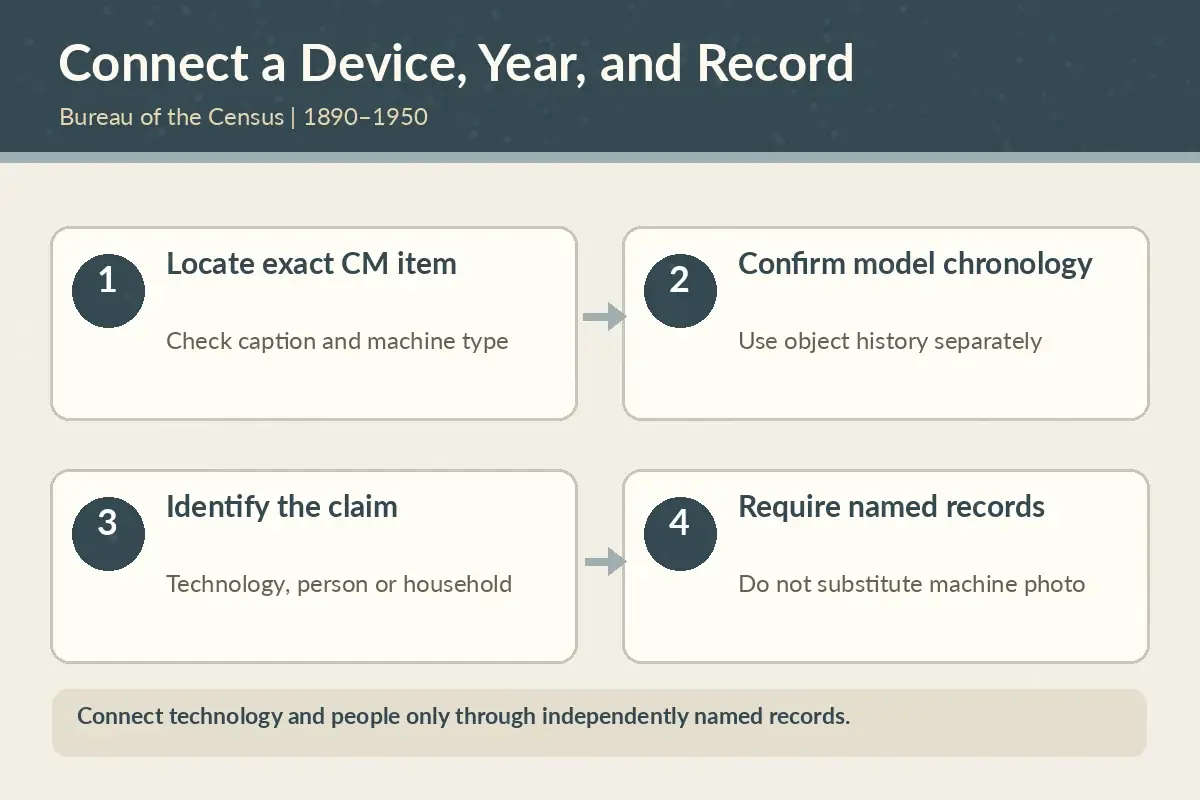
NARA’s Still Pictures guidance is useful for CM item access and captions. The Smithsonian museum object record is an appropriate source for the specific 1920 machine’s documented history. Use both when describing technology but keep the institutional citation attached to each claim. If an article mentions an earlier tabulation method, confirm the chronology from a reliable history or primary documentation before treating a photo’s visual similarity as proof.
A practical finished citation can state that an RG 29 CM image shows a particular machine as labeled and that a separate Smithsonian artifact demonstrates a known period of use. If no label or model can be verified on the CM image, stop at the broader description “census tabulating equipment.” For a genealogical statement, cite the actual population return or person-level record. This division produces a trustworthy technology story without fabricating a census schedule, machine operator or family name.
More Genealogy Tool Guides
How We Research and Check Each Source
The foundational claim was checked in the National Archives guide for this record group: The RG 29 inventory describes 99 CM photographs and lantern slides of tabulating machines used by the Bureau of the Census, 1890–1950; Smithsonian documents a separate surviving Census Bureau machine made in 1920 and reused after modification in 1930. This level of inventory establishes a collection, not the identification of every object or person depicted. The method described here separates archival series scope, observations of an actual item, and independent claims obtained from other records. Its illustrated diagrams are original explanatory drawings, not photographic facsimiles from the archive; no image in the article is presented as a digitized archival original. Specific items require their own identifiers and their own verification.
We also consulted NARA research guidance for this material type and, where relevant, separately cataloged historical objects. The reader should cite the exact item, date, caption, media type, location or person identified, and the consulted version, rather than treating a general web inventory as proof of an unseen frame. If digitization is unclear, request details from the repository. For editorial transparency, our affiliate disclosure explains the site’s relationship standards; no paid archival endorsement or special collection access is claimed. The goal is to separate a photographed counting device from the original person-level census records and employment evidence.
It is the NARA still-picture series code for 99 tabulating-machine photographs and lantern slides dated 1890–1950.
No. Search the actual population schedule for that jurisdiction and census year.
The museum object and NARA still-picture series are separate records; any exact image match must be proved.
No. A named caption or independent employment record is needed.
Search RG 29 CM for machinery history or census schedules for family evidence.