
The National Archives identifies 42 glass negatives in Record Group 120, series RPM, depicting an Inter-Allied marksmanship competition in Belgium in 1919. The collection belongs to the American Expeditionary Forces records and can illuminate a specific postwar military event. Yet the official RG 120 inventory does not provide a named participant list, competition scores, or complete venue details in its short summary. A photographic scene and a results sheet answer different historical questions.
If your family story mentions a relative competing in Belgium after the First World War, begin with the image’s original caption and any independent source naming the person. A uniform, shooting target or gathering of officers might suggest the general subject but cannot establish that a particular soldier competed, won a prize, or was present on a given day. Treat each negative as evidence of an observed moment. Build a separate record for the competition’s organization, rules and results when those sources can be located; do not infer them from the existence of the 42 plates.
Find the RPM Series Before Identifying the Event

Search the NARA Catalog by RG 120, RPM, Inter-Allied marksmanship, Belgium and 1919. Preserve the exact phrase used by the inventory, as a modern search may produce images of unrelated national championships or military shooting practice. Ask whether the individual plate captions specify a city, range, participating forces or a competition date. The broad year 1919 is a reliable series descriptor, but not a day-month date for every exposure.
Build a plate ledger: archival identifier, original caption, photographer credit if present, visible scene, attached date and type of object. Note whether you viewed a glass negative, a photographic print, a scan or only an online description. Two prints from the same exposure are one visual observation, not independent confirmation. If the caption or mount has been edited, distinguish that annotation from the original negative and record any conflicting labels.
Separate Competition From Ordinary Range Training
A target, a line of uniformed participants and a range structure may look similar in a competition and a training exercise. The series description places RPM within a named competition, but researchers still need item-level corroboration before attributing every pictured scene to a specific stage or round. Look for ceremonial flags, official captions, visible awards or contemporaneous press descriptions, while avoiding unsupported assumptions about national teams or the rules of scoring.
A photograph may show spectators, organizers, instructors or support personnel in addition to competitors. Do not assign a precise role to a person because of where they stand. Create separate fields for documented role and visual hypothesis. If a caption says only “group at range,” preserve that wording and mark the connection to the competition as derived from series context, not direct proof of individual participation.
Search for Results in Textual Sources Instead
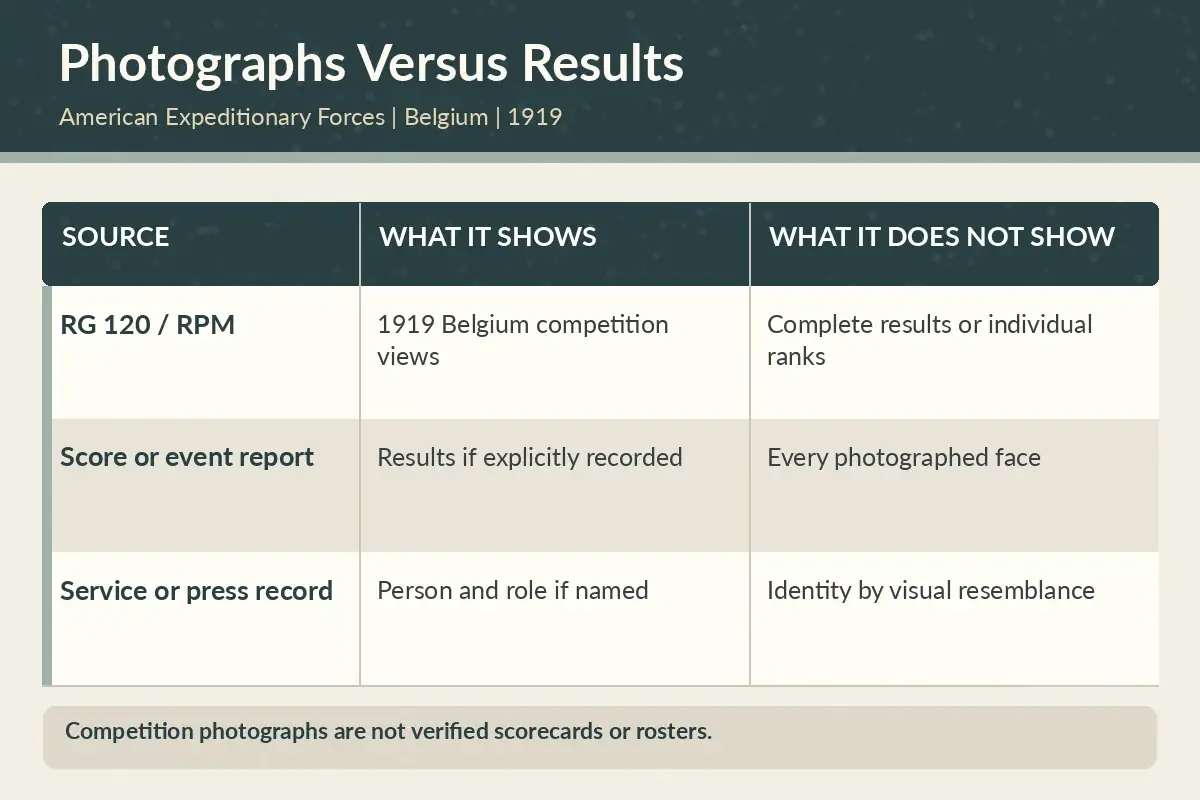
A photograph cannot ordinarily tell the score of a shot, the final ranking, or how officials interpreted a disputed result. To research winners, seek a dated event program, contemporaneous military correspondence, after-action report, reliable newspaper account, official notice or an actual results list. Such records may be held outside the still-picture series, and their existence should not be assumed without a finding aid. A trophy visible in an image does not automatically reveal its eventual recipient.
If an independent result names a soldier, confirm the person against rank, unit, service number when available, and other dated records before connecting that name to a face. The same surname may belong to several servicemen. A score card or a program entry can establish a named entrant only within its own scope; it does not guarantee appearance in an RPM exposure. Record conflicting spelling, date or unit information and explain why an identification remains tentative.
Place the 1919 Event in Military Context
The AEF records extend beyond frontline combat and include occupation-era administration and postwar activities. A 1919 inter-allied competition should not be described as a 1918 battle or evidence that the participants fought at a particular front. Check an independently dated unit history, orders or service record for the relevant location and period, if such records survive. A unit stationed in Europe also does not prove every member took part in a competition.
A personal narrative can accurately say the Archives holds Belgian competition images from 1919, and separately describe a confirmed service assignment when supported. If the family story supplies a location that differs from the caption, retain both sources while investigating the discrepancy. Avoid silently moving the event to a famous battlefield merely to make the story more dramatic. Context is a research aid, not an invitation to fill missing personnel history.
Write an Accurate Caption and Source Note

For a publication-quality citation, include RG 120, series RPM, exact item identifier, caption text, media type and any verified image date. Ask NARA’s Still Pictures research service about digitization and the location of the originals if the online catalog is incomplete. Reproduction conditions and attribution should be checked for the actual image, not inferred from federal custody alone. An uncredited modern reconstruction should never be passed off as an archival negative.
Separate three statements in the final family account: the source describes the competition, a particular picture shows the people or objects visible, and an independent named document links a relative to the event. When only the first two are established, state that limitation. Readers gain a verifiable explanation of the historic event even when no participant can yet be named, rather than an unsupported winners list assembled from faces and uniforms.
More Records and Archives Guides
How We Research and Check Each Source
The foundational claim was checked in the National Archives guide for this record group: The RG 120 guide describes 42 RPM glass negatives of an Inter-Allied marksmanship competition held in Belgium in 1919. This level of inventory establishes a collection, not the identification of every object or person depicted. The method described here separates archival series scope, observations of an actual item, and independent claims obtained from other records. Its illustrated diagrams are original explanatory drawings, not photographic facsimiles from the archive; no image in the article is presented as a digitized archival original. Specific items require their own identifiers and their own verification.
We also consulted NARA research guidance for this material type and, where relevant, separately cataloged historical objects. The reader should cite the exact item, date, caption, media type, location or person identified, and the consulted version, rather than treating a general web inventory as proof of an unseen frame. If digitization is unclear, request details from the repository. For editorial transparency, our affiliate disclosure explains the site’s relationship standards; no paid archival endorsement or special collection access is claimed. The goal is to separate documented competition scenes from unsupported athlete identities, rankings or military operations.
It is the series code for 42 glass negatives of an Inter-Allied marksmanship competition in Belgium in 1919.
No. Its short still-picture inventory is not a results table.
Not necessarily; roles require original captions or corroborating documents.
No; do not turn a postwar competition into a battle scene.
Find item-level captions and independent personnel or competition records.