
The National Archives identifies 60 photographs of the 1930 Navajo enumeration in Record Group 29, still-picture group NR. They are an unusual way to see how an important federal count was carried out. They are not, however, a substitute for the schedules in which enumerators recorded households. Even an image featuring an enumerator beside a group of people does not supply the names of every person in the frame.
Start by opening the RG 29 inventory and NARA’s Native American still-picture guide. Note the original group identifier 29-NR, the item number if present, and the historical wording of any caption. Preserve that wording as source evidence, while using respectful contemporary language in your own description. The population schedule is a separate research target.
Understand What the NR Photograph Group Contains

In the NARA guide, NR appears among still pictures associated with the Census Bureau. The number 60 describes photographs in the group, not sixty enumerated families or sixty complete census districts. A series-level description tells you why the material is filed under RG 29; an item-level record may give a more precise location, subject, photographer, or caption. Do not transform the series summary into details that only an individual image could provide.
When searching, try the exact identifiers “29-NR” and “Navajo Indian enumeration” as well as a locality or photographer when supported by an actual caption. If results include other Native American photography, check the record group and local identifier before assuming the image is part of NR. The same topic can appear in federal records created for very different administrative purposes.
Choose a Place Before Searching a Household Name
The strongest next step toward a person is geographic. A confirmed trading post, community, agency area or other historically documented place may help identify the relevant 1930 census enumeration district. NARA’s geographic search guidance describes moving from a place or institution to an enumeration district number and the roll on which schedules were filmed. A modern place name should not silently replace the historic wording in the record.
After finding the district, inspect the actual schedule pages, including adjacent households, marginal notes and spelling variations. Federal census spellings and name order can be inconsistent. Compare ages, family relationships and neighboring names against other records instead of matching a single given name to a face in a picture. Photography and census schedules were created for different reasons and do not form a one-to-one portrait directory.
Distinguish a Recorded Caption From a Proven Identity
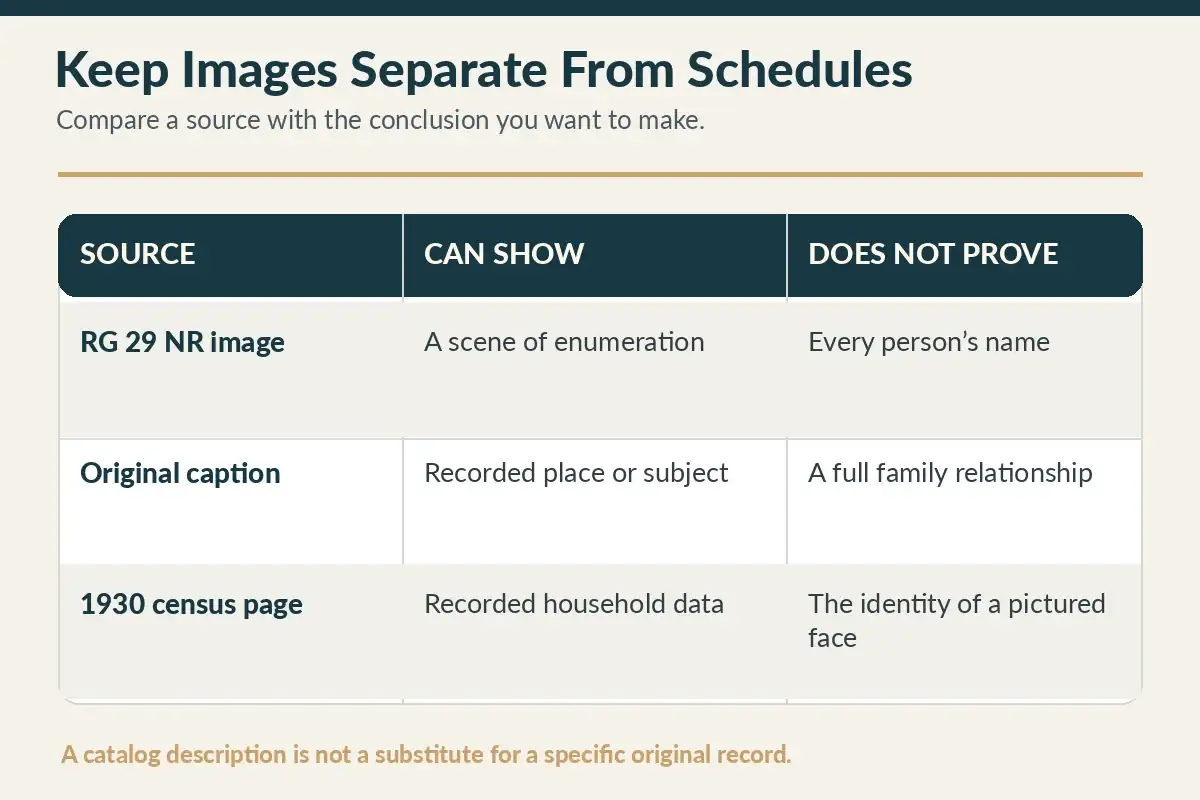
An original caption may identify an enumerator or offer a broad description of a community. That is evidence of what was written when the picture entered an archive, not necessarily an exhaustive list of the people shown. A handwritten caption added later should be dated and attributed if possible. An institutional label about an activity must not become a personal identification without supporting documentation.
Use a small claim ledger with three columns: the exact caption; what can be seen directly; and what another source is needed to test. For example, “enumerator at work” is an activity description. “This is my grandmother” is a specific historical claim requiring a demonstrated connection between the face, place, date and named records. Ethnic appearance, clothing or family resemblance cannot carry that burden.
Handle Community Context and Historical Categories Carefully
Federal agencies used historical classifications that may not match how people or communities identify themselves. Quote the catalog’s title exactly when necessary for locating the item, then clearly identify it as the archive’s inherited terminology. Do not infer language, clan, citizenship status or cultural practice from the appearance of a photographed person. Historical administrative categories are evidence of government practice, not a comprehensive account of a person’s identity.
The date 1930 is essential, but it is not a guarantee that a photographed household was listed on the same day, in the same district or in exactly the format expected. Enumerators traveled, captions may omit detailed locations and schedules reflect formal recording practices. Keep the circumstances of the photo, the scheduled enumeration and any family memory as three separate strands until a solid match joins them.
Build an Item-Level Citation That Can Be Checked

For each photograph, capture the repository, record group, group code NR, full item identifier, caption wording, date supplied, and the stable catalog record when available. If the image is viewed only as a thumbnail, say so. Never describe an unexamined original as though you checked annotations on its reverse. A short but complete photo citation lets another reader challenge or confirm your interpretation.
For a census household, cite the census year, state or relevant jurisdiction, county or enumeration area, district number, sheet or page, dwelling or family number when present, and the archive or image provider. Compare each citation side by side. The two source types may support one argument, but no generic series heading establishes a family relationship.
A Worked Example With an Unnamed Census Scene
Imagine an old family album containing a reproduction of a 1930 photograph said to show a census interview. The picture matches the general activity visible in an NR image, but the family note gives only a community name. First find the archival item and copy its actual caption; then identify the best-supported 1930 census district for that community. Search the district for independently documented relatives without presuming that the people in the photo appear on a particular schedule page.
If the schedule offers a plausible household, compare ages, known relatives and later documentation. If no item-level caption names the people photographed, the result should remain “possible family connection.” That limitation still produces a useful finding: a well-documented community context and a separate record of a household, neither falsely presented as proof of who is pictured.
Retain both photographs and census references in your notes
At minimum, keep two clearly labeled citations in the family research log. One cites the complete 29-NR photograph description and its original caption; the other cites the 1930 census page with its geographical context. Record transcription uncertainty, especially for names written differently in several sources. A later identification offered by a descendant can be valuable testimony, but cite its informant, date and basis. An unverified recollection should not be quietly promoted to a verified archival fact.
More Records and Archives Guides
How We Research These Historical Sources
We begin with the NARA inventory and the 29-NR still-picture guide, then use item-level citations rather than inventing details from group descriptions. We compare questions about a photograph with the separate 1930 schedule search procedures. This method treats Indigenous family identity as something that must be documented carefully, not inferred visually.
Check archival availability separately for every item; a listed group is not a promise that all photographs are available as digital downloads. Before the FAQ, our general affiliate disclosure explains site relationships; none of the research links in this article relies on a claimed paid arrangement.
No. NR designates a still-picture group. The census schedules are a separate set of records.
The guide lists sixty photographs associated with the Navajo enumeration of 1930.
Not unless the actual caption does so, and any identification should be checked independently.
Use a historically supported location to find the census enumeration district and inspect the named schedule.
The series description does not establish online availability of every item; check specific catalog records.