
The National Archives identifies a small but unusually revealing set of color slides in the U.S. Civil Service Commission records: series IB, a presentation titled “An Inventive Bunch.” NARA describes roughly 80 images made about 1977 to highlight technological and social contributions by federal workers. The distinction matters. A curated slide show is evidence of what its organizers wanted viewers to notice; it is not automatically a laboratory notebook, a patent application, or a biographical index. Begin with the presentation as a historical object before extracting claims about named people.
Searchers may arrive with a family story about a government employee who devised a technique, improved an office process, or worked on a public-service innovation. IB may help explain the work culture and the language of federal innovation, but it cannot be treated as a definitive inventory of everyone who contributed. Preserve the original slide title, series, and arrangement. If a caption names a technology without its workers, leave the personal credit open. If a worker appears without a project name, avoid attaching that person to a nearby slide.
Start With the Archival Series and the Actual Research Question
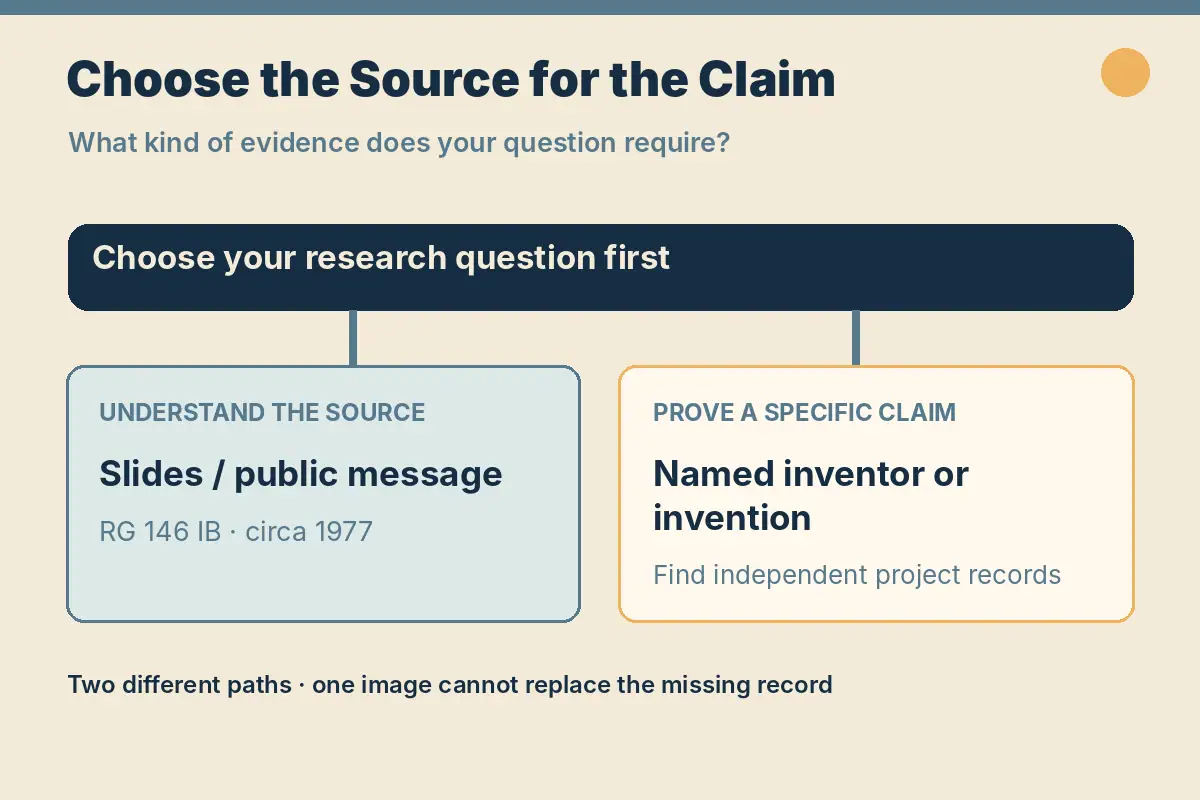
The date “circa 1977” belongs to the slide show description, not necessarily to each technological advance mentioned. A display can celebrate discoveries from different decades. Make three dates in your notes: the approximate presentation date, any date printed on an individual slide, and an independently sourced date for the development itself. Do not silently merge these. The U.S. Civil Service Commission is the archival record-group creator; a project celebrated in IB might have originated in a different federal agency.
A practical first pass is to describe each relevant slide in plain language: object or process depicted, text visible in the caption, persons clearly identified, and any uncertainty. Ask NARA for the item or folder identifier needed for a precise request. Distinguish a slide from a duplicate print and any separate accompanying script. Do not assume a narration survives merely because the format could have supported one. A catalog description may name only the series, so item-level access and caption checks may still be necessary.
Before searching, write the question in one sentence: Did a specific federal employee develop the pictured innovation? The most defensible first query is “An Inventive Bunch, RG 146, series IB, circa 1977.” It combines the historical creator, the official series designator and the subject period rather than assuming a name index exists. NARA’s record-group guide is a map to holdings, not a guarantee that every individual item has been digitized or that its caption is complete. Track the entire chain of references from the guide to the catalog description and, when possible, the individual object. Keep unresolved matches in a separate working list instead of promoting them to facts.
Read Dates, Formats, and Custody Before Interpreting the Scene
For an invention claim, construct a two-column test. In the first column put what the slideshow asserts or illustrates; in the second put what another dated institutional source actually says. Agency annual reports, technical publications, contemporary proceedings, and patent documentation can sometimes identify development stages or authors, but each has different evidentiary limits. Patents may credit an inventor without establishing who implemented a federal service, while personnel files may show employment without proving ownership of an idea. Credit requires deliberate corroboration.
The official description specifies 80 color slides and covers a federal workplace presentation about technological and social contributions. Those details define a useful search boundary, not a promise that the surviving material is exhaustive. The source format is color slide presentation; that matters because an image, a script, a formal report, and an administrative list document different things. Preserve the original wording of uncertain place names and date ranges. Record whether a statement comes from a series-level description, an item caption, or an independent document. The same claim should not count as independently confirmed merely because several later websites repeat one NARA description.
Compare What the Source Shows With What It Cannot Prove

A person-level story also needs a name-disambiguation procedure. Compare full names, work units, dates of employment, role descriptions, and independent records. A captioned photograph of a team does not establish that all pictured individuals designed the device in view. Federal positions and programs change names; a later agency label can be anachronistic when applied backward. If the evidence establishes only that a worker participated in a program, write that narrower finding rather than a family legend of sole inventorship.
The tempting shortcut here is that a pictured achievement belongs to a particular person, agency, patent, or date. That is exactly the inference to test rather than assume. The original material concerns a federal workplace presentation about technological and social contributions, while a question about named inventors or federal employees calls for more specific evidence. Build an evidence ledger with a source citation, date as written, direct observation, proposed interpretation, and an explicit uncertainty column. When two captions conflict, keep both versions until the original item, creator’s context, or another contemporaneous record resolves the difference. An absence from this particular collection is not evidence that a person or event did not exist.
Build a Stronger Proof Chain With Independent Records
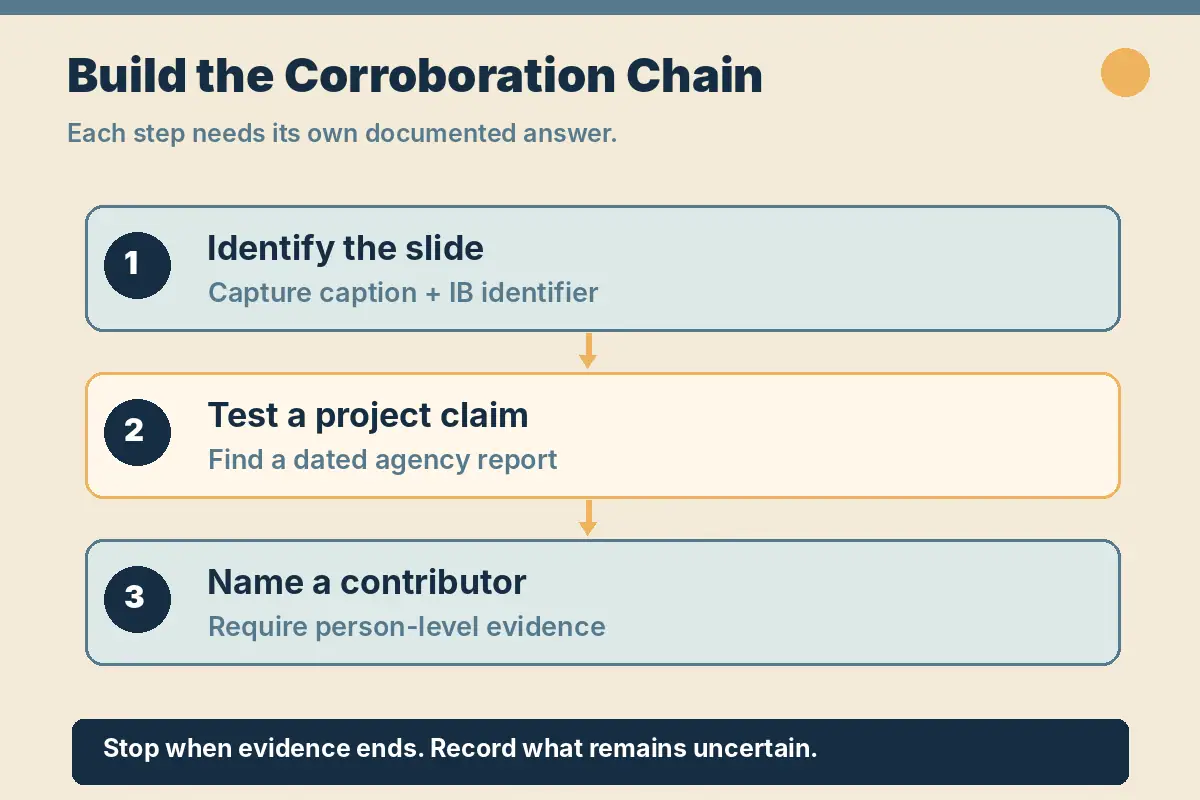
Use the source openly in a finished article. Describe IB as a period presentation that celebrated federal workers, identify any artifact as a modern illustration unless it is an authenticated NARA reproduction, and separate the image’s direct content from additional historical interpretation. An unanswered question about individual authorship does not weaken the research: it marks where a different class of records is needed. Present the slideshow’s narrative accurately, then make the corroborating records do the biographical work.
For the question “Did a specific federal employee develop the pictured innovation?” the most promising next evidence is agency reports, invention records, patents when relevant, and employee documentation. Do not make the archival image or planning document carry more weight than its content allows. Instead, compare exact names, dates, locations, agencies, and identifiers only where a source supplies them. A matching year may establish broad plausibility but not individual identity. A familiar place-name may cover more than one site. State the narrowest defensible conclusion first, then list the particular missing record that could change it.
Document an Example Without Overclaiming a Person or Property
Imagine finding an item that appears highly relevant but has no personal name in its caption. Your first note should read “RG 146 IB: item-level attribution not established,” followed by the visible or textual details actually present. Do not invent an inventory number; enter the real identifier only when the catalog or archival staff supplies it. Next write the proposed claim in a separate field and identify the independent source needed. This prevents a tentative identification from spreading through a family tree, photo album, or historical narrative as if the primary record had already confirmed it.
A well-maintained worksheet uses five fields: original record citation; item date and any uncertainty; what was directly depicted or stated; separate corroborating document; and what remains unproved. If an image is reproduced from a slide or photographic print, label it as a derivative and retain the source image’s identifier. If you create an explanatory illustration instead, identify it as modern artwork rather than implying it is an original scan. When publishing a narrative, link readers to the relevant official description and avoid publishing sensitive personal information without a justified research and privacy basis.
More Genealogy Tool Guides
How We Research the Record Series and Its Limits
We checked NARA’s RG 146 record-group guide for the original description, dates and designation IB. We used the Still Picture Branch guide to distinguish visual-series descriptions and reference codes, and NARA’s getting-started guidance for the path from a topic to records. A curated slideshow demonstrates a public message, not the documentary chain of invention or an employee roster. The explanatory graphics are original modern interpretations, not reproduced archival documents. Sources and individual item access may change; confirm current catalog descriptions when requesting copies. Read our affiliate disclosure.
No. NARA describes a circa-1977 color slide presentation, not inventor applications or patent dossiers.
The guide lists about 80 color slides in series IB.
No. Circa 1977 describes the presentation; a depicted development could be earlier.
No. Individual credit needs evidence naming a role and connecting it to the work.
Start with the RG 146 guide, then search the NARA Catalog and retain the IB series designation.