
CSC 10 contains Civil Service Commission examination marks and results for candidates in open or limited competitions from 1876 to 1991. It is valuable when a family letter mentions a civil service examination, but it is not a universal employment register. A name beside marks shows what the examination record actually reports, not automatically that the applicant received, accepted, or retained an appointment. Begin with a candidate, approximate examination year, department or post, and locality, then investigate the later employment claim separately.
Choose the Competition Before Searching the Candidate
First transcribe the family clue exactly. “Passed an exam for the India Office” differs from “was appointed to a colonial post,” and a school certificate may refer to a different examination altogether. Build a small identity card with the person’s full name, approximate birth year, address or district, and the words used for the intended post. Keep the uncertainty visible when a family memoir was recorded decades afterward.
The National Archives identifies CSC 10 as examination and interview results, not a list restricted to those ultimately hired. The Commission administered examinations from 1855, but the CSC 10 date range given in the guide begins in 1876. Do not assume an early Victorian ancestor must be in these volumes. Search within the series by competition, date, or candidate when the item descriptions permit it.
An open competition could generate multiple plausible candidates with similar surnames. Record the job category, examination center if documented, year, and any identifying details actually printed. If your only evidence is a single surname and a score, hold the identification as possible rather than certain. Use another document created near the same date to distinguish people with overlapping names.
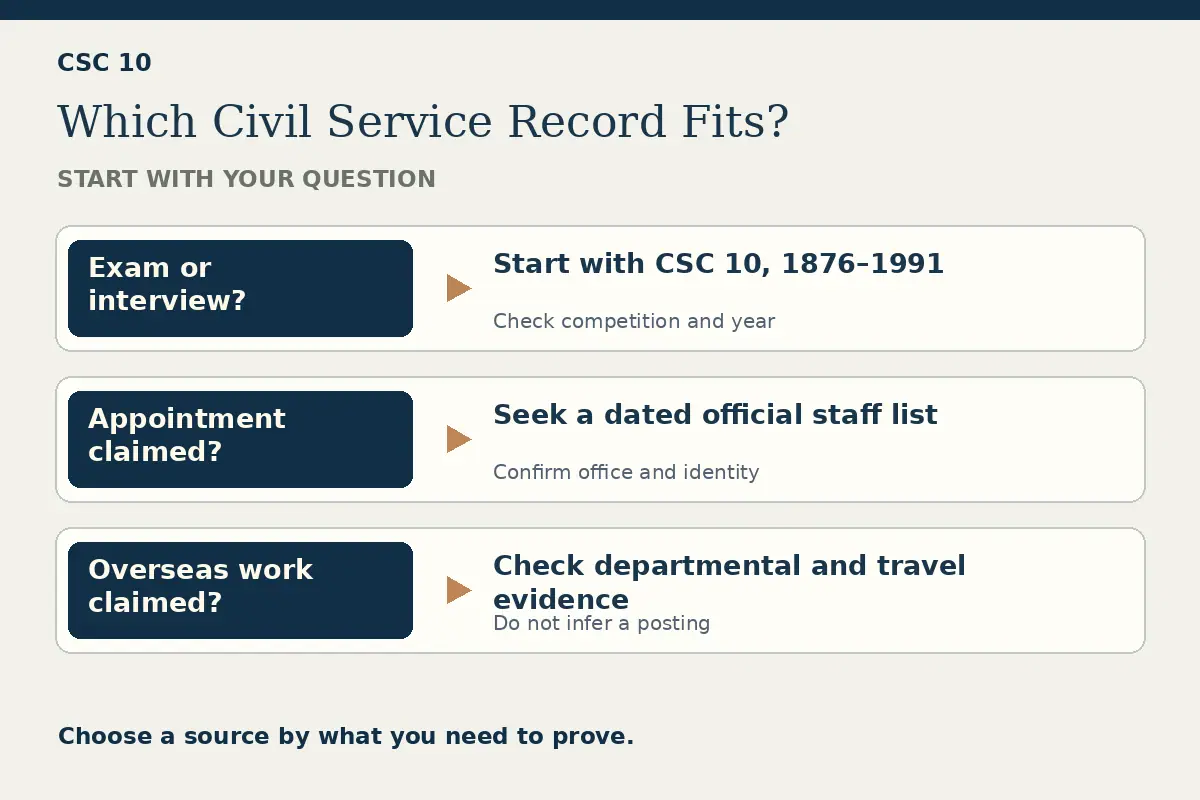
Separate an Examination Result From Appointment
Make four entries in a dated ledger: application or examination, reported result, appointment, and subsequent service. Each row needs its own source and citation. Only fill the third row after locating an appointment notice, departmental staff list, service record, or another contemporaneous statement. The year of the examination can precede an appointment, but it may also be followed by no appointment at all.
Read the original page layout rather than relying on a transcription. A total score, competition rank, eligibility notation, or remark may have meaning only in relation to neighboring candidates and the heading above the list. If the item is a set of interview results, do not rewrite its status as a written test. Document the exact words of the column instead of converting an unfamiliar abbreviation into a modern grade.
Where the family story mentions a move abroad, do not infer overseas posting from a competition category alone. A candidate may have competed for a colonial appointment and never traveled. Passenger lists, annual official lists, correspondence, and the receiving department’s establishment papers answer different questions. Match the department and the dates before attaching any travel or residence claim.
A useful worked example would distinguish a reported 1884 competition from a later 1886 directory entry. Those dates are illustrative only: if the candidate name appears in both, you still need department, initials, and workplace evidence to decide whether the records describe the same person. Never label an illustrative timeline as a real person’s career.

Record What Each Source Actually Proves
Build a source table for the person rather than merging every name hit into a narrative. The CSC 10 entry can establish an observed result under the recorded identification; an official appointment announcement can support appointment if it clearly matches the person; a later staff list can support service at that later date. None of those documents by itself proves an entire uninterrupted career.
Watch especially for a recurring title with changing duties. “Clerk” in one department may be a junior appointment, while “clerk” in a local institution is unrelated. Preserve the office and the exact historical grade if recorded. Do not promote a candidate to a senior job just because a similarly named person later held one.
When citing a candidate list, give the whole heading that identifies the examination and list type. An alphabetical list, ranked pass list and set of raw examination marks are not necessarily interchangeable. The safest transcription preserves status words and footnotes verbatim before translating them into a modern family-history note.
Follow Official Lists and Departmental Records
Once a candidate is identified, seek an independent series from the employing office. The National Archives civil-servant guide points researchers to published official lists for certain departments and to scattered departmental papers. These resources have different coverage. A missing name may mean an office was omitted, a year was not consulted, or the person was not yet on staff, not proof of rejection.
Check the interval between the candidate date and the supposed start of work. A later residence, professional directory, or government notice may resolve whether the individual entered service. If a name occurs in two departments, ask whether it represents a transfer, two different people, or an incorrect identification. The strongest sequence uses the same middle initials, job description, and career dates in more than one independent record.
Keep the identification tentative when the evidence gives only a common surname. A candidate’s age and address on an independent record may be decisive; a high mark is not an identity test. Record conflicts without rounding dates until they look compatible. Your goal is to establish the actual person before explaining occupational history.
It is often tempting to explain an unconfirmed appointment by saying the candidate failed, withdrew, or was rejected. None of those conclusions follows from an isolated result. Use the narrowest defensible wording: the record documents participation or a stated outcome, while appointment status remains undetermined pending the appropriate employment evidence.

Avoid Common Candidate-List Misreadings
Do not treat a catalogue year range as the examination date for every entry in a volume. Nor should a catalogue description be mistaken for an image of the underlying result. Write down the full piece reference and page or folio whenever possible. If the material is inaccessible online, note that you have confirmed the catalogue reference but have not inspected the individual candidate.
A failed search is limited by the terms and material checked. Try alternative given names, initials, department titles, and adjacent years, and record each attempt. Some Civil Service Commission material does not survive or is described only at volume level. Avoid turning an unsuccessful name search into a categorical statement that the person never sat an examination.
More Records and Archives Guides
How We Research Civil Service Candidates
We start with The National Archives guide for civil and Crown servants, use its explicit CSC 10 coverage, and test each piece-level Discovery description against the family question. We distinguish the catalogue, the marks or interview record, and later employment evidence. A research note should include a precise reference, relevant dates, the literal status wording, and a clear statement of whether any later appointment has been independently demonstrated.
The examples on this page describe source logic, not reconstructed biographies of real candidates. Where only an index or summary is available, we identify it as such. See the affiliate disclosure for site transparency; archive access may involve local consultation or copies, but no commercial partner is implied by this research route.
No. Marks or interview results document the competition record. A separate appointment or establishment source is required to support employment.
No. The Commission began in 1855, but The National Archives identifies CSC 10 exam marks and results from 1876 to 1991.
It may, if the competition is documented, but an overseas appointment or journey needs independent evidence.
Match competition, year, recorded identity details and independent contemporaneous address or departmental records.
Cite the description as a finding aid and do not claim to have read an individual result until the relevant original is inspected.