
The Women’s Bureau photographs in NARA Record Group 86 include a WWT group of about 1,500 images showing women in wartime occupations from 1940 through 1945. These photographs can document visible types of work, equipment, working environments, and the agency’s selection of subjects. They are not a roster of everyone who held a job and do not necessarily prove that an unidentified worker in a family story appears in a particular frame. WWT is an archival series designation, not a personnel file number.
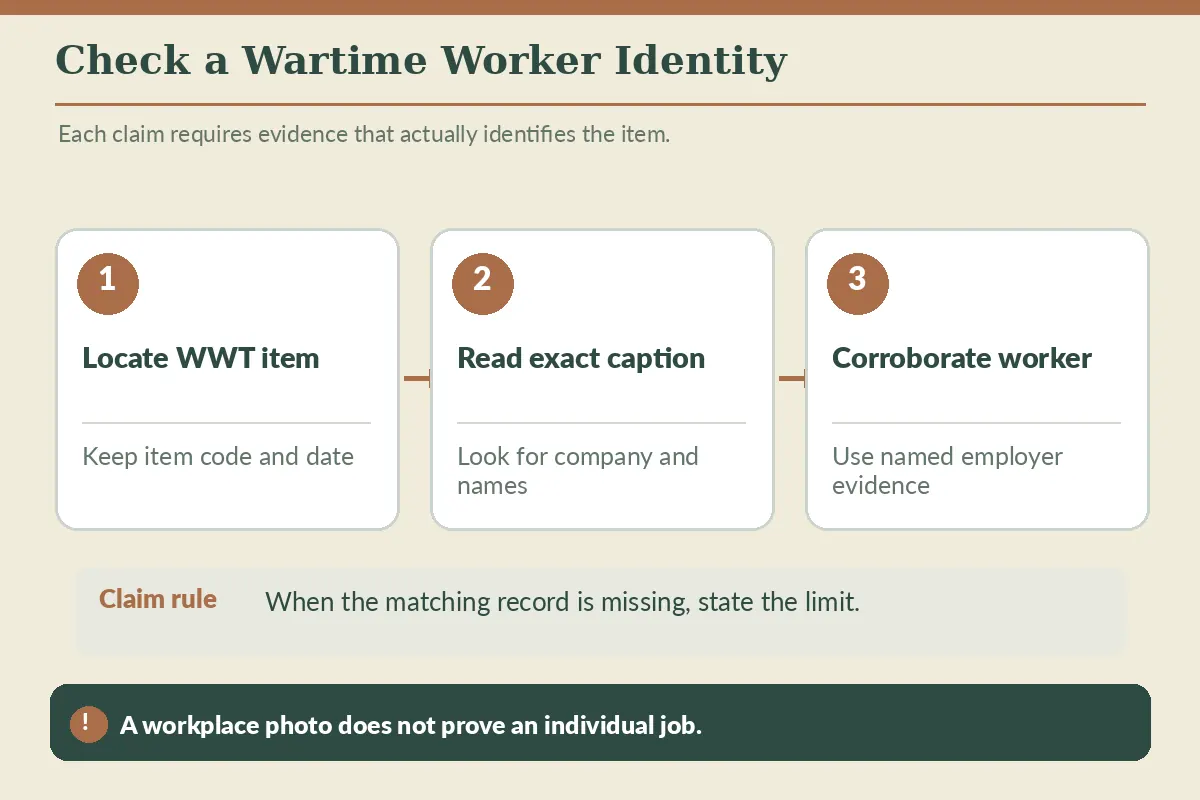
Begin with the original WWT caption and identifier before searching a surname. An especially useful documented example is the Bell System telephone switchboard image, cataloged by NARA DocsTeach as 86-WWT-28-3, dated December 22, 1943. The image supports a specific work setting and date as the archive describes it. It does not turn every woman at a wartime switchboard into an identifiable operator or show her entire career. A convincing family caption needs a second source for the person and the employment period.
Identify WWT Rather Than the Broader RG 86 Picture Files
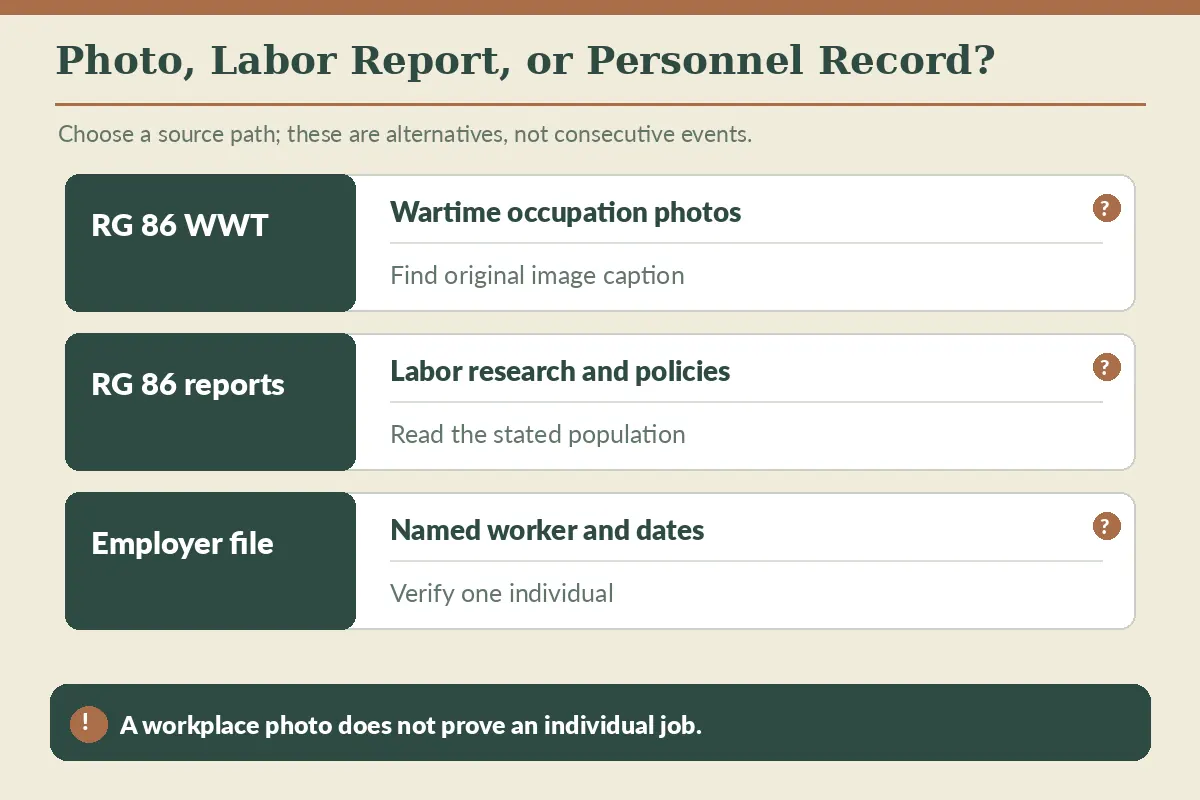
RG 86 contains more than one visual grouping. NARA lists G photographs covering women at work, working conditions and women’s rights across 1892–1945, while the WWT set is specifically tied to World War II occupations from 1940–1945. Do not treat a photograph from G as WWT because it shows a woman at a factory bench or because it later appeared in a wartime publication. The correct code belongs in the citation and determines which finding aid to use.
The photographs span several spheres: industry, agriculture, professional work, military service, home work, and other vocations. The existence of an occupation in the series does not demonstrate that women everywhere had identical work conditions, pay rates, hiring practices, or legal status. The Women’s Bureau selected subjects for public information and research purposes; collection scope is not a statistically representative labor survey. If an image appears promotional or posed, say what is documented about the production rather than declaring all pictured scenes staged.
Search the National Archives Catalog with RG 86 and WWT, plus the original subject and a state or city if known. Keep both a collection-level date span and item-level date. A print might be captioned 1943 while a source folder spans 1940–1945. Note the photographer if credited; never infer who operated the camera from the agency that retained the print.
Read the Dated Switchboard Image as a Specific Example

NARA DocsTeach provides an item-level citation for “Photograph of Women Working at a Bell System Telephone Switchboard,” identifier 1633445, with the archival reference 86-WWT-28-3 and date December 22, 1943. It is a strong starting example because an item, not just a broad theme, has been located. The caption anchors the workplace subject. It cannot identify an individual operator without names or an independent personnel source.
Do not confuse what the image depicts with a national claim about wartime jobs. A telephone switchboard may show a service or clerical activity, not assembly of military hardware. The Women’s Bureau wartime collection includes many types of work. Asking whether a family member worked for a telephone company in a particular city is different from asking whether wartime women used large switchboards. The former requires employment evidence; the latter might be illustrated by an accurately cited print.
Look for any company, equipment, place or photographer statement in the original caption. Compare it with company directories, union records, appointment notices or family letters only when the geography and date fit. A family oral history can suggest a name to investigate, but the original photo still needs its own visual and textual evidence. If the caption names no one, do not add a woman’s name based on a resemblance to a portrait.
Connect Occupation, Wage Policy, and the Named Worker
NARA’s RG 86 description separately mentions records about women workers in defense production during World War II and Women’s Bureau reports, bulletins and research material. Such documents can help establish how the agency discussed working conditions, occupations and wartime participation. They are not necessarily personnel records for a particular factory or operator. A policy bulletin cannot prove that a relative earned its stated wages, while a photograph cannot prove a labor-law protection was applied in that workplace.
Build a three-column comparison: the photo and its verified caption; the employer and dates from a named source; and the prevailing policy or working-condition context from contemporary agency material. For example, a directory entry may place a woman in a specific occupation during a year, while a dated WWT picture documents equipment at a potentially comparable workplace. Unless the two sources actually identify the same company, location, and person, describe the photograph as illustrative context rather than a personal portrait.
Separate exact employee identity from the spelling of names in captions. Women may appear under different surnames across marriage, payroll and later family documents. Do not use a modern assumed name to replace the form preserved by a contemporary record. Note alternate names with independent citations, and restrict claims about living people or sensitive employment files as required by archive access rules.
Create an Accurate Family-History Caption and Image Citation
Record the full archival reference, the title as transcribed, date precision, creator or holder, and National Archives identifier where available. For the switchboard example, 86-WWT-28-3 and identifier 1633445 make the image reproducible. Those are stronger than citing only “women at work in World War II.” If a digital derivative has been cropped or colorized, identify the alteration so readers understand it is not the unchanged archival image.
A careful family narrative can say, “This RG 86 WWT photograph documents a wartime telephone-switchboard setting in 1943; it is not identified as a portrait of our relative.” Add a separate sentence about a named relative only when payroll, correspondence, a directory, a military document or another contemporaneous source connects that person to the occupation. If a family member was photographed, preserve the independent provenance of the family photograph rather than attaching the WWT identity of a similar-looking public-domain image.
Use the archive’s series description to understand coverage and an item record to establish particulars. The WWT total of roughly 1,500 is a holdings statement, not a guarantee of fully digitized or searchable individual portraits. When an image is unavailable online, request the corresponding finding aid or a reference inquiry using the exact series code and any known identifier.
More Family Story and Preservation Guides
How We Research These Archival Photographs and Claims
The official RG 86 guide establishes the WWT subject and date range. The NARA DocsTeach item supplies a verifiable reference for one switchboard image, not a list of named operators. We also used NARA’s Still Picture Branch guide and image research instructions. We have not established that any particular ancestor appears in the series. See the affiliate disclosure for editorial transparency.
It is the NARA photographic grouping for Women’s Bureau images of wartime occupations, 1940–1945.
No. G has broader 1892–1945 subject coverage; keep the archive’s exact code.
Yes. NARA identifies a Bell System switchboard photograph as 86-WWT-28-3, dated December 22, 1943.
No. Pair an item-level caption with a named employer or personal record.
No. Pay requires payroll, a contract or other wage evidence at the relevant workplace.