
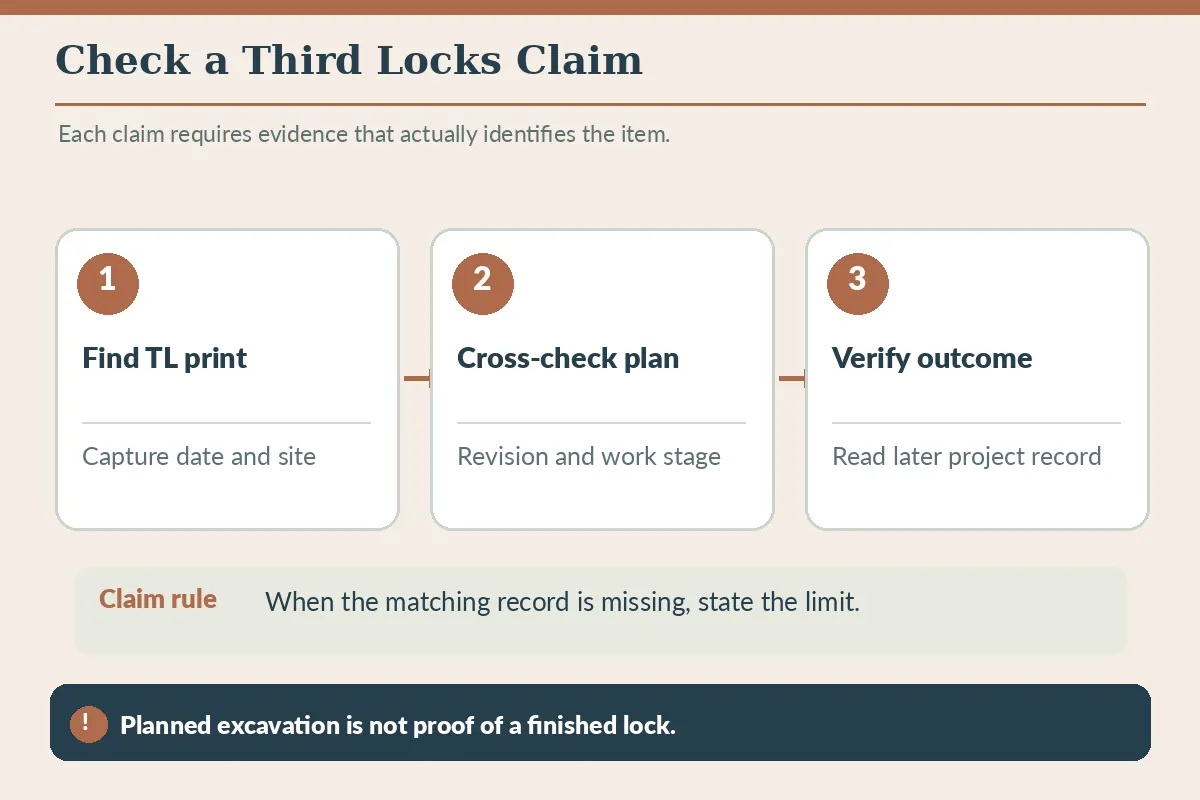
The Panama Canal’s Third Locks Project generated substantial photographic and engineering records during the 1940s. In Record Group 185, NARA describes about 9,500 photographic prints under TL dated 1940–1945 and 4,500 negatives under TLN. The guide separately lists engineering plans dated 1943–1944. These are records of a project, not automatic proof that a finished additional set of locks opened and operated. An excavation image may establish a work phase or a photographed structure; the project’s final outcome must be verified in different evidence.
Researchers should first decide whether they need a print, a negative, a design, or a report. TL and TLN refer to different media groups, and a design drawing may show an intended arrangement rather than built dimensions. In family and local history, even a labeled photo of a work gang does not establish a particular relative’s employment or identify everyone on site. Work backward from the precise archival label, not from a modern summary of what the Panama Canal eventually looked like.
Choose TL Prints, TLN Negatives, or Third Locks Engineering Plans

NARA’s RG 185 guide places TL photographic prints in the Panama Canal records for 1940–1945 and notes that the prints are held in Atlanta. TLN is the corresponding archival designation for Third Locks photographic negatives in the same general era; it has its own stated extent. The presence of both media does not prove a one-to-one relationship between every print and negative. Match identifiers and captions rather than assuming two similar views are the same exposure.
The same federal record guide identifies plans, in folios and with reports, dated 1943–1944, as well as a small set of Third Locks Project drawings associated with a January 17, 1944 report. These documents serve different questions. A photo can establish visible excavation, temporary structures, tools, or site conditions. A plan can establish an engineering intention at a stated revision. A report can document official reasoning, testing, or recommendations. None alone demonstrates that a specified design was actually constructed.
Use the exact RG 185 subheading and reference when asking a repository for material. Write down print number, negative number if known, plan sheet number, report title, dates, and locations in separate columns. The guide also lists a distinct 1940–1943 Gatun Locks relocation photographic group. Do not mix that relocation series with the Third Locks TL project just because both concern canal engineering in the early 1940s.
Read Excavation and Testing Scenes Without Treating Plans as Results

A photograph of rock cuttings, borings, retaining structures, heavy equipment or an exposed foundation may be powerful evidence for how engineers evaluated or prepared a site. It is not a completion certificate. The Third Locks work can be researched through combinations of site photographs, engineering drawings, geological observations, laboratory records and dated reports, but each must be kept in its original context. A laboratory image, for example, can show apparatus; only the underlying test record shows measured results, methods, uncertainties and acceptance criteria.
When using a photo, identify whether its caption gives a station, location, direction of view, camera date or stage of work. A later print date is not necessarily the exposure date. Compare visible landforms, alignments and construction features against plans only after establishing the plan’s issue date and revisions. Plans may contain alternatives, and a legend marked “proposed” should not be silently converted into “existing.” A sequence of cuts seen across photographs may suggest progress but cannot tell the full duration without a dated run of source images.
For work history, distinguish the photographed structure from a promised operating capacity. Avoid writing “this is the completed third lock” unless a completion record and correct physical location independently support it. Write instead: “Construction-phase image of the Third Locks Project, according to the cited RG 185 item,” followed by the exact documented phase. The archive’s project label is descriptive; it is not a claim that the full project was realized.
Separate Construction Workers and Contractors From the Project Record
A worker beside an excavator, survey tripod or concrete form is not automatically a named Panama Canal employee. Construction records may involve agency engineers, contractor crews, visiting specialists, inspectors and other personnel with different employers and assignment terms. The camera’s presence does not function as a time sheet. If a photograph contains a name, verify that name in a contemporaneous payroll, personnel list, correspondence, contract file or other independent record relevant to the location and date.
Build three time lines: the project’s documented engineering stages, the photographed site’s exposure dates, and the named person’s verified employment or residence. A family member might have worked on another canal-related project in the same decade. Matching the words “Panama Canal” and “1943” is not enough to connect that person to the TL or TLN scene. Compare job role, worksite, employer and exact interval. If a company ledger is missing, clearly mark the connection as unproved rather than assigning the relative to an attractive photograph.
Keep administrative provenance straight as well. NARA’s records cover successor organizations and later custodial transfers. A later agency holding the negatives does not mean it took the photographs at the date of exposure. Original creator, administrative successor and current archival custodian belong in separate source fields to avoid erroneous attributions in citations.
Create a Print-to-Negative and Plan Crosswalk
A practical research table has one row for each claim: RG 185 TL print identifier; corresponding TLN number only if explicitly documented; location or camera view; captioned date; referenced engineering sheet and revision; later textual source; and a judgment of confidence. This structure protects against accidentally pairing a print with an unrelated negative or claiming that a design exactly matches construction conditions. Record blank fields as “not identified,” not zero or nonexistent.
When you request materials, provide both the series designation and the specific item information. Because NARA describes some relevant items in Atlanta, check the appropriate reference route before expecting a College Park pull or universal online download. The series totals reflect holdings described by the guide, not a guarantee that every frame and plan has been digitized.
For publication, distinguish literal observations from interpretation in the caption. “A cut in rock and machinery are visible” is an image observation. “Construction took place at this named site” requires the item metadata or reliable site matching. “The planned lock was completed” requires a later independent official source. If the third claim is not supported, omit it and preserve the first two. Readers can learn a great deal from an accurately dated unfinished project without converting it into a success story.
More House and Local History Guides
How We Research These Archival Photographs and Claims
The NARA RG 185 guide supports the TL/TLN designations, approximate counts, 1940–1945 dates and separately described engineering plans. The RG 185 records-control index identifies relevant schedule headings; it does not replace examining an original project report. NARA’s still-image research instructions help locate item metadata. We have not verified the identity of any pictured worker. See our affiliate disclosure.
NARA labels Third Locks Project photographic prints from 1940–1945 with TL.
No. TLN is the archival grouping for project photographic negatives.
No. Plans document design or intention at a stated revision; construction status needs separate evidence.
The NARA guide lists holdings, including material in Atlanta, not comprehensive digitization.
Only when an original caption and independent named employment evidence support the match.