
To find U.S. naturalization records, identify the person’s residence during the likely proceeding, determine the court and date range, then search declarations and petitions rather than a certificate alone. Naturalization procedures and custodians changed over time. Before September 27, 1906, numerous federal, state and local courts could grant citizenship. After federal standardization, court records and federal immigration agency files followed different paths. A search that overlooks those distinctions may produce an apparent “no record” even though the relevant petition survives elsewhere.
Estimate the proceeding date using residence and citizenship clues
Assemble a timeline from censuses, immigration records, marriage records and any citizenship annotations, retaining the exact wording and year. A census tick or reported immigration year is a clue, not a certified naturalization. Residence matters because the court where papers were filed may differ from the first landing port. Build a plausible filing interval and note county or city changes. Someone could submit initial papers in one jurisdiction and finish later in another, so one courthouse search may not cover the whole process.
Beware of treating every family member as a separate petitioner. Different periods had derivative rules affecting spouses and children; the legal consequences cannot be resolved from a simplistic surname search. Note birth and marriage years when interpreting household citizenship statements. The goal at this stage is a candidate court and period, plus a list of evidence still needed, not a conclusion about a living descendant’s present nationality. To go further, our guide “U.S. Passport Applications, 1795–1925” shows how to find birth and travel clues.
Find the court that created the papers before 1906
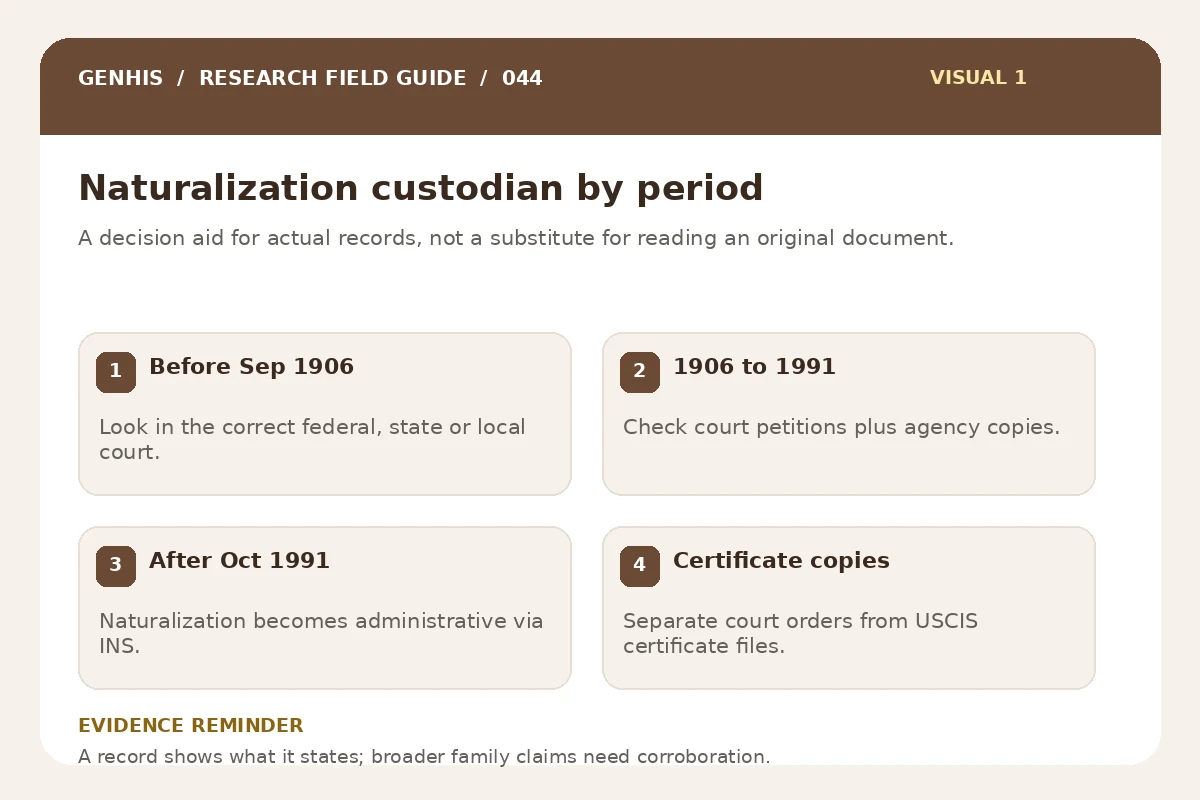
Prior to September 27, 1906, a range of courts of record could grant citizenship. As NARA explains, federal archives generally do not hold papers created by state or local courts, although selected donated or microfilmed material is an exception. Use historic courthouse directories, state archives finding aids and county clerks to identify the record series. Confirm court name, location, original jurisdiction and preservation status rather than assuming everything is in an online federal index.
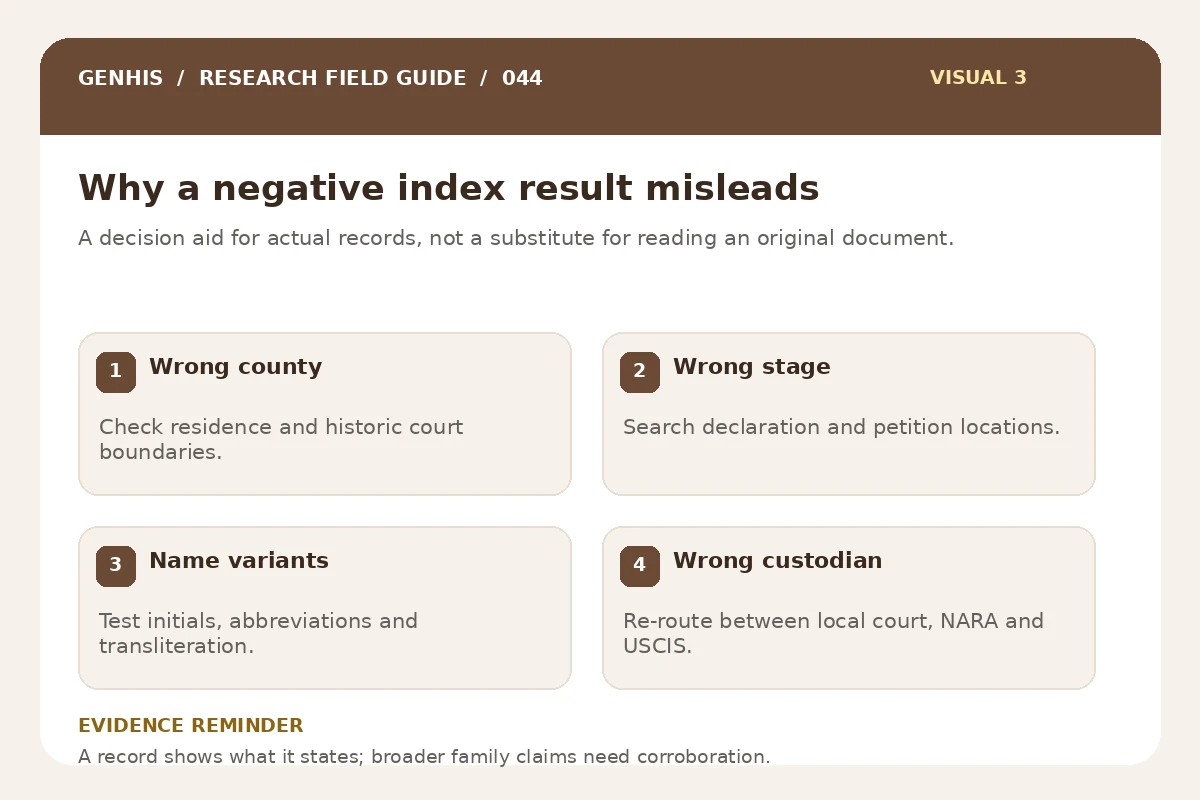
Look for both declaration books and petition or final-admission volumes. Indexes can be alphabetical only within one specific court or have gaps. Search spelling variations, initials and the person’s address or occupation when available. An entry for a name matching a later census could belong to somebody else; compare witness names, birthplace, family details or signatures where the documents supply them. Label unlocated records as a bounded negative within a specific court series.
Understand the post-1906 standardization and separate custodians
The 1906 change helped standardize naturalization forms and federal reporting but did not instantly put all proceedings into one database. Court petitions generally created before October 1991 can be in federal court holdings at NARA or in other courts that retained their own records. NARA often has declarations and petitions rather than the certificate issued to the new citizen. Certificates and related duplicate records from 1906–1956 can be represented in USCIS C-Files, and later agency series have their own rules. Our guide to USCIS genealogy program records goes deeper into what exists and how to request them.
For proceedings after October 1991, naturalization became an administrative function under the immigration agency, making the federal court archive an inappropriate blanket starting point. Always check the named court and the current NARA finding aid for its covered years. A statement that USCIS has certain records is not proof it has the exact historical certificate number you need. These are separate evidence and custody questions. For a step-by-step method, see how to find historical U.S. court records for genealogy.
Distinguish intention, petition, decision and certificate
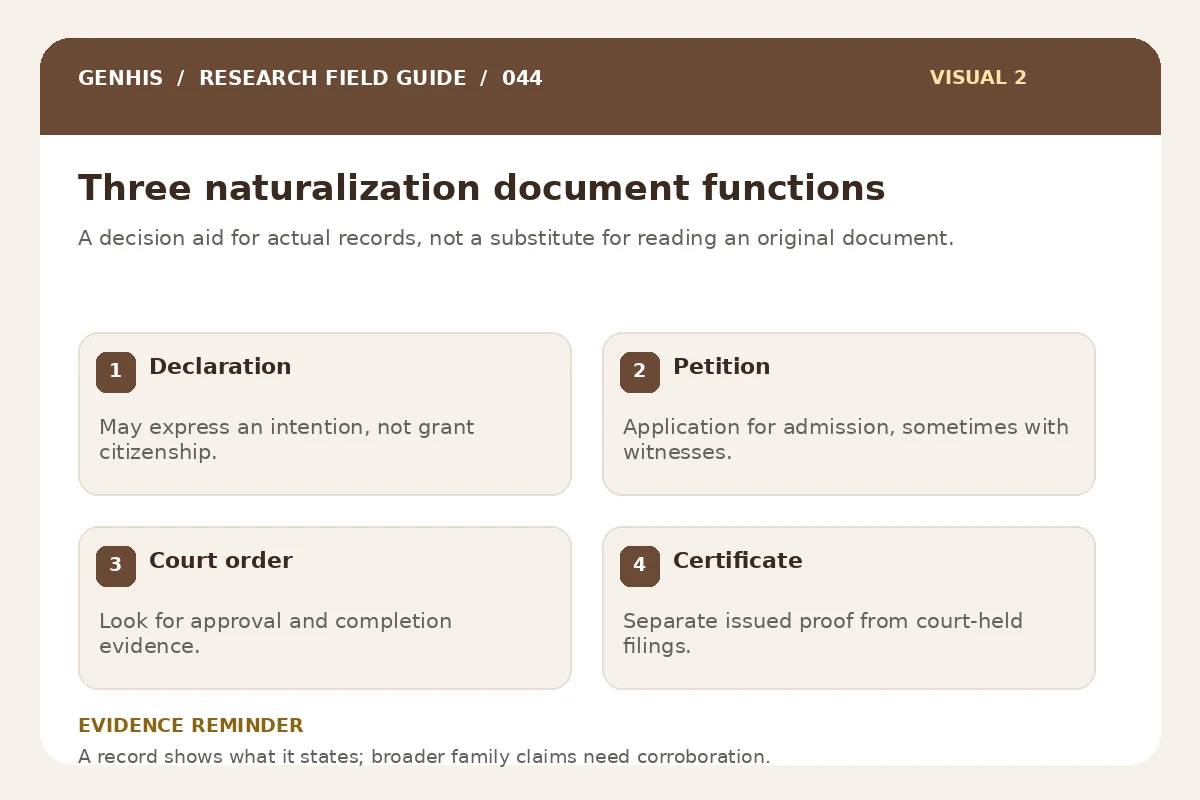
In a research ledger, create a line for each actual document: its date, court, document type, application or petition number, exact subject name and stated birthplace or arrival data if present. A declaration may show a wish to become a citizen, while a petition and later action can reflect the proceeding’s progress. A witness affidavit is not automatically an independently verified statement of every biographical fact. Do not label an unfinished petition “naturalized” just because an index names the person.
Consider the fictional case of Pavel Marin: a declaration is indexed in 1904 in one county, while a family story says citizenship was gained in 1912 elsewhere. The first finding cannot establish the second claim. Search the second court and period, look for a final order and compare identifying details. If the record remains missing, report the difference between the documented filing and the unsupported family tradition. The scenario illustrates evidence boundaries; it is not an historical person.
| Document | Typical role | What needs confirmation |
|---|---|---|
| Declaration of intention | Expresses intention to naturalize | Whether citizenship was later granted |
| Petition for naturalization | Formal petition and supporting details | Court judgment and applicant identity |
| Oath/order | Final court action where documented | Whether this is the same person |
| Certificate/C-File | Issued proof and federal agency copy | Which custodian retains a version |
Record what was searched and preserve responsible conclusions
Create a result note that identifies every repository, index, year span and document book examined, including negative searches. When obtaining a petition, cite its specific number, volume or digital frame. Transcribe names and dates exactly, with unclear readings marked, before reconciling spelling variants. Save a separate paragraph explaining why the petition appears to belong to your ancestor and the independent records used for that conclusion. A complete citation enables later correction if a second person with the same name appears.
Never state that the absence of a NARA file proves an ancestor was never naturalized. NARA explicitly limits the meaning of negative searches to the material it holds. Equally, finding a historical petition is not official proof of current citizenship for a descendant. Citizenship questions and document certification belong to the responsible agencies and qualified counsel. This page teaches historical source work and does not replace legal evidence required in present-day proceedings.
How We Research: jurisdiction, source provenance, and uncertainty
We compared NARA’s principal naturalization guide, certificate-history explanation and regional court descriptions, and used USCIS only for the distinct agency-file stage. The 1906 and 1991 changes affect both record format and custodial routing; we did not convert them into guarantees that a specific certificate survives. The Pavel Marin example is invented to show why a declaration and completed naturalization cannot be conflated. Historical laws concerning derivative citizenship also require period-specific review beyond a simple ancestry article.
Authoritative record sources and repository limitations
www.archives.gov — source guide. NARA details the 1906 and October 1991 transitions, court custody and document types. This repository statement identifies record types and filing boundaries, not evidence that a named petitioner became a citizen.
www.archives.gov — source guide. NARA describes standardized certificate files and the agency custody of duplicate naturalization documents. This repository statement identifies record types and filing boundaries, not evidence that a named petitioner became a citizen.
www.archives.gov — source guide. NARA regional guide outlines the varying courts and contents of naturalization records. This repository statement identifies record types and filing boundaries, not evidence that a named petitioner became a citizen.
www.uscis.gov — source guide. USCIS explains the distinct historical agency file service for relevant naturalizations. This repository statement identifies record types and filing boundaries, not evidence that a named petitioner became a citizen.
More Records and Archives Guides
Privacy, disclosure, and the limits of this guide
This is a genealogy records guide, not proof of naturalization, citizenship, lawful status or eligibility for dual citizenship. Historical courts and agencies have different access rules; redaction and certification requirements may apply. No federal agency is portrayed as a paid affiliate or sponsor. Consult the GenHis affiliate disclosure and current official instructions before sharing or requesting documents containing living-person data.
No. Before 1906, state and local courts also naturalized people, and they continued in some cases afterward. Start with the jurisdiction and its records.
No. A declaration may be an earlier step. Look for the petition, judgment or other evidence that the naturalization actually occurred.
NARA generally does not hold the certificate issued to the person. USCIS maintains copies in the relevant historical agency series for many post-1906 naturalizations.
No. A negative NARA holdings search only states that the searched facility did not find the record in its custody, not that no proceeding happened.
Historical derivative-citizenship rules varied. Do not impose one modern rule on another period; research the applicable law and independent family documentation.