
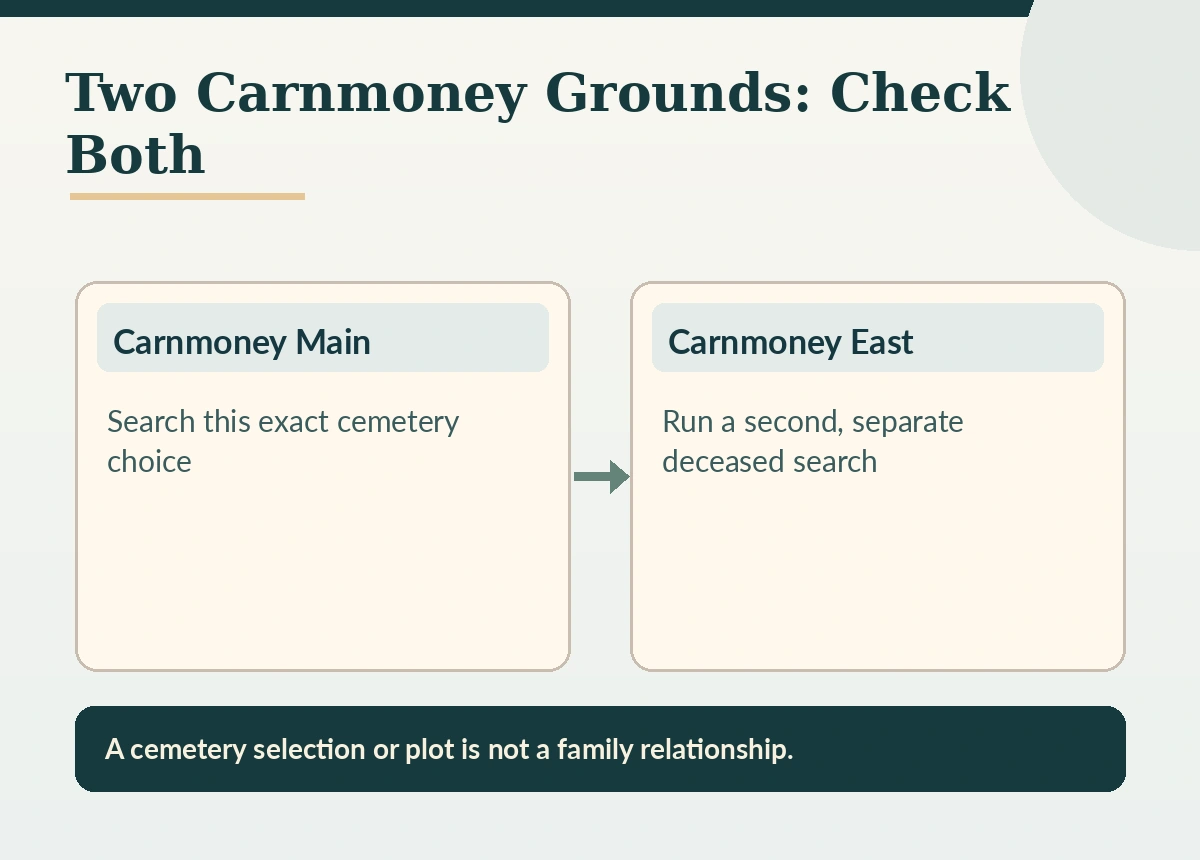
To find a burial in Carnmoney, start with the Antrim and Newtownabbey cemetery search and choose either Carnmoney Main Cemetery or Carnmoney East Cemetery. These appear as separate selections in the official portal, so a search confined to one can miss a relevant entry in the other. The database is a location aid that may include transcribed errors. It does not establish parentage, prove ownership of burial rights or guarantee that a headstone still exists.
Select Carnmoney Main or East before searching a surname
Open the portal’s cemetery selector and note the names of both Carnmoney Main and Carnmoney East. Run the search separately for each cemetery, especially when the family story merely says ‘Carnmoney.’ Record the chosen cemetery, spelling and date filters. Do not merge results from two similarly named grounds into one supposed family plot without an exact plot or interment reference.
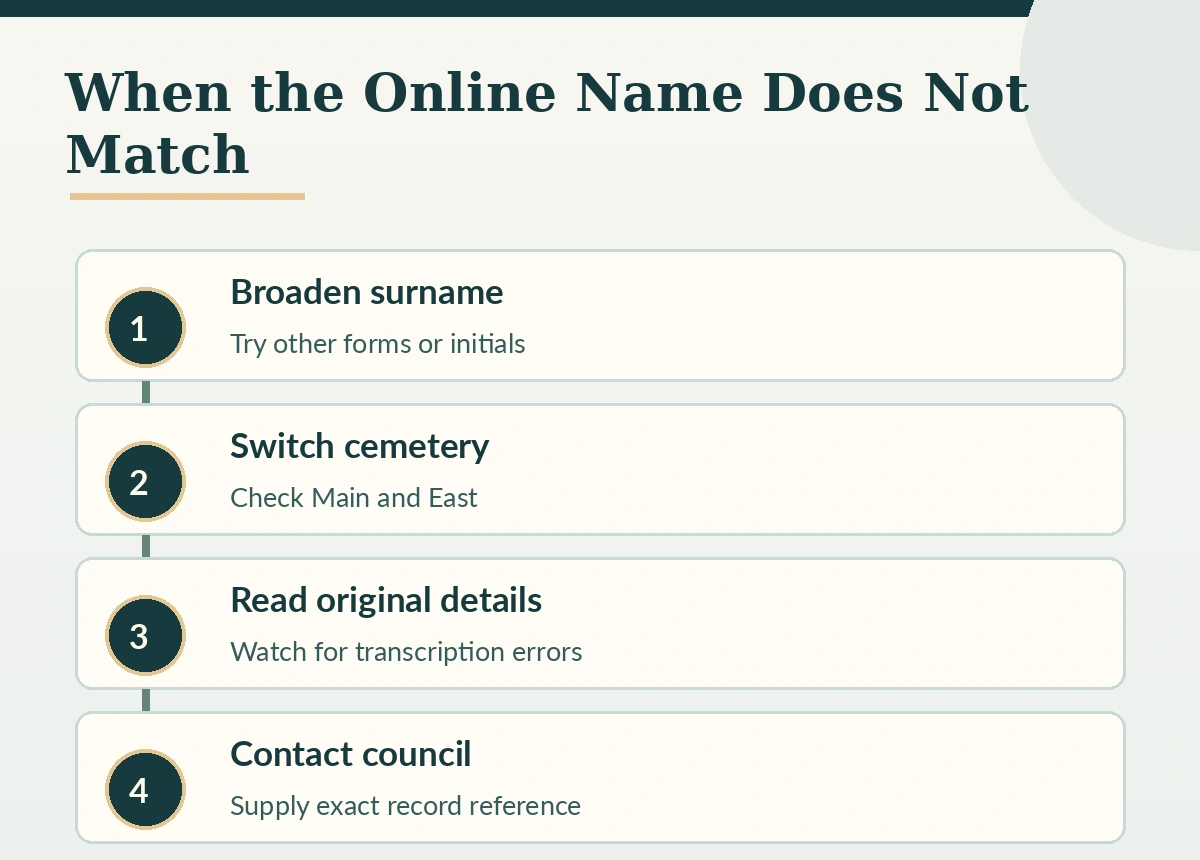
For a difficult surname, start with a short fragment or maiden-name possibility where the search permits it, then compare dates. Burial indexes may contain a legal name different from a family memorial inscription. Search variations of given names, double-barreled surnames and initials, and note whether the record refers to the deceased person or another person associated with a grave.
Read service dates and plot labels as separate fields
A deceased-search entry can help identify a cemetery and a burial or service record, with location details dependent on its completeness. Transcribe each date and reference as written. Do not automatically turn a service date into a death date: burial typically follows death and a record may use another administrative date. Locate which field the interface actually labels before adding dates to a family tree.
If a plot label is provided, preserve all letters, sections and numbers in order. A modern cemetery map is only useful when the plot identifier and the mapped section correspond. A matched surname at the same cemetery is not enough. If the map’s layout, a grave number or a service type is unclear, send the council the exact portal reference rather than relying on a guessed position.
Understand transcription errors in the public index
The official portal warns that errors may have occurred during transcription and describes an ongoing quality-check process. An absent result could mean a spelling error, record coverage gap or a restriction, rather than no burial. Capture a screenshot or transcribe the index entry accurately, then ask about the supporting record where a correction would materially affect the person’s identity.
The site provides a ‘Suggest an Edit’ option and a council cemetery contact for suspected errors. Use that route to report the original wording and corroborating evidence; do not alter the family tree silently and present your version as a corrected municipal register. Preserve both the original index transcription and the disputed reading in the research log.
Keep burial, grave space and commemoration distinct
A named deceased entry can be evidence of an interment or service, depending on what the source says. A plotted grave space identifies a location, whereas an inscription is a commemorative statement potentially added later. None of these by itself proves that another person at the same plot was a spouse or biological relative. Prepare separate claim lines for event, location and relationship.
A family member might be commemorated on a stone but buried elsewhere. Conversely an unmarked burial may be real even without a grave-marker image. Treat the presence or absence of a headstone photograph as a separate evidentiary problem and contact the cemetery for clarification before making an on-site search. For a related choice, see our guide “Limerick Gravestone Inscriptions”.
| Record | What it can establish | What it cannot establish alone |
|---|---|---|
| Carnmoney Main portal result | Recorded deceased candidate for Main | East Cemetery location |
| Carnmoney East portal result | Recorded deceased candidate for East | Kinship or grave ownership |
| Plot or mapped position | Specific location when confirmed | All people sharing a surname |
Use namesakes and addresses to test identity
If two people called John McAllister appear with plausible dates, compare each candidate’s age, recorded burial date and any address in the original administrative record. Then search civil death registration, a contemporary obituary or parish evidence as appropriate. A funeral notice naming a relative may help establish identity, but it is still a separate source with its own informant and possible errors.
Make a two-candidate table and state precisely which independent facts favor one entry. An approximate age can be wrong; matching surnames can be common across an extended family. If both candidates remain plausible, cite both cemetery records and keep the assignment open. The aim is a defensible conclusion, not a quick name-match count.

Use PRONI when a modern portal cannot answer
A cemetery search does not replace historic parish burial registers or civil death records. When the suspected burial predates the coverage shown in the municipal search, investigate the religious congregation and historical locality. The Public Record Office of Northern Ireland (PRONI) holds many earlier archival series, but existence and digitization vary by congregation, place and period. Our guide “Glasnevin Cemetery Records” covers a related question.
Identify the parish and burial jurisdiction before looking for substitute records. A place with a similar name elsewhere in County Antrim may not be the correct cemetery. Note any negative council search and follow it with targeted church, civil-registration or newspaper evidence instead of concluding that the ancestor did not die in the area.
Preserve a cemetery-specific citation and careful conclusion
Cite the operator, exact cemetery name, indexed deceased, event or service date as shown, plot or section code, record URL or identifier, and date accessed. If the portal offers no permanent entry URL, save sufficient search details for another reader to reproduce the lookup. Any corrected reading should be cited to supporting documents separately.
An appropriate conclusion may be that the council’s online database places a named individual in Carnmoney East with a particular record reference, while a claimed relationship to another plot occupant is unproved. Follow that conclusion with one next record to inspect. It is better to have a precise burial hypothesis than a false family group assembled from nearby graves.
More Records and Archives Guides
How We Research Carnmoney Records
We checked the Antrim and Newtownabbey search portal’s selectable cemetery names, its warning about ongoing transcription corrections, and Northern Ireland archival guidance for older records. The site makes different claims about location, transcription and historical sources; our workflow respects that distinction. We do not invent grave numbers or genealogical relationships. If you need to consult paid services, review current terms independently. Our site’s policy is at affiliate disclosure; no specific provider is endorsed here.
No. The official portal lists them separately. Check both when an older family reference says only Carnmoney.
No. It identifies a place or administrative reference, not a biological or legal relationship. Verify family links using independent records.
Keep the original indexed text and report the suspected transcription error through the portal or council contact, with evidence supporting a proposed correction.
Only if that date is explicitly identified and supported. Burial or service dates should not automatically be described as dates of death.
Try both cemeteries and spelling variants, check the portal coverage, then consult appropriate historic church and PRONI records for the right period.