
QFA 1 is The National Archives’ Digitised Seals Register, a digital form of its seals card index. The Archives specifically advises beginning by seal category, not assuming you can first search the entire register by a personal name. A card can point to the owner, the seal design, and the dated document to which an impression is attached. It is a finding aid: the card is not itself the charter, deed or proof that two people sharing an emblem were relatives.
The most reliable result is a chain from category to register card, from card to the parent document, and only then to a cautious identification. Seals can carry a name or title in a surrounding legend, but they were also borrowed, reused, and occasionally anonymous. That means an attractive heraldic impression is not a shortcut to a pedigree. Write down the iconography and inscription you actually see, and compare them with the text and context of the document bearing the seal.
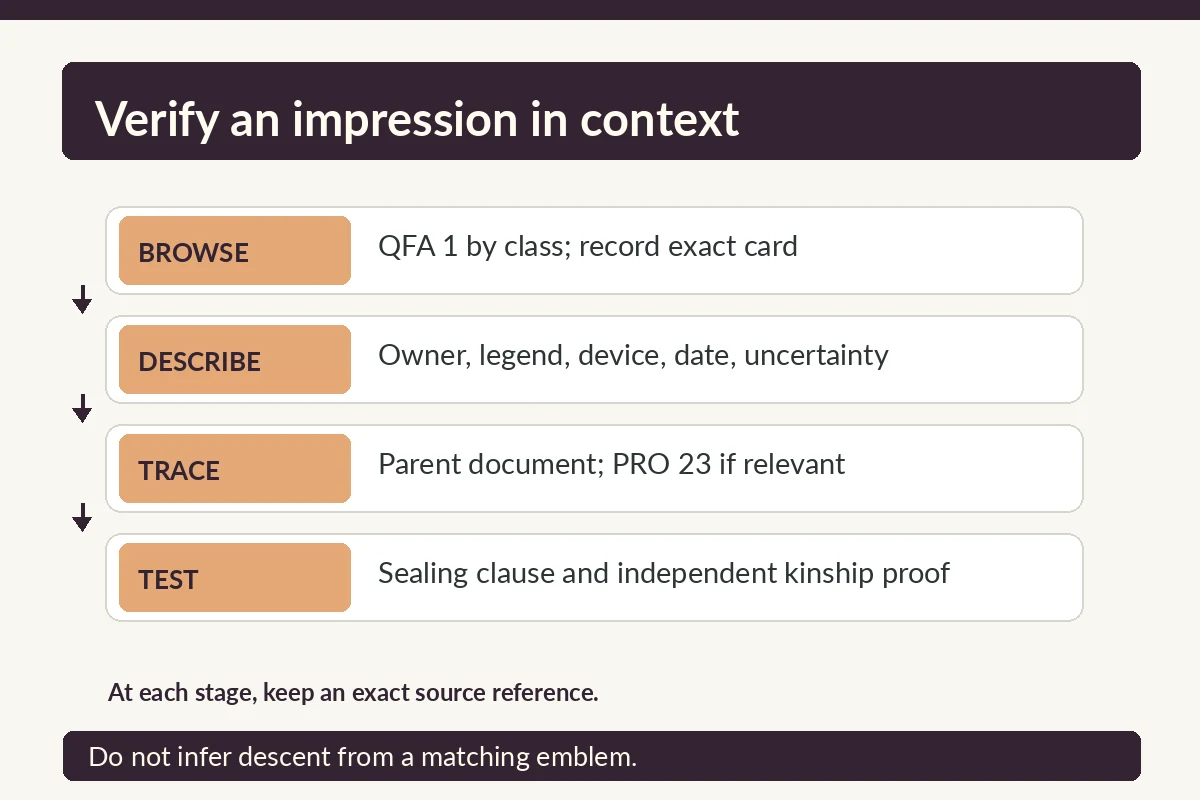
Search by seal category before personal name
The Archives recommends a category-first search in QFA 1. For royal material it gives ‘England’ and ‘Sovereign’ as an example; the retrieved cards can then be browsed in the chronological sequence of reigns. Other groupings include ecclesiastical, monastic, local, official and different forms of personal seals. Decide whether you seek an individual’s emblem, the seal of an institution, or one used by an office before choosing the category.
For a layperson, consider the register’s personal armorial and non-armorial divisions, including separate men’s and women’s categories, and equestrian impressions where relevant. A person who held an office may also appear under that office. Do not presume that a modern surname search will surface every suitable card. Save the precise query, the category and the card reference or download, so another researcher can retrace the browse route.

Extract the card fields and describe the device
The Archives explains that its seal cards can describe the named owner, date of the associated document, color, shape, size, device and legend, with additional remarks. These fields help differentiate similar impressions, but each should be transcribed as a card statement until the original object is checked. A shield, figure or equestrian scene is a useful visual identifier, not an identification of every later wearer or family bearing similar heraldry.
Keep the impression’s physical features separate from your interpretation. Record which side is the obverse or reverse if the source distinguishes them, whether a counterseal is present, and any legible wording. If a portion is missing or illegible, mark it uncertain rather than supplying the expected heraldic label. A modern catalogue paraphrase can help you find a card; your citation should make clear whether you inspected the image or relied solely on its summary.
Follow the card to its parent document
The crucial field is often the reference to the document bearing the seal. Use that archival reference to find the associated charter, writ, letter or other instrument. Read the names, action, date, witnesses, sealing clause and any explanation of whose seal was used. A seal on a conveyance can authenticate that document’s form; it does not by itself prove the instrument was completed as intended or that the parties belonged to one family.
The Archives also points to seal moulds in PRO 23, which can show clearer impressions and include a reference to the original document. Mould photographs may reveal a device obscured on a surviving impression, but a mould is a later record of an object, not an interchangeable original. Compare the card, the mould if one exists, and the parent instrument with all their separate references intact.

Avoid borrowed seals and heraldic family leaps
The Archives’ glossary explicitly notes borrowed seals and ready-made anonymous seals. An owner could use another person’s matrix, and more than one person could use a similar design. Where the document’s sealing clause mentions a borrowed seal, that wording matters more for identifying the act than a modern assumption based on the motif. If an anonymous seal bears no owner name, resist assigning it to the nearest surname on a deed without further evidence.
A heraldic design can be a clue to status or affiliation, but equal devices do not establish biological descent. Test the supposed kinship against independent dated deeds, probate evidence or other records that explicitly link named persons. Keep the seal-holder, the party who borrowed a seal and the relatives mentioned in the text as distinct roles. Where the chain is incomplete, state ‘attributed’ or ‘possibly associated’ and specify who made the attribution.
Cite three layers of seal evidence accurately
An auditable note has at least three potential references: QFA 1 card, parent document, and any separate PRO 23 mould image used for comparison. Include the document date as written or catalogued, category used, card details and any uncertainty in the legend. If the parent document is not available online, describe the access route indicated by the catalogue instead of implying you inspected the seal. Images of some seals and moulds are online, while others require archival consultation.
Conclude with a bounded claim such as ‘the QFA 1 card attributes an impression on [document reference] to this named office or person.’ You may strengthen it if the parent document’s text and the seal agree. Do not conclude that another identical surname, coat of arms or later owner is descended from the seal user unless separate genealogical evidence supports the relationship. The careful distinction preserves both the seal’s historical value and the family’s accuracy.
More Research Method Guides
How We Research and Verify These Records
This guide uses the record-series descriptions and the boundaries explained in The National Archives guide Secondary archival guidance. The sources identify the kinds of documents, their arrangements and possible access routes; they do not certify any particular ancestor, institution or map as independently inspected. Check each original item and the current catalogue access status before quoting a detail as a documentary finding.
We separate a catalogued lead from an original document, an administrative statement from an event, and a possible identity from a proven link. Historical names, jurisdictions and date ranges can be uncertain; missing entries are not negative proof. Reader information is editorial, not a claim of professional archival representation. Review our affiliate disclosure before following any commercial material on the site.
No. The National Archives instructs researchers to begin with seal categories, then browse the digitized card images.
No. Heraldic similarity is a clue, not proof of biological descent; compare independent dated family records.
It leads from the seal card to the original charter, letter, deed or other document on which the impression appears.
It may provide a clearer comparative impression and a parent-document reference, but it is a separate later visual source.
Read the sealing clause and card notes; preserve uncertainty and do not assign a personal identity from the device alone.