
KB 27 contains the King’s Bench plea rolls, often called Coram Rege rolls, from 1273 to 1702. They record many civil and Crown proceedings, but a name or procedural entry is not automatically a judgment. Start with an approximate date and court term, a county and the kind of action; then inspect the relevant section of the roll and follow later terms if necessary. The National Archives warns that many rolls have limited indexes and use abbreviated Latin. Its King’s Bench research guide gives the key route for navigating terms, docket books and rotulus numbers.
Choose KB 27 Before or After the Court’s Split
The important chronological gate is 1702. KB 27 holds rolls of both the Plea side and Crown side up to that point; later material split into separate series, including KB 122 for civil pleas and KB 28 for Crown business. Do not search a nineteenth-century case in the medieval series simply because a later source calls it King’s Bench. Identify whether you need a civil action between parties or a prosecution involving the Crown, as that affects the section and possible supporting records.
Record the court term—Hilary, Easter, Trinity or Michaelmas—rather than relying only on a calendar year. A legal term can span an unfamiliar dating convention and the same lawsuit may surface in more than one term. In the absence of a term, use an independently dated deed, newspaper report or later legal document to establish a range. A pedigree that quotes only a surname from a roll is inadequate evidence of identity without place, case and date.
Understand the Plea Side and the Rex Section
The rolls can contain civil pleas, fines and forfeitures, Crown pleas in a Rex section, and attorney-related business. A civil appearance or an entry about an attorney does not show that either side prevailed. The National Archives describes the formulaic Latin and standard procedural phrases that can obscure whether the case reached a hearing. Before summarizing any entry, identify which section it occupies and whether its language reports a claim, a procedural step or an actual legal conclusion.
Build an evidence table with the parties, county heading, term, rotulus and action. Transcribe legal words that signal continuance, default or further process instead of forcing every line into ‘won’ or ‘lost.’ If a defendant appears with an occupational description or parentage, consider whether those words are distinctive enough to identify the same person in other records. Some personal details function as court identifiers, not proof of a broader family history.
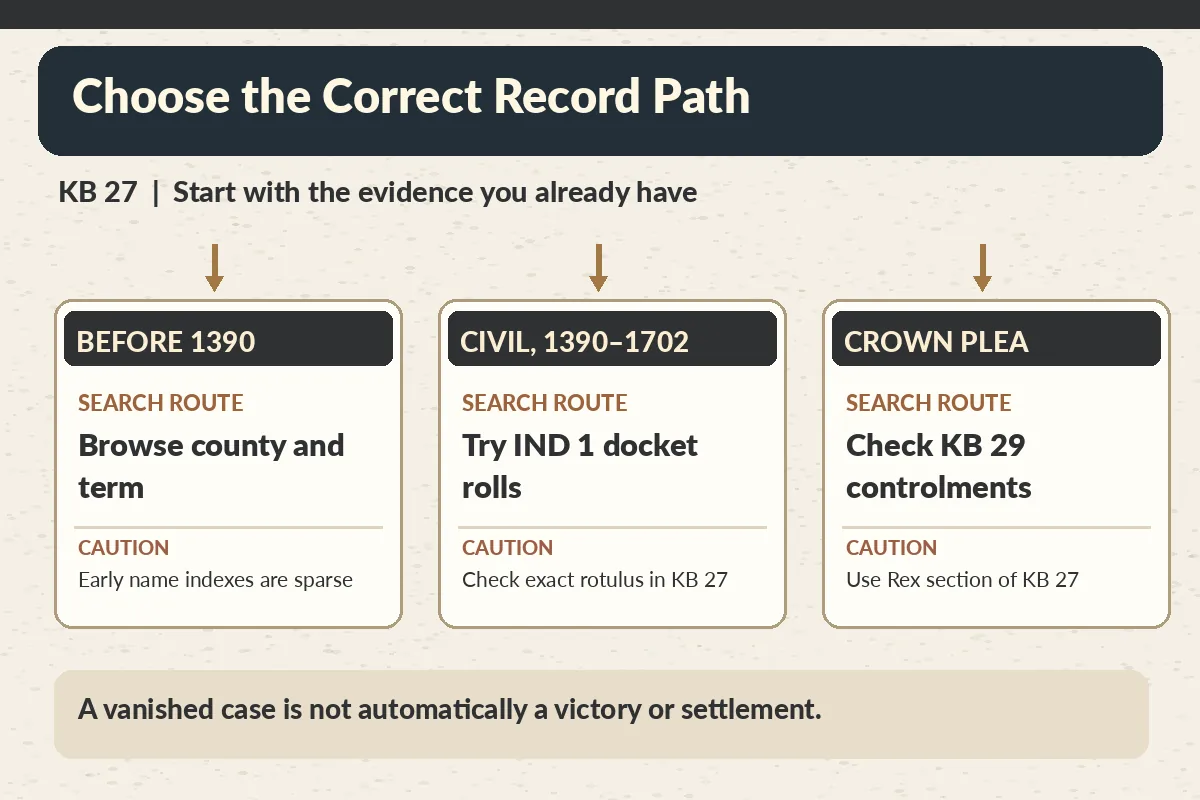
Use the Correct Finding Aids for the Period
For many earlier rolls there is no complete name index. The official guide advises browsing by county and date or using surviving writs as partial cross-references. From 1390, docket rolls offer more extensive assistance for civil pleas; IND 1 contains several relevant groups of docket books. For Crown material, controlment rolls in KB 29 can point back to KB 27 rotuli. The choice is conditional on date and side of court, not a universal chain that everyone must follow.
Selected online indexes made from photographed rolls can accelerate a search, but their coverage is selective. Treat a search result as a pointer to the original term and rotulus. Keep spelling variants because medieval clerks Latinized personal and place names. If your surname search fails, try the county and dated term rather than announcing that the case never existed. A missing online index entry may simply reflect an unindexed roll.
Trace the Same Case Across Multiple Terms
A single entry may be a continuation rather than the beginning or end of a proceeding. Once you identify the parties and action, trace backwards for the initial complaint and forwards for a disposition or for the point at which a case disappears from the surviving rolls. Record each term and precise rotulus separately. A cross-reference is especially valuable when the handwriting or county heading changes. Do not combine two similar cases merely because the plaintiffs share a common name.
A case that disappears from the record may have settled, lapsed, moved procedurally or simply escaped detection. The survival and indexing of files are uneven, so the absence of a later entry is not evidence of acquittal or settlement. A documented final judgment should be quoted or carefully summarized with its actual citation. The threshold for claiming the outcome is higher than the threshold for establishing that litigation happened.

Work a Civil Debt Example Without Assuming Liability
Suppose a 1480s county entry names a merchant and a neighboring landholder in a debt plea. Note that the roll records an action; then use the term, county and rotulus to locate its place in the docket material if available. Search next-term rolls for the same parties and transaction, not just for the same surnames. If an entry describes an appearance and grants time, the court has not necessarily decided liability. Document that procedural posture plainly.
To connect the litigants to a family, compare residence, trade, dated land deeds or probate evidence. A merchant called William Brown in one court could be different from an identically named person in a parish register. The evidentiary goal is twofold: establish what the court record actually says and independently establish who the named participants were. Even a sound identification does not turn every allegation into a proven debt.
Preserve the Latin, Reference and Research Limits
Cite KB 27 with the piece number, court term and individual rotulus, not simply ‘medieval plea rolls.’ Record the edition or transcription consulted and correct it against the image or original when possible. Note where the original is difficult to read, where an abbreviation is uncertain and whether a published summary silently modernizes terms. Do not fabricate a complete quotation from a short catalogue abstract or presume that digital images cover every relevant membrane.
Your final conclusion may be that an action is documented in one term and no judgment has yet been found. That is a positive finding with a known limit. Give future researchers the county, term, side of the roll and next candidates to search. Such a record can be valuable for a family’s geographic and legal context even when it provides no proof of kinship or the outcome of the dispute.

More Records and Archives Guides
How We Research and Verify This Archive Series
Our source check starts with The National Archives research guidance and a second reference, this complementary finding aid. We record the original series, piece or item, date, creator and access method before making a personal or legal inference. Documented statements and independently corroborated outcomes are separate categories. Where a file is missing, unindexed, closed or not inspected, we say so rather than manufacturing negative evidence. A cited catalogue lead does not mean we have seen every folio. For disclosure of any commercial relationships, see our affiliate disclosure.
The principal King’s Bench plea roll series runs from 1273 to 1702.
No. Coverage is limited and many searches require term and county browsing.
No. It may record a claim, appearance or other step before any decision.
Use the Rex section and appropriate controlment material such as KB 29.
The KB 27 piece, court term, side and rotulus where known.