
King’s Bench Pleadings J 54: Read a Titanic Claim Without Treating It as a Verdict starts with a distinction often missed in family and local history research: an archival entry describes a particular document or administrative act, but does not automatically establish every related event. Use the official series research guide to select the correct record, then check the related source guidance before extending the conclusion. The steps below identify what J 54 Kings Bench pleadings can show, what it cannot show, and which independent reference could resolve uncertainty.
Understand What a Preserved Pleading Actually Is
J 54 contains preserved civil-court pleadings, including King’s Bench Division matters in the High Court of Justice. Pleadings formally describe claims and defenses. They are not a complete transcript of a trial, a bundle of every witness statement or proof that one party’s account prevailed. The National Archives points researchers to J 54 for cases in the main 1880–1942 period and notes the digitized Titanic-related pleadings as a particularly accessible example.
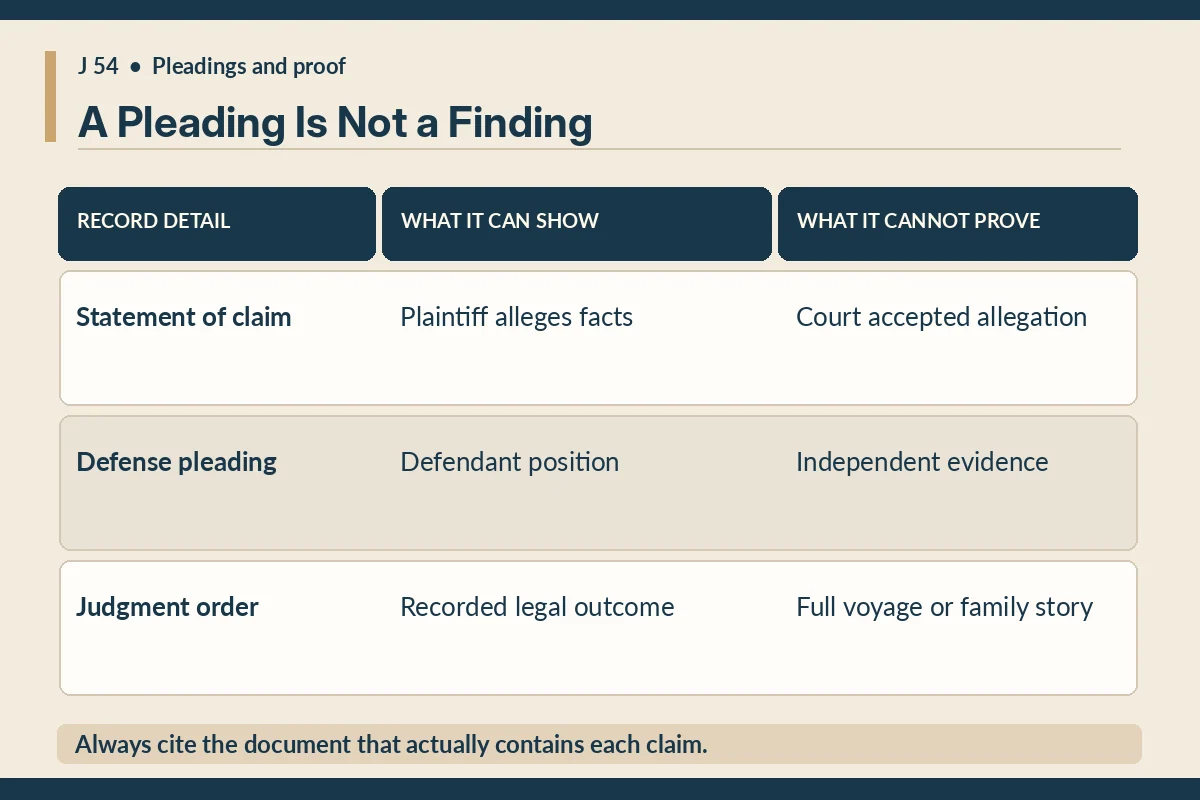
This matters in family history because a plaintiff’s statement may mention relatives, occupations, addresses or an alleged loss. Such detail is valuable evidence that a claim was made under a particular name, but the narrative can be contested. First label every passage by its procedural role. Keep the parties, dates, claims, defense and order in distinct parts of your working notes rather than turning allegations into established facts.
Search by Filing Period and Plaintiff Name
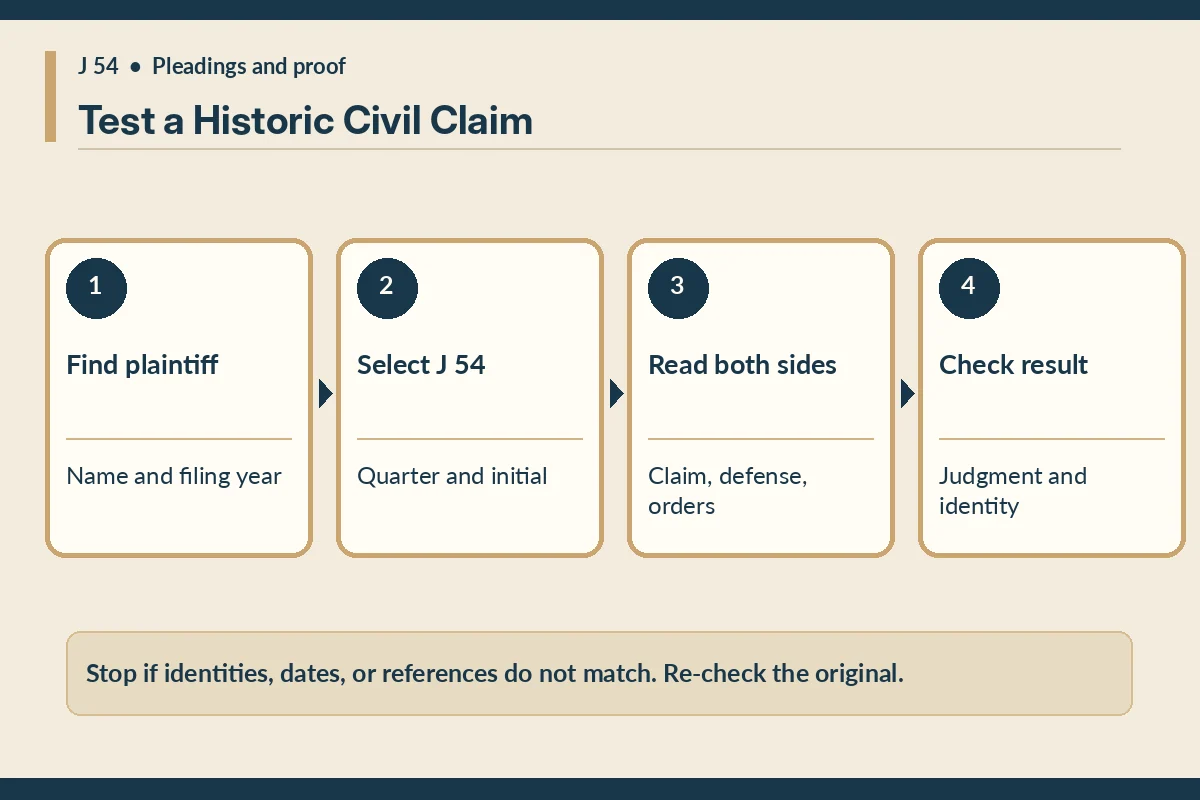
The official King’s Bench guide describes J 54 pleadings from April 1880 to 1942 arranged in quarterly groupings and alphabetical ranges under the plaintiff’s surname initial. The catalogue may show a reference covering a letter span rather than one person. Search by year, then browse by archival reference and locate the appropriate plaintiff range. Searching for the defendant alone may miss the relevant description.
The filing arrangement reflects court administration, not necessarily the date of the incident. A tragedy, contract dispute or alleged injury may have occurred earlier than the filing. Record the relevant quarter and piece reference, then distinguish the incident date, date of claim and judgment date. If a matter falls outside the J 54 period, consult the guide’s alternative series instead of squeezing a case into an unsuitable date range.

Read a Titanic Lawsuit as Opposing Positions
Civil actions associated with the sinking of Titanic provide a clear test. A claimant may allege negligence or loss, naming a person who died and asking for damages. The allegation proves the legal position presented, not independently the cause of the disaster, a personal relationship or the amount ultimately awarded. Search for a defense and a judgment order before summarizing the legal outcome.
If a pleading describes a passenger as a son or employee, compare the claimed relationship with civil registration, a passenger list or other independently created record. Litigation language is often precise but may be written to satisfy particular legal requirements. It is not a substitute for a birth certificate or a complete employment history. The same caution applies to every historic civil pleading, not only a famous maritime case.
Distinguish Formal Pleadings From Witness Evidence
A statement of claim describes what the plaintiff says happened; a defense may admit part of it, deny another part or raise legal arguments. Sworn depositions and exhibits are distinct types of material and may not survive alongside pleadings. Do not cite a party’s formal allegation as a direct eyewitness observation unless the text explicitly establishes that basis and the relevant evidence has been assessed.
To compare documents use columns labeled author or party, date, assertion, and recorded procedural status. A defense that disputes negligence is evidence of a denial, not proof of due care. A judge’s order may resolve a claim without settling every factual question a modern family historian has. Search for judgments or orders where available, and describe any gaps instead of inventing a full trial scene.
Check Which Court and Series Applies
Procedural changes in the late nineteenth and twentieth centuries affect where records survive. The National Archives guide places some earlier pleadings in J 55 and other King’s Bench materials in KB 16. J 54 also includes many Chancery Division pleadings, so the existence of a piece in this series does not identify the division by itself. Read its heading, court and case type.
An action concerning an estate, company or personal injury may have several parallel records. Record the exact court division rather than calling every J 54 file a King’s Bench prosecution. Civil pleadings are not criminal indictments. They have different parties, standards and outcomes; a family tree that describes a civil defendant as “convicted” without criminal proceedings has made a serious category error.
Test an Uncertain Identity From the Case Papers
Imagine a pleading identifies a John Davies as a claimant following an incident at sea. A family album shows a John Davies from Liverpool. The shared name does not establish they are the same person. Write an identity table with age, address, occupation, relationship to the incident and dates for each record. Look for the features that distinguish one man from other plausible candidates.
Where the claim mentions a dependent or a deceased passenger, confirm that relationship separately. A surviving case file might be rich on alleged damages yet silent on birthplace. Conversely, a civil certificate may establish family ties but not the legal outcome. The reliable conclusion states what each source shows, marks contradictions and names the missing record needed to bridge the two narratives.
More Records and Archives Guides
How We Research Historic High Court Cases
Our process selects the right court, year and plaintiff-initial range; reads original J 54 pleadings; separates statements of claim from defenses; and pursues available orders or judgments. We preserve distinct citation dates for the incident, filing and recorded outcome. This protects historic legal accounts from the common error of treating a pleading as proof of the disputed event.
We use The National Archives court guides to establish search arrangement and record purpose, not as stand-ins for original case papers. Digital availability varies by piece. We do not claim every case is fully digitized or every pleading has an accessible judgment. For transparency about linked services, read our affiliate disclosure.
The National Archives guide describes the main King’s Bench J 54 pleadings from April 1880 to 1942, with some separate later samples.
Usually by year and quarterly period, then initial letters of the plaintiff’s surname; browse the relevant alphabetical range.
Yes. The National Archives notes that King’s Bench pleadings relating to Titanic were digitized.
No. It records what the claimant alleged; the defense, evidence and final outcome must be examined separately.
No. Pleadings set out formal positions; sworn evidence and other documents can survive separately or not at all.