
What a Federal Seed Request Really Documents
The Office of Congressional Seed Distribution supplied seeds to constituents of members of Congress. Its archival records belong in Record Group 54, which covers the Bureau of Plant Industry, Soils, and Agricultural Engineering and predecessor offices. A dated seed request can show that a person or correspondent asked about a distribution, but not that the person cultivated the seeds, owned the land, or even received a parcel. Begin with the exact name, address, date, and wording that appear in the actual request rather than a family story about a prosperous farm.
The NARA Guide identifies the office as established in 1902, after earlier seed work in the Division of Seeds, and says the program ended in 1923. It lists overlapping material from the predecessor era. Those transitions explain why an 1890s receipt might appear in the same institutional history as a 1910 congressional distribution. Do not impose the 1902 office name on earlier documents as if the same administrative arrangement operated unchanged. The precise record series and its creator are part of the evidence.
Choose Requests, Purchases, Distribution, or Receipts
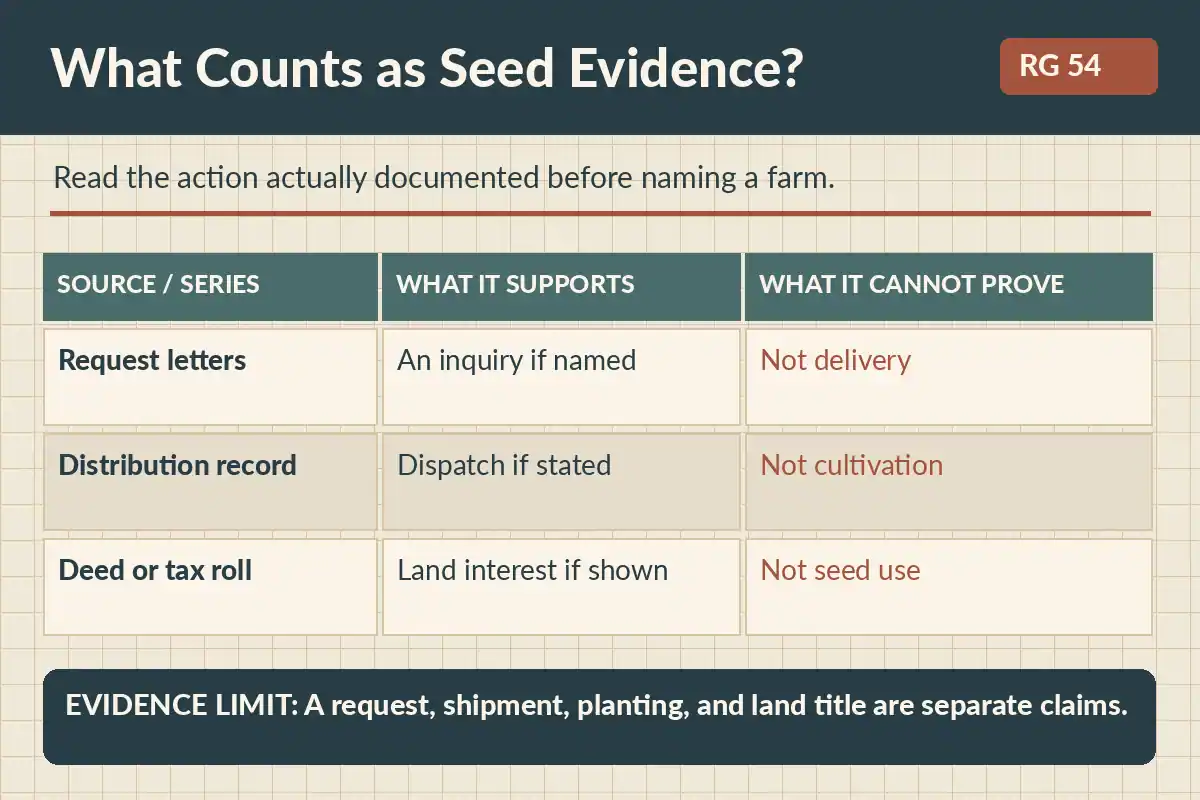
Section 54.3.9 gives several separate ranges: correspondence on requests for seeds and plants, 1904–1908; a Record of Congressional seed distribution, 1901–1923; seed purchase records, 1891–1916; and a receipt book for congressional seed distribution, 1886–1900. The categories describe different administrative actions. A seed purchase entry could identify a government supplier and quantity, not an individual constituent. A request could precede a distribution and still fail to prove delivery. Treat the later distribution ledger as the place to investigate dispatch only when the specific entry supports it.
Select the series according to the wording of the family clue. For a letter asking a representative for vegetable seeds in 1906, search incoming request correspondence and then look for the period in the distribution record. For a story about supplying seed to the government, start with purchase material rather than the constituents register. For an 1895 acknowledgment, the earlier receipt book may be more relevant than the later office files. Make a request-to-shipment worksheet: source, date, named sender or recipient, action, and whether a second document explicitly connects them.

Decode a Mailing Address Without Overclaiming a Residence
A constituent might use a post-office address that served a wide rural area; the stated place is not automatically the legal township of a farm. Keep the full original address including county, post office, and any routing abbreviations. Then consult the appropriate contemporary postal guide, county map, or local directory. Where a town name changed, document the change rather than silently updating the address. In an account of agricultural work, the distinction between where mail was received and where land was cultivated is central.
Do not let a unique-looking surname make the identity certain. An adult woman could request seeds, a school could seek seeds for a garden, and a household might use one person’s name for correspondence. The register entry itself has to establish the role. Census occupation, an agricultural schedule where available, tenancy agreement, tax assessment, or recorded deed can address different claims about farming. A document showing someone received seeds proves only the event stated there; a surviving field or garden cannot be identified from the mailing address alone.
Understand the Different Meanings of a Quantity
Record the unit whenever a list states seed quantity: packets, varieties, pounds, lots, or requisitions cannot safely be compared without a key. The same numbered entry might be an office transaction identifier rather than the count of seeds delivered. If an abbreviation is unclear, examine the heading and preceding pages of the physical volume instead of guessing from a cropped image. National registers often summarize a congressional allotment at the level of a district or member of Congress; such a summary may omit the final named recipient altogether.
The Office of Congressional Seed Distribution also left policy correspondence, 1901–1908, and procurement records. These can explain how the program functioned, but a general rule does not tell you that a particular request complied with it. If the distribution record has no field that can be tied to a named person, the honest conclusion is that it documents the program rather than an individual event. Preserve that distinction in captions for family photographs and in the notes beside later farm documents.
Test a Family Farming Claim With Outside Evidence
Suppose a family remembers that an ancestor received free seeds in 1907 and built a commercial nursery. The correspondence might document a request; a distribution register might document an administrative mailing; neither proves the nursery existed. A local business directory, dated advertisements, land-use tax record, or nursery invoice could test the commercial claim. The records should align by place and year, not merely share a surname. If a contemporary directory identifies two households with the same name, list both as candidates until an address or occupation separates them.
Use a chronology with distinct verbs: requested, listed for distribution, recorded as received, cultivated, sold, and owned. Never replace those verbs with a single claim such as “farmed here.” A seed packet might be a keepsake from a school project or a household garden. If there is no receipt or independent evidence for delivery, say “the record documents a request” and stop there. The strongest family history is often one that identifies exactly which part of a long tradition has been corroborated.

Cite the Correct Office and Plan a Focused Search
Ask NARA about RG 54, section 54.3.9, naming the Office of Congressional Seed Distribution and the particular series, approximate year, and postal address. Include the exact variant surname or representative’s district if it appears in your evidence. Ask whether the described volume has a name index, how its entries are arranged, and whether it is accessible online or only on site. The 1995 Guide-level inventory does not establish digitization for every page, and a broad Catalog hit does not mean every person in that series is indexed.
Save the repository, record group, series title, volume, page, date, and original spelling of the subject. If you used a later government pamphlet to understand program procedure, cite that separately as context; RG 287 government publication holdings are not substitutes for the operational RG 54 registers. If the search fails, identify the exact years and volumes checked. A missing name in the surviving ledger means no match was found there, not that a constituent never obtained seeds from any source.
More Records and Archives Guides
How We Research This Archival Question
We reviewed the official RG 54 archival series description and checked the date spans and record types in the source against every decision shown in the accompanying explanations. We also used a second institutional source for the historical or collection-specific distinction. These are descriptions of archival holdings and practices; they are not evidence that a particular person, building, design, or vessel was present. We did not infer complete series survival or universal digitization from a collection heading. The evidence table marks what remains to be verified in an individual record.
For the research and citation workflow, we checked NARA’s Catalog guidance, which distinguishes record groups, series, file units, and individual items. Researchers should use current Catalog entries and repository staff to confirm custody, availability, exact date coverage, and restrictions because the printed Guide to Federal Records is a historical overview rather than a constantly updated item inventory. All reader-facing images on this page are original explanatory illustrations, not scans of original archival objects. We have not confirmed any paid partner referral; the site’s affiliate disclosure states the general policy.
NARA dates the office from its 1902 establishment through the program’s 1923 termination, while listing predecessor material from earlier years.
No. Request correspondence documents requests; the relevant distribution or acknowledgment evidence must be examined separately.
Yes. RG 54 describes a congressional seed distribution receipt book for 1886–1900.
No. A recipient address and agricultural property title are independent questions.
The broad archival description does not guarantee item-level digitization; check the current Catalog and custodian.