
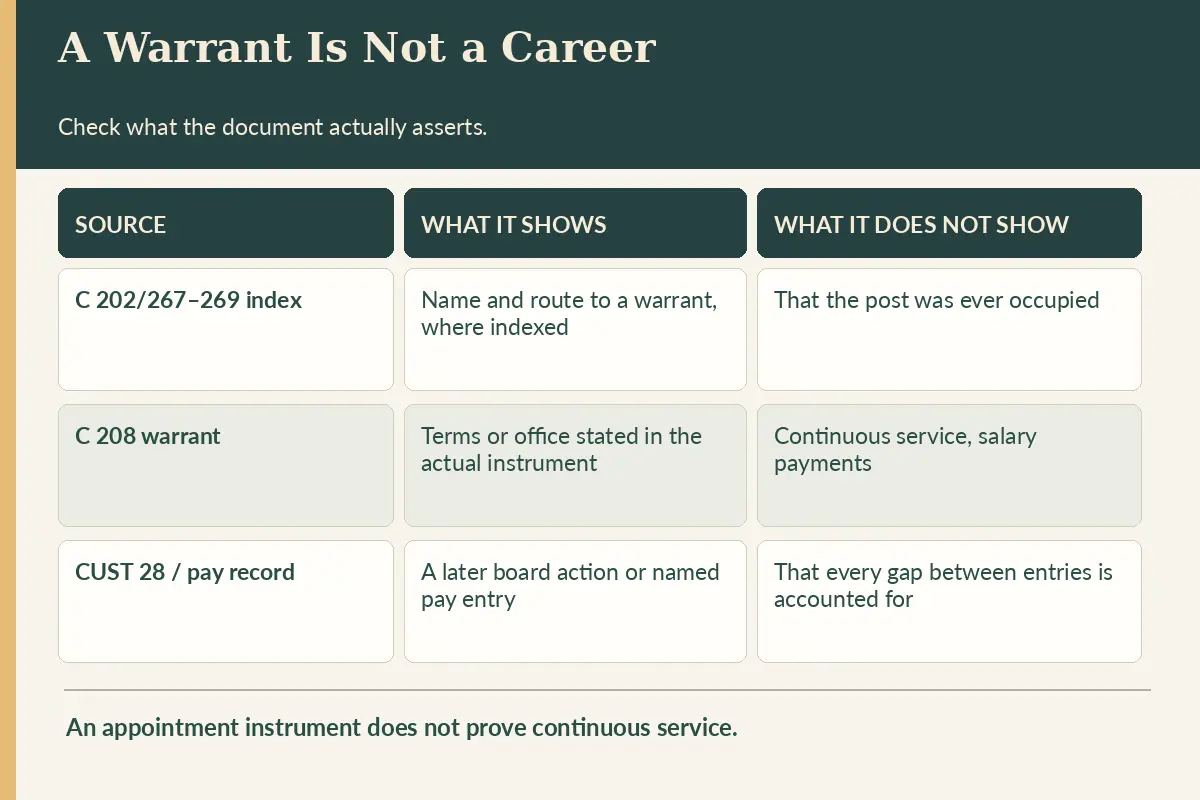
The National Archives identifies a specific route to warrants for the appointment of Customs officers between 1714 and 1797: search the indexes in C 202/267–269 and use their references to locate the warrants in C 208. A warrant is evidence of an official act naming an office or proposed appointee, not a biography of the officer. It does not by itself prove that the person took up duties, stayed for a particular number of years or received every salary payment.
This is a different task from searching Customs Board minutes. The official Customs officers research guide explains that CUST 28 records events affecting existing officers, such as leave, transfers, suspension, dismissal and pension, but not their initial appointments. Start by deciding which event the family story alleges. Do not search the longest-running series merely because its dates look convenient.
Separate an original appointment from a later career event
Write a one-sentence question before searching: “Was Thomas Example formally appointed to a Customs position at a named port in 1762?” Do not replace that with the broader claim that he served there for thirty years. An original warrant could be followed by a move, a cancellation, resignation or another office. The index is only a pointer. Capture both the historical spelling of the office and the town, and do not assume that a modern port boundary reflects eighteenth-century administration.
Build an identity profile from independently dated information: approximate birth, residence, occupation and known associates. A warrant entry naming “John Williams” is weak identification without a distinctive locality or contemporaneous supporting document. Keep separate candidates if the name recurs. If a family history reports a promotion rather than an initial appointment, use the warrant route only where the document actually records the relevant act.

Use C 202/267–269 as a finding aid to C 208
The National Archives specifies the particular index pieces C 202/267–269, not the whole C 202 series as a universal name database. Check the index’s alphabetical or chronological arrangement in the actual volume and copy the locator exactly. An index spelling can differ from the instrument. Search for surnames with alternative spellings, and note the page or entry number alongside the referenced warrant. If the index is difficult to read, photograph or transcribe the complete entry with surrounding context.
Next locate C 208 using the citation supplied by the index. Read the full warrant, not merely a catalogue summary. Record its date, issuing authority, role and geographic jurisdiction. Pay attention to endorsements and whether the instrument grants, renews or changes an appointment. Do not silently convert the document date into a first working day. Where the instrument lacks the person’s age, relatives or address, mark those details as unknown.
Corroborate the officer and distinguish parallel series
A person can appear in more than one archival route without every item concerning the same event. The official guide identifies CUST 18 and CUST 19 for historical pay lists and quarterly bills of salaries; they address money paid or billed, not the legal language of an appointment. CUST 39 holds pension records and staff lists, but the records are not name-indexed throughout. CUST 28 minute books reveal later administrative action, with significant losses of pre-1814 material following the Custom House fire.
A practical three-column timeline should distinguish instrument date, any confirmed payment date and later board decision. Even a strong agreement of name and port is not necessarily sufficient if two officials were relatives or namesakes. Compare successive entries, rank or exact office; a transfer minute may identify the earlier place. An absence in salary accounts may reflect incomplete coverage rather than proof that a warrant was never used.
Account for the record’s date and survival limits
The 1714–1797 warrant pathway is not a promise that every officer working in England, Scotland or Ireland has the same central paper trail. The National Archives guide emphasizes that there is no single index of Customs personnel. Jurisdiction and record creator can change the search. Later records may survive under another department, while local archives may retain port or property information. Before deciding a name is absent, verify the dates and internal scope of each index piece actually checked.
Keep a negative-search log containing series, piece, period, spelling and the portion examined. If you checked a printed extract rather than the original, name the extract and record its limitations. If access requires a visit to Kew or a copy order, a Discovery description cannot be used as though you had personally inspected the warrant. An unknown result is more accurate than a definitive denial based on a catalogue keyword search.
Present a cautious but useful family-history finding
A precise result reads: “A warrant dated [date] in C 208 names [name] for [office] at [place], located using C 202/[piece].” A separate sentence can cite any later salary list or transfer minute. If the later evidence is missing, say that service after the instrument remains unconfirmed. Such wording allows future researchers to examine the same evidence instead of inheriting a confident but unsupported career narrative.
Save the full citation, including archive, C 202 index entry, C 208 piece and folio or page. Quote only the words that establish the particular office, and avoid assuming a modern equivalent job title. If another person of the same name appears, explain why this identification is preferred or keep the candidates unresolved. A small, reproducible warrant ledger is more useful than a long chronology constructed from conjecture.

More Records and Archives Guides
How We Research and Verify These Archive Routes
This guide is grounded in The National Archives research guidance, which identifies the collection purpose and relevant series. We retain the exact piece reference using Discovery, and read the original item whenever possible before assigning a date, role or person to a specific event. A catalogue description establishes a route to evidence, not every fact that the original item might contain.
Our diagrams are original explanatory illustrations, not photographs or facsimiles of archive documents. Dates given for a series are not guarantees of complete survival or personal indexing. This guide does not assume a paid relationship with any archive or copying provider; our affiliate disclosure explains the site’s editorial approach.
Use C 202/267–269 to locate the relevant warrants in C 208.
It documents the appointment instrument; pay or administrative evidence is needed to confirm service.
The National Archives says these minutes generally concern officers already in service, including transfers and dismissals.
A fire at the London Custom House in 1814 destroyed many earlier minutes.
Record both the C 202 index locator and the exact C 208 instrument, with original date and page or folio.