
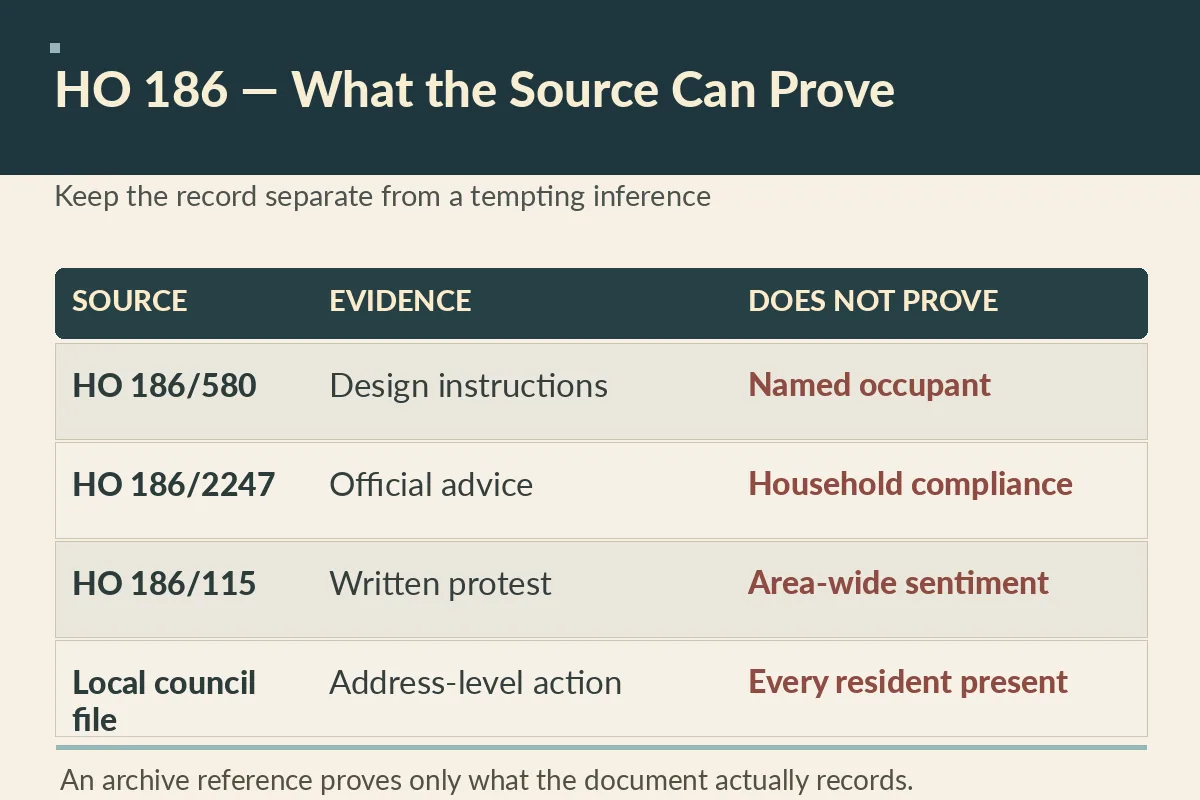
HO 186 contains Air Raid Precautions and Ministry of Home Security administrative files from the Second World War era. It can show how authorities planned shelter use, circulated warnings and received reactions. It is not a register of every household’s shelter or wartime whereabouts. Start with a documented home-front event, identify the type of official paper and compare it with local civil-defence or property records. The National Archives’ Home Front source collection supplies actual examples: HO 186/580 for Morrison shelter instructions and HO 186/2247 for public precautions leaflets.
Identify the Document Before Inferring Behavior
The same broad HO 186 series holds different kinds of materials, including planning files, publicity and responses from the public. A Ministry of Home Security leaflet is evidence of an instruction distributed or prepared for circulation; it cannot demonstrate that every resident read it. A plan for a shelter is evidence of a design, not proof that the structure was installed in a particular house. Establish the creator, date and stated audience first.
Record whether the source is a final instruction, a proposed design, a complaint or a report following an incident. Each answers a different question. If a drawing contains idealized placement or dimensions, it describes a recommended arrangement in the source’s historical context, not a reliable reconstruction of any specific domestic interior without additional evidence.
Read the Morrison Shelter Material Precisely
The National Archives identifies HO 186/580 as an extract describing how to assemble a Morrison shelter. The document reveals construction features and how the government presented the shelter to the public. It does not by itself say which houses received one, what it cost a particular family or whether it survived a raid. Do not treat a generic diagram as a photograph of a named person’s home.
A useful caption cites the archive reference and calls it an instruction. If you need to determine whether a specific address received a shelter, look for council records of distribution, household correspondence, photographs with reliable provenance or contemporary local reports. The existence of a national scheme only narrows the possible historical setting; it does not identify beneficiaries without corroboration.

Trace Public Notices Without Claiming Compliance
HO 186/2247 includes gas-mask and air-raid instruction material used in the Home Front teaching collection. The records show what authorities told residents to do and how the notices were framed. They are not evidence that the instructions were consistently followed. A household photograph showing a mask may demonstrate possession on a particular date, but possession alone is different from training, everyday carrying or use during an alert.
Keep the medium in your citation: printed leaflet, newspaper insertion, public-information card or departmental file. Print date is not necessarily date received. The National Archives also preserves a leaflet returned with anti-war writing in HO 186/115. That item documents a particular protest message, not the opinions of all residents of the town from which it was sent.
Connect Policy to an Address With Independent Records
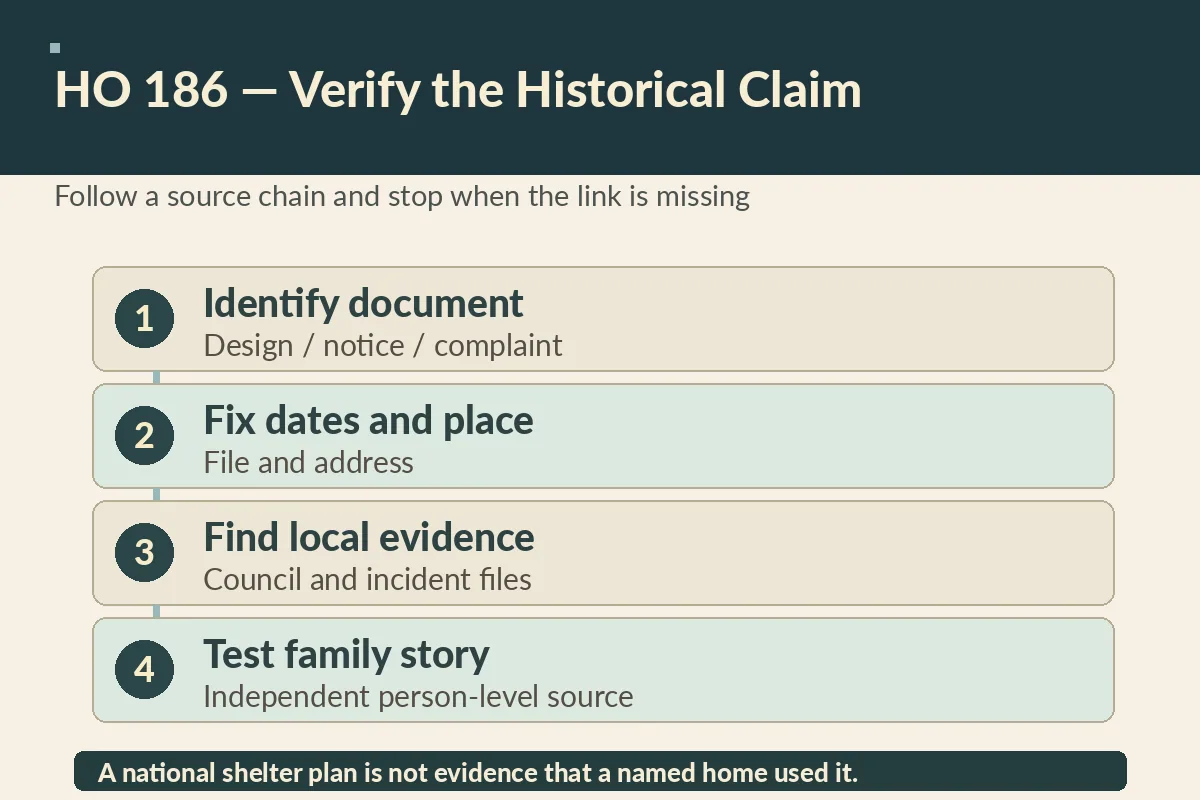
A search for an ancestor’s home should begin with a reliable address and date from electoral registers, directories or household correspondence. Next identify the local authority that managed air-raid precautions. Its surviving committee minutes, shelter allocation papers or wardens’ material may be more relevant than a central department’s national guidance. Those local records have uneven survival and should be checked repository by repository.
A bomb-damage report, where it survives, may show an incident at or near an address; it does not automatically show the family’s presence at the moment of impact. The National Archives’ guidance to bomb-census records directs researchers to a separate series, HO 193, which should not be conflated with the general HO 186 planning file. Keep place-level and person-level evidence in separate columns.
Read Complaints as Statements, Not Determinations
Letters from residents or organizations may describe discomfort, inadequate facilities, cost or anxiety. Such a letter is important firsthand evidence of what its author reported, but the claim may have been contested, misunderstood or left unanswered. If officials annotated the complaint, identify whether the note records receipt, an instruction to investigate or a decision. The three procedural states are not interchangeable.
For a dispute about a public shelter, seek the council response and contemporaneous inspection or engineering record. If no response survives, describe the complaint in its own terms rather than turning it into a proven defect or alleging it was ignored. Preserve all dates and the writer’s address as given in the source; do not attach an unrelated later household with the same surname.
Avoid Reconstructing a Raid From a Planning Leaflet
An official precaution leaflet cannot prove that a raid occurred in a location. Conversely, a raid record cannot prove that a particular person had a mask or used a shelter. Construct separate evidence lines for the official warning, the local incident and the individual’s documented activity. Newspaper accounts, diaries and official local incident reports may disagree; their viewpoints and timing should be recorded explicitly.
A later family recollection can supply valuable context but may compress several alerts or moves into one event. Check the address and chronology before adding specific dates. When describing a hazard, keep the discussion historical rather than treating obsolete wartime directions as modern safety advice; present-day emergency guidance has different standards and belongs to current authorities.
Preserve the Difference Between Plans and Experience
A careful local-history summary can truthfully say that wartime authorities circulated guidance about a shelter design and that particular councils implemented schemes, if both claims have records. It should not say a named family hid beneath a particular model without their own testimony or address-level documentation. Use cautious verbs—planned, distributed, reported, allocated, installed, occupied—only when the relevant source supports each one.
For future researchers, log the HO 186 document, full descriptive title and date; the locality searched; and the independent evidence still needed. This makes missing records visible rather than hiding uncertainty under a vivid narrative. If there are two people with the same name in the area, compare address and household relationships before assigning a letter or a civil-defence position to either.
More House and Local History Guides
How We Research and Cite These Records
We identify the record type from the National Archives’ Home Front examples and retain the original HO 186 item number for every claim. We compare planning material with local records, not with assumed household behavior. Instructions, protests and incident reports receive separate labels because they come from different observers and serve different purposes. We do not infer the experiences of an entire community from a single leaflet or letter, and we do not offer obsolete historical shelter instructions as current guidance. Commercial transparency is covered in our affiliate disclosure.
The Ministry of Home Security Air Raid Precautions files, including civil-defence planning and publicity.
No. HO 186/580 is an instruction; household allocation or use needs separate evidence.
Public information and air-raid or gas-mask precaution leaflets.
No. It records the words of the person or people associated with that item.
HO 193 is a separate source for bomb-census information, with its own coverage limitations.