
Victoria’s historical government-school pupil registers are generally found by identifying the school, not by typing a student’s name into a statewide register index. Public Record Office Victoria (PROV) says pupil registers in its School Records holdings are not indexed by student name. Many records concern schools that have closed, and survival varies. Start with the school’s historical name or number, locality and approximate attendance years; then locate the correct series and inspect the actual register if accessible.
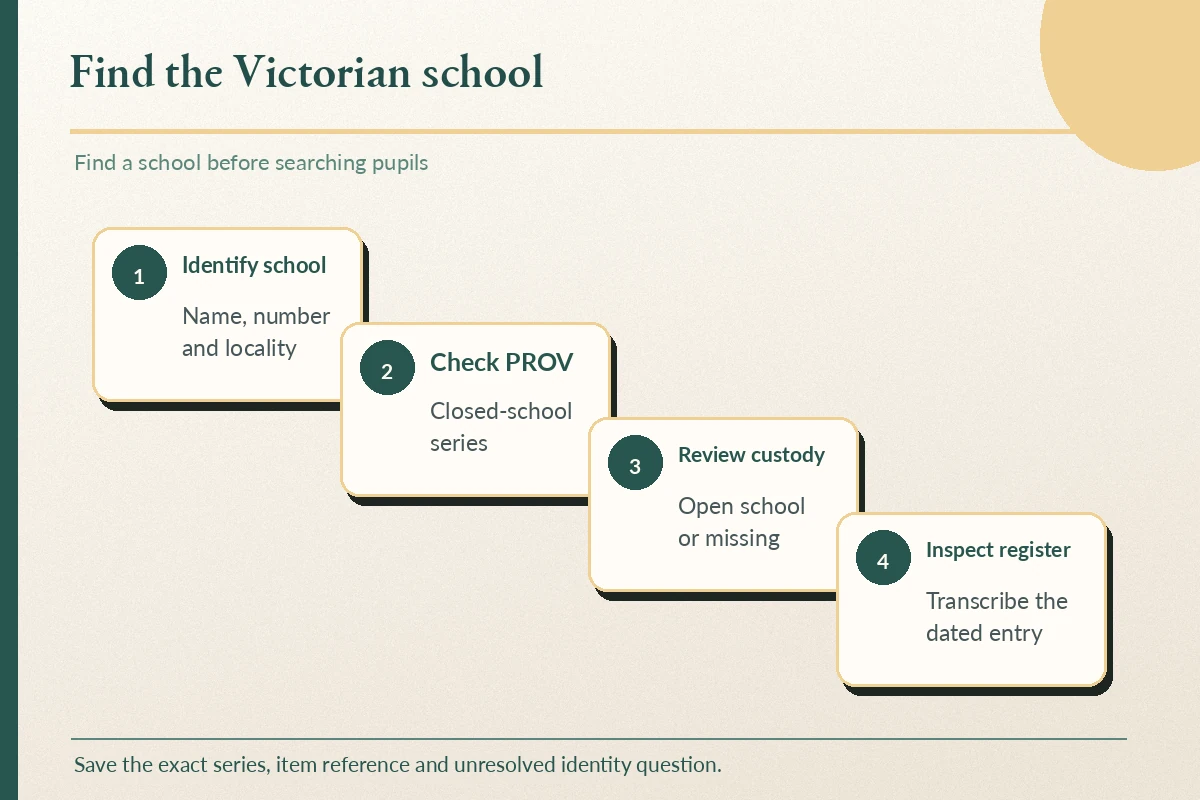
Find the school before searching for the child
PROV specifically recommends a school name, region and year to locate government-school and pupil records. A modern place name can mislead when a school changed name, moved or amalgamated, so collect any historical school number and variant institutional names. School enrollment can be suggested by a family address, sibling’s recollection, local directory or teacher record, but these are leads rather than proof of attendance. The pupil’s surname alone is usually not a productive catalog query because PROV says the pupil registers themselves are not indexed by name. Write a narrow school-and-date question before opening the catalogue.
Understand why PROV holds some schools but not others
PROV says the School Records series are mostly from government schools that have closed. Records from schools still operating are more likely to remain with the school. Some earlier schools closed without surviving records or without transferring everything. Therefore the absence of a school series cannot establish that a child was never enrolled. Ask whether the institution was government-run during the relevant period; private, denominational or other educational settings may have different custodians. The presence of a school’s administrative file does not guarantee pupil registers survive. Make custody and preservation separate columns in the research log.
Use two different PROV entry points
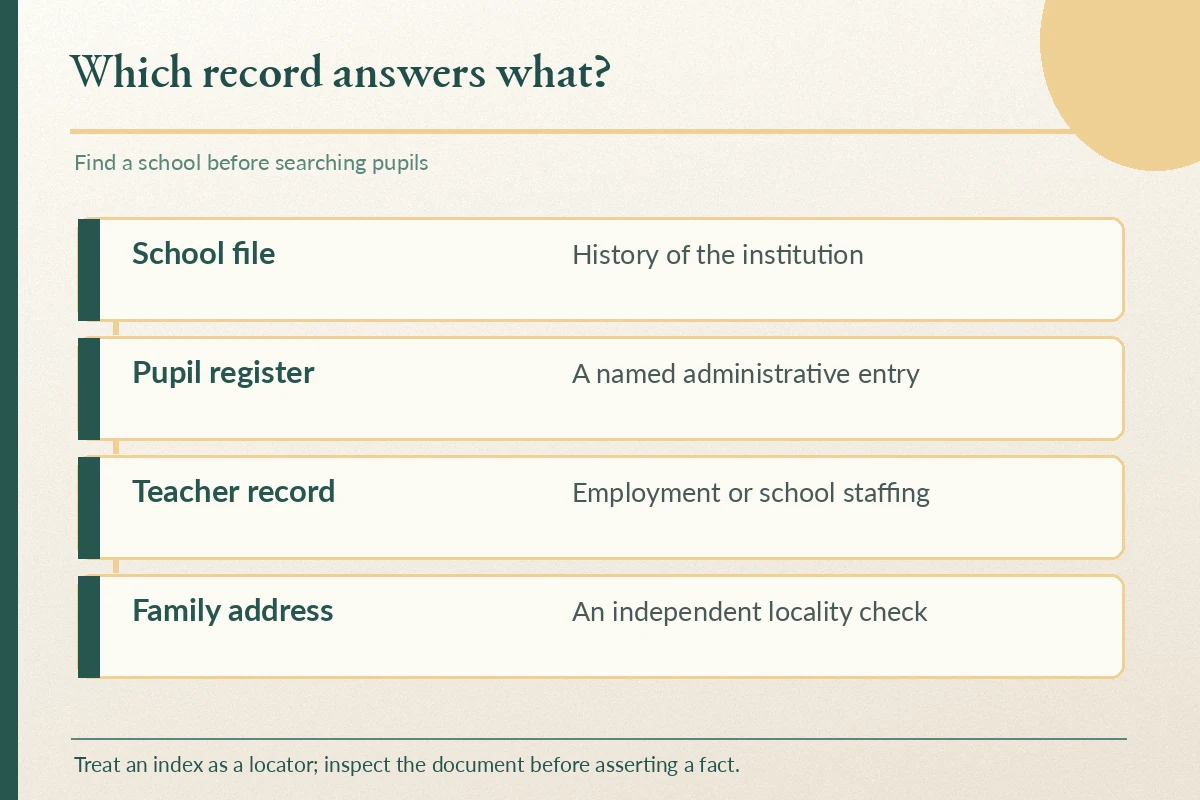
The Government School and Pupil Records topic directs researchers to search the school name and then terms such as pupil, teacher or council. PROV also offers School Records after 1873, an Education Department search across multiple series principally concerning school correspondence, buildings and management. These are complementary, not equivalent. PROV also publishes a distinct 1839–1873 school-records route covering five early correspondence series (VPRS 19, 61, 880, 878 and 903). Search a pre-1873 school in that earlier system rather than assuming later Education Department filing applies. A subject file might prove that a school existed or changed name without listing pupils. If one collection returns an education-department file, inspect its series description before assuming it is a register. Follow the record creator and item number so you do not cite school correspondence as a child’s enrollment entry. If that is your next decision, our guide “Victoria Teacher Service Records, 1863–1959” explains how to read VPRS 13579.
Check series dates and the school identifier
A school that operated from the 1860s to the 1920s might have only a register from one decade or a damaged fragment. Compare the school’s dates of operation with each series’ start and end dates. Look for changes in school number, whether records were transferred after closure and any item-level access restrictions. Record the precise school title in the archive as well as the commonly used local name. A child who attended a nearby branch or a predecessor school may appear in a different series. If you cannot establish the school, use dated family addresses and local school histories to create a shortlist rather than forcing a single catalog hit.
Read the pupil register as an administrative record
Where the register survives, examine column headings and actual entries, not an abstract assumed field list. A pupil record may contain enrollment or departure information and other details, but formats vary. Transcribe the date alongside the person’s name, noting handwriting, abbreviations and corrections. Do not infer a child’s biological parent from an unidentified adult whose name appears as contact, guardian or fee payer. Nor does a child with the same surname in the same school automatically belong to the same household. Treat each entry as a record of the school’s administration at a particular time.
Build a school attendance chronology
Create columns for school name/number, source identifier, first documented attendance, last documented attendance, residence or guardian as written, and uncertainty. If two registers overlap, do not assume a move occurred exactly on either entry date. For a fictional child, May Bennett, a record showing entry in 1906 and another showing admission to a neighboring school in 1908 provides a sequence of registrations, not a proof that the whole family moved houses. This example is invented. Compare an independent dated address record before concluding a migration or family change. Remember that dates may be entry dates, not the first-ever education of a child.
Connect school records to other evidence without overclaiming
A household census, where available for the jurisdiction and date, electoral roll, rate book or family letter may supply independent locality clues. Australian surviving named census material is not uniformly comparable to UK or US household returns; never promise an exact census cross-check for every year. Compare a registered child’s age, school and guardian with a civil birth record or relevant church register only where access permits. If a teacher’s name appears, that is a school relationship until other evidence says otherwise. A siblings hypothesis can be supported by repeated addresses and named adults, but must not arise from surnames and adjacent register lines alone.
Recover missing results with a school-focused search
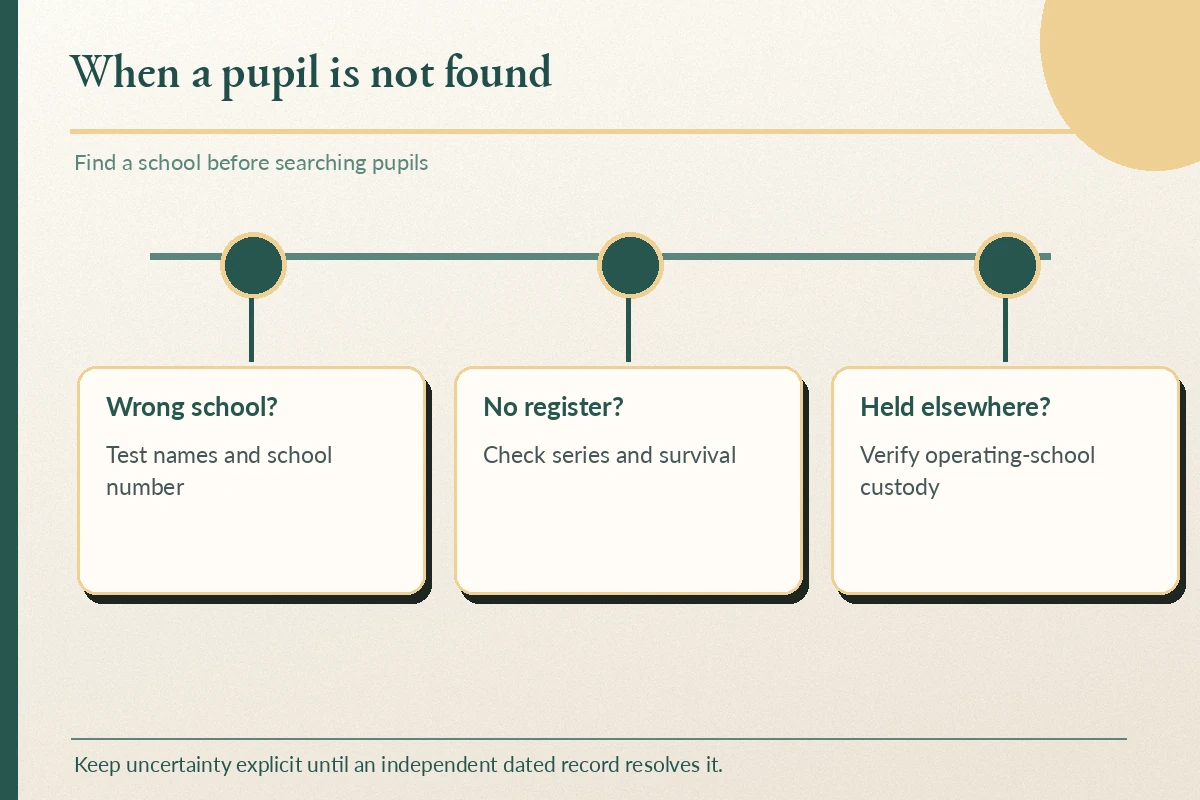
If the main topic search fails, vary the school’s historic name or number and search a nearby township or locality. Check the Education Department correspondence series for clues to school mergers, closures and renumbering. A missing digital image may mean the record is held for reading-room consultation rather than absent. PROV guidance explains that many records were not preserved; do not turn a documented gap into evidence that a child skipped schooling. Write down which school candidates and date ranges you have tested. If the school is still operating, follow the institution’s current lawful archival access route without assuming PROV has custody. Our guide “Western Australia School Admission Registers” covers a related question.
| Search starting point | Likely result | Check before claiming |
|---|---|---|
| School name or number | School Records series | Does a pupil register survive? |
| Education Department topic | Administrative correspondence | Not a pupil name index |
| Open pupil volume | A dated admission or attendance | Read original column headings |
| No catalog result | Possible custody or survival gap | Do not conclude nonattendance |
Respect privacy and sensitive school records
School files can name children, guardians and officials. Some school records may contain punitive or welfare-related material, which should not be reproduced casually. Avoid digitizing or publicly sharing personal information from restricted or recent files without authority. Historical descriptions of discipline and schooling may reflect unequal access or discriminatory practices. Read these records in context, and treat Indigenous students’ records with particular cultural and privacy sensitivity. School attendance is one administrative dimension of a life; it does not prove a child’s household, full education, parentage or later identity without independently sourced links.
Write a source citation that works years later
Record PROV as the repository, the school’s archival name and number, the exact series and item identifiers, register dates, page or image location, and any available URL. Cite a school series description separately from a pupil entry when that is all you have viewed. Retain a literal transcription of uncertain names beside the image reference and mark any proposed identification as tentative. The finished worksheet should tell a second researcher which school you searched, how you navigated to the volume and which gap remains. That is more reliable than an uncited family-tree note saying “attended a Victorian school.”
How We Research
We read PROV’s school-and-pupil records guidance and the separate Education Department search description. We treated school naming, records custody, survival and child identification as different tests. The sample child is imaginary, and no undisclosed student list was used.
More Records and Archives Guides
Official sources and archival guidance
PROV explains that pupil registers are not name-indexed and school-name/place/year searches are essential (prov.vic.gov.au).
PROV describes a separate search for school-related Education Department records created after 1873 (prov.vic.gov.au).
Also, PROV education portal distinguishes school and pupil holdings and physical versus online access (prov.vic.gov.au).
PROV separates five pre-1873 school correspondence series from later Education Department records (prov.vic.gov.au).
Independent historical education research. Respect access controls and privacy in records about pupils and potentially living families; no affiliate or sponsored links are recommended. See our GenHis affiliate disclosure.
PROV says its pupil registers are not indexed by student name; start by identifying the school and likely year.
No. Holdings emphasize schools that have closed and vary substantially in survival and type.
PROV advises they are more likely to remain with the operating schools; check the current custodian and access conditions.
Not necessarily. It often documents a school’s management, buildings or staffing rather than named students.
Save the exact school identity, series and item number, dated page, wording of the entry and any unresolved identity question.