
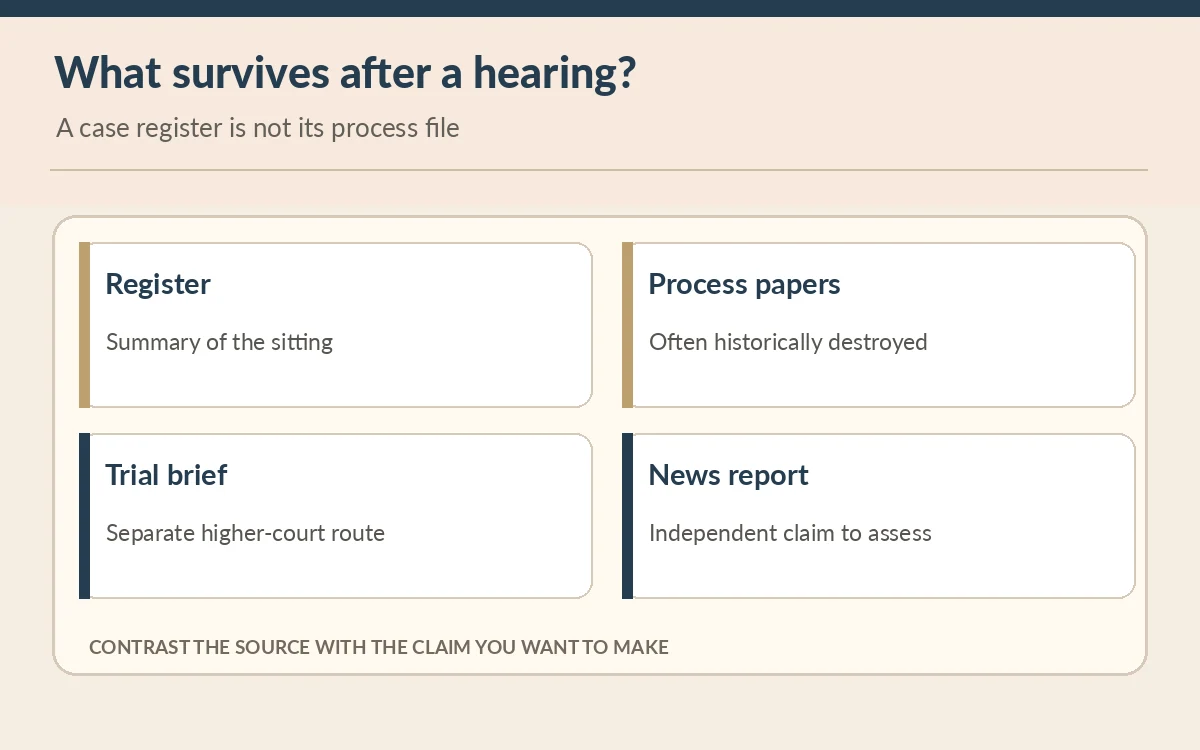
Victorian Courts of Petty Sessions recorded many local matters in summary registers, but their entries are not the same as a preserved case file. Public Record Office Victoria (PROV) advises searching by the court’s town and the year, then choosing the appropriate court level. Registers can identify parties, date, presiding official and the decision recorded for that sitting. The underlying paperwork, often called “process,” was frequently destroyed before archival transfer. A modern search result for a familiar surname therefore opens a question—what did this particular court record on that day?—rather than proving guilt, parentage or a complete case history.
Identify the sitting court before searching a person
Start with the date and community named in a newspaper notice, family letter or another contemporary source. Victorian courts were organized around particular towns and several jurisdictional levels. A minor local dispute may have been heard in a Court of Petty Sessions, while a more serious criminal prosecution or substantial civil action could involve a different court. Do not search one statewide book for every kind of case.
PROV explains that many town-level courthouse collections sit under locality names, such as a town followed by “Courts.” Search the historical town itself; modern amalgamated council boundaries are not necessarily the right clue. If the reported event happened near a jurisdictional boundary, investigate the likely adjoining courthouse and document why you expanded the search.
Use the PROV location-first finding route
The PROV summary case guide recommends entering the location into its court search, without adding “court” or “courts” to the text. The records are organized by sitting court rather than being a single national database of defendants. After identifying a matching courthouse, select a register that covers the relevant date and branch of jurisdiction. Write down the court agency name and catalogue identifier as carefully as the person’s name.
A search index may return a volume rather than an entry about your person. Check which pages and date intervals the volume actually contains before interpreting a blank name search as absence. Where an item needs a Reading Room visit or third-party access, note that route. Do not state that you inspected the original if you saw only a catalogue page.

Read a summary register as a dated procedural record
PROV lists typical register content as parties, presiding judge, hearing date and the court’s recorded decision, with details varying by court and matter. Transcribe the column headings and the entry in the same order as the page. A date may identify a hearing or procedural step rather than the date an alleged incident occurred. Words in a charge column must not be rewritten as a conclusion of guilt.
If a matter was adjourned, dismissed or transferred, write the exact outcome and search later sittings or a higher court, rather than collapsing multiple steps into one verdict. An entry for two people on one line may show opposing parties, not relatives. Identify each role before drawing genealogical conclusions.
Know why a register may be all that survives
PROV warns that most nineteenth- and early-twentieth-century Magistrates and County Court process documents were destroyed before the archive was established in 1973. A register can be the surviving primary source, even though it is briefer than the original pleadings, warrants or depositions. Do not promise that each register hit can be followed to a complete case packet.
The archive reports that thousands of local Magistrates Court registers have been digitized through historical access projects, but coverage and availability must be checked for the particular town and volume. A digitized register is not the same as a fully indexed collection of every defendant. Browse by date if a name query fails, and distinguish a missing case file from a missing register.
Distinguish petty sessions from higher-court trial briefs
PROV’s broader criminal-case guide directs researchers to different records for serious crimes, including trial briefs associated with County or Supreme Court prosecutions. A newspaper account of an indictable charge may mention a preliminary committal at a local court followed by trial elsewhere. Those are separate administrative proceedings; both may need to be followed to establish the sequence. For the next step, our guide “Victoria Criminal Trial Briefs, 1841–1949” explains how to find cases in VPRS 30.
Before moving court levels, compare the accused person’s name, stated locality, date, charge and any case number. A brief held in a higher-court series is not automatically the continuation of a same-name petty sessions entry. For civil matters, investigate the relevant civil jurisdiction instead of forcing a criminal-trial search.
| Source | Strongest use | Proof limit |
|---|---|---|
| Petty Sessions register | Date, parties, recorded decision | Not a complete case file |
| Newspaper report | Possible hearing or locality clue | Reporter may lack process papers |
| Higher-court brief | More serious prosecution context | Requires case identity match |
| Directory or electoral roll | Occupation or location comparison | Not proof of case involvement |
Test a fictional case with two likely defendants
Suppose the name Henry Morgan appears in a Ballarat newspaper report from 1892 and again in a distant coastal town’s court register. In a fictional comparison, the Ballarat record names a carpenter who matches your family’s independent directory evidence; the coastal record gives no occupation at all. That may make Ballarat a better candidate, but it still does not prove the accused is your relative. Record the exact court, day and parties for both cases.
Search a nearby electoral list or address record for a dated identity clue. If neither court entry states an age, occupation or address, say so and keep the finding provisional. All characters and outcomes here are illustrative; no archival case or real defendant is being asserted.
Recover from a failed surname query
A missing result can reflect transcription, incomplete indexing, a wrong court town, a misspelled personal name or a sitting date outside the selected volume. Search the courthouse by town and browse the dates around the event; then test variant surnames using the same locality. If an account names a police station or magistrate but not the court, that may help identify the correct nearby sitting place.
Use contemporary newspapers to locate an event or check a procedural sequence, but describe their claims separately from the official register. A newspaper reporter did not necessarily have access to original court process documents. If no register survives, note the precise locality and years checked rather than claiming the alleged event never happened.

Cite and interpret the outcome proportionately
A retraceable citation gives PROV, creating courthouse, register series or catalogue identifier, register date range, book and page, parties, entry date and access method. For a digitized scan, retain an image locator; for a reading-room consultation, retain the item requested. Maintain distinct citations for newspaper coverage and later trial material. This keeps a charge, a recorded decision and a family identification separate.
Legal terminology and procedures shifted over time. Some historical descriptions are stigmatizing; quote only the necessary wording, identify it as archival language, and avoid speculative accusations about descendants or living people. A court record is one piece of evidence about a named party at a particular sitting, not a definitive biography.
How We Research Victorian Court Registers
We checked PROV’s location-first summary-case instructions, its description of typical register fields, the warning about destroyed process documents and the distinction between Magistrates, County and Supreme Court files. Our Morgan comparison is hypothetical. We did not assume a specific court volume is digitized or open to remote viewing. For a real conclusion, inspect the correct courthouse volume and corroborate identity independently.
More Records and Archives Guides
Original Archive Guides and Finding Aids for Victorian Court Cases
Public Record Office Victoria: how to locate summary registers and what they contain (prov.vic.gov.au).
PROV: court-level and locality choices for case records (prov.vic.gov.au).
PROV: summary cases versus criminal trial briefs and other court records (prov.vic.gov.au).
Editorial disclosure: This guide does not contain a paid placement or affiliate recommendation. Read the GenHis affiliate disclosure for our site-wide policy. Historical records may contain errors, unequal treatment or distressing descriptions; cite original context and avoid exposing private information about living people.
There is no basis to assume complete statewide person indexing; start with the historical court town and date.
It may name the parties, court official, sitting date and the decision recorded for that day.
No. PROV says much historic summary-court process paperwork was destroyed.
No. Read the decision or later proceedings separately from the allegation.
Look for a distinct County or Supreme Court record and verify the case link by place, date and parties.