
A Cascades Female Factory index result may identify a convict woman moving through a particular institution at a specific time. It does not provide her complete life story. Tasmania’s archive identifies CON139/1/1 as a register of women admitted to the Female House of Correction at Cascades between June 1833 and March 1834. Its transcribed entries can be searched through the Tasmanian Names Index, with links to relevant original pages. The record is unusually useful for tracing where a woman came from and where she was sent afterward, but its short surviving interval must never be generalized into a complete census of all women at the factory.
Define the institution and the narrow surviving dates
The Cascades Female Factory in Hobart was one institution within Van Diemen’s Land’s convict system. Libraries Tasmania describes the female factory operating during the nineteenth century, with overlapping purposes of labor assignment, confinement and punishment. A family story may use the word “Factory” without specifying Cascades or another establishment. First check the place, month and administrative setting before applying the CON139 label.
CON139/1/1 covers 1833–1834, not the full life of the institution or the transportation era. A negative search of this volume cannot rule out a woman’s admission in a different year. You may need a conduct record, a different admissions series, an institutional baptism entry or an earlier assignment notation for events outside the narrow CON139 window.
Search the Tasmanian Names Index for linked entries
Start with the woman’s known surname and given-name variants, then broaden to a vessel name or approximate age if other convict documents supply one. The Tasmanian Archives project connected transcribed CON139 data with individual Names Index entries, allowing researchers to move from a name to the surviving register page. Capture the index entry’s spelling before silently standardizing names in a family tree.
The Names Index is a finding aid. Note any transcription uncertainty, then inspect the linked page when available. Work across the entire entry, not just the matching name line: columns and context can explain who recorded the admission, how long the stay lasted and the preceding or subsequent destination. If the image is unavailable, say you used a transcription only.
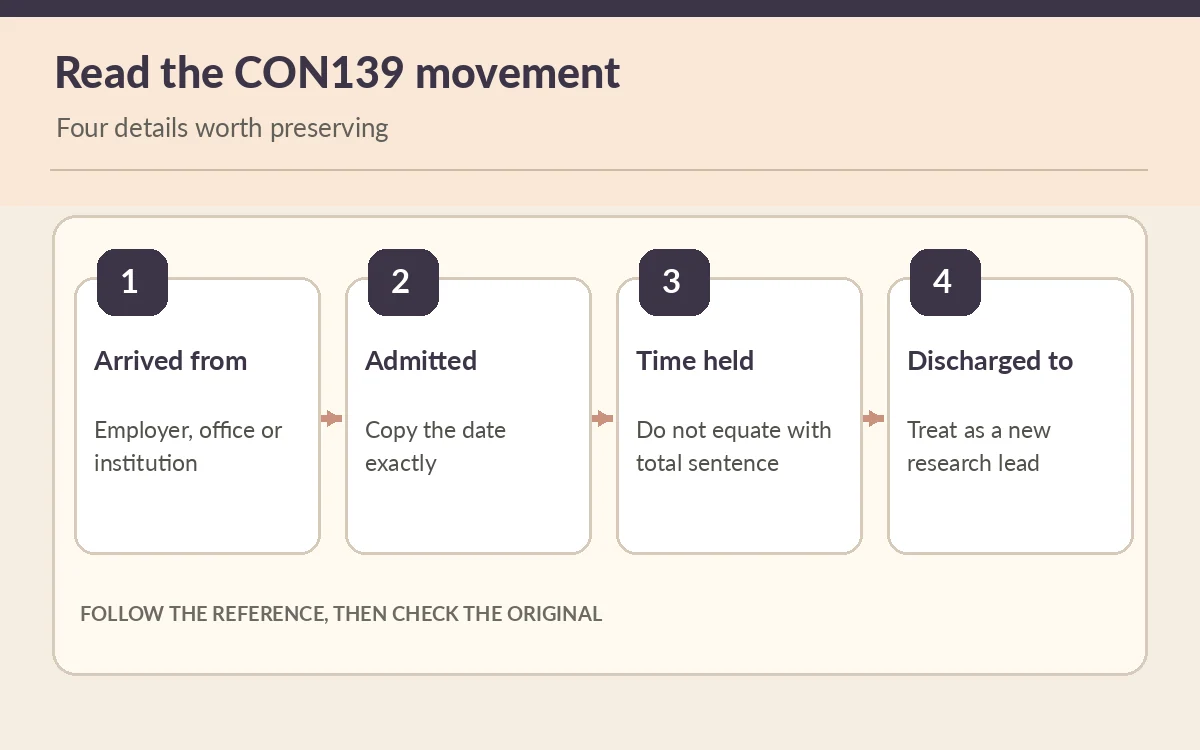
Separate the admission, discharge and destination events
According to Libraries Tasmania, the 1833–1834 register records where women arrived from, time held at the factory and where or to whom they were discharged. These are separate events in a person’s timeline. An incoming employer name indicates an administrative connection at that point, not necessarily a family relationship or a lifelong employer. A discharge destination is not evidence that the woman remained there for years. For the fuller picture, see our guide “Tasmania Queen’s Orphan School Records, 1828–1879”.
Make a four-column chronology: dated movement, exact wording, record reference and the next document to test. Preserve uncertain abbreviations and blank cells as recorded. If a stay spans two calendar months, do not interpret the duration as a total sentence or claim that it equals time in the colony.
Follow the woman into a conduct or description record
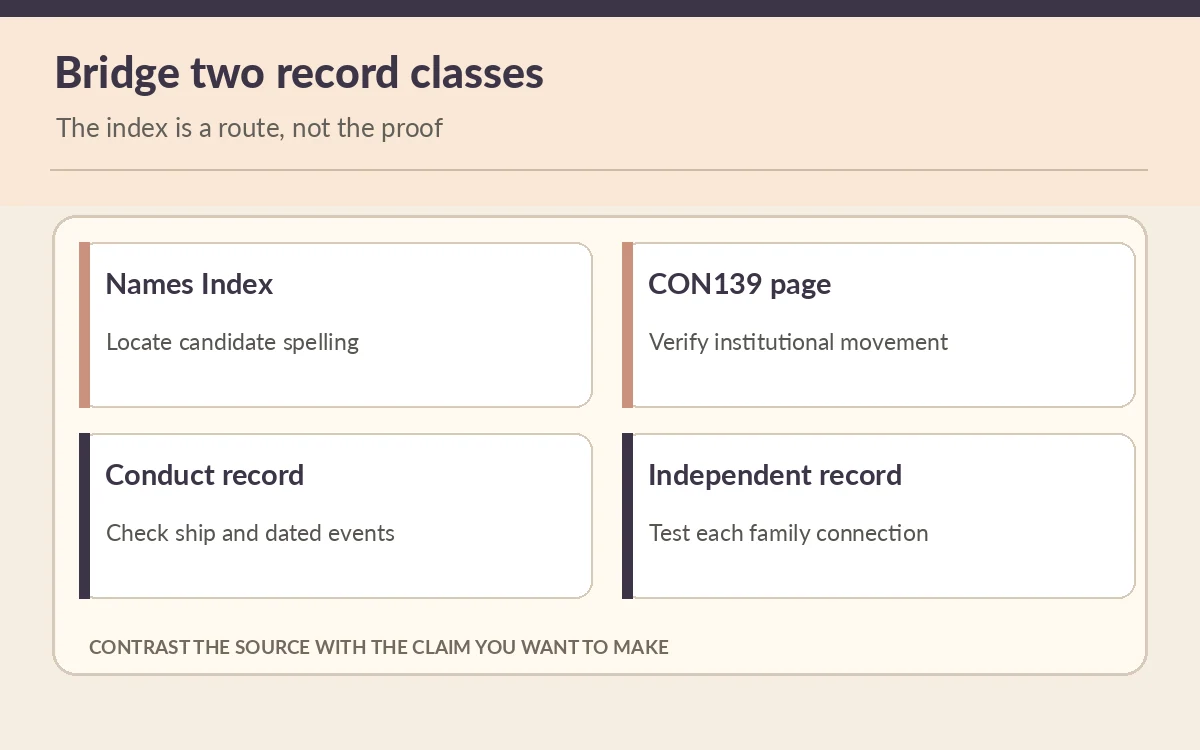
The Tasmanian online convict guide lists distinct record classes: female conduct records, descriptions and indents, as well as materials from separate institutions. Use any ship name, age, native place, convict number or trial detail from a trusted independent record to identify the correct individual. An entry in the female factory register may have too little information by itself to distinguish same-name women. To go further, our guide “Parramatta Female Factory Index, 1826–1848” shows how to find women and children.
A conduct record can provide a broader administrative sequence. Compare its dates and institutional abbreviations with the CON139 movement and retain conflicting readings. Where a woman’s status changed from assignment to another arrangement, the record may reflect that change without fully describing her personal reasons or relationships. Administrative punishment language must be reported as historical state terminology, not endorsed as a moral judgment.
Handle references to children with exceptional care
The register and related materials sometimes document children in the institution. The Tasmanian Archives project explicitly notes that some records concern children and babies and that details may not survive elsewhere. A child’s appearance next to a woman, or in a related institutional return, is not by itself proof of biological maternity. Carefully inspect whether the document explicitly names a mother, guardian, child or other relationship and verify the link in a baptism, civil record, conduct register or another contemporary source.
Names, ages and dates can be misread on faded pages. Keep transcription, interpretation and the proposed family relationship separate. Avoid turning institutional experiences into a sensational narrative: record only what the evidence says, acknowledge systemic coercion and do not speculate about a person’s motives for being confined.
| Source | Strongest use | Proof limit |
|---|---|---|
| CON139/1/1 | Admission and discharge movement | Only 1833–1834 |
| Tasmanian Names Index | Transcribed name and page link | Transcription may be imperfect |
| Female conduct record | Other dated administrative events | Not a personal autobiography |
| Baptism or civil record | Potential named relationship | Verify exact parties and date |
Use a fictional same-name comparison
Suppose an imagined ancestor named Eliza Brown is reported at Cascades in late 1833. The Names Index produces one Eliza Brown associated with a source employer and another similarly named woman in a different record. Copy both entry references. A credible match would require a compatible admission date plus independent evidence such as the same transport ship, earlier assignment or description. A matching surname and an employer of the same town are not enough.
If a discharge column points to a person called Mrs Clark, that is an onward assignment clue, not a maternal or marital link. The hypothetical example has no bearing on any real historical Eliza Brown. Keep both candidate identities open until the conduct record and other period documents identify one person consistently.
Understand gaps and the limits of a transcribed index
The archive’s own articles emphasize that the survival of CON139 offers only a glimpse and that many lives are poorly documented. An empty Names Index query may reflect variant spellings, different years, a missing page, a transcription issue or the fact that another female factory was involved. It does not mean a woman’s experience of confinement never happened. Search linked convict records chronologically and cite the limits of each dataset. For the fuller picture, see our guide “Tasmania Convict Assignment Records”.
If you cannot find an original image for a transcription, do not describe an illegible marginal note as fact. Equally, if a name appears in a later biography without a page citation, treat it as a lead to test. The best research outcome may be a bounded account of two documented movements with important unanswered intervals, not a complete imagined biography.

Cite the page without erasing its institutional setting
Record the repository as Tasmanian Archives / Libraries Tasmania, the Female House of Correction creating context, series CON139/1/1, the identified page or entry, and the Names Index record or URL with an access date. If you consult a female conduct record, give its separate CON number and page. One compound citation that mixes an admission with a conduct entry hides which statement came from which source. If that is your next decision, our guide “Tasmania Convict Records” explains how to find conduct registers and trace a sentence.
Use respectful language for women subject to transportation, labor assignment and punishment. When discussing children or possible relatives, separate a verifiable archival statement from inference. Historic records reflect officials’ descriptions and power rather than a neutral or complete account of the individual’s life.
How We Research Cascades Female Factory Entries
We checked Tasmanian Archives articles describing the register, its exact surviving interval, how linked transcriptions work, and the related classes listed in the official online convict guide. We did not assume continuous factory admission records or infer parentage from proximity. Eliza Brown and Mrs Clark in our comparison are expressly fictional; decisive claims require the page image and an independent identity match.
More Records and Archives Guides
Original Archive Guides and Finding Aids for Cascades Admissions
Tasmanian Archives research: CON139/1/1, admission sources, discharge destinations, linked Names Index transcription (libraries.tas.gov.au).
Tasmanian Archives: exact June 1833–March 1834 register context and case-based interpretation (libraries.tas.gov.au).
Libraries Tasmania: female factory, conduct, description and baptism record classes (libraries.tas.gov.au).
Tasmanian Archives: CON139 scope, women and children, institutional context, survival limits (libraries.tas.gov.au).
Editorial disclosure: This guide does not contain a paid placement or affiliate recommendation. Read the GenHis affiliate disclosure for our site-wide policy. Historical records may contain errors, unequal treatment or distressing descriptions; cite original context and avoid exposing private information about living people.
Tasmanian Archives describes the register as covering June 1833 to March 1834.
Yes. The archive has linked transcriptions from CON139 to relevant Names Index entries.
No. It records an administrative connection; relationship claims need separate proof.
Not necessarily. Check explicit wording and corroborate with a baptism or other contemporary record.
CON139 is narrowly dated. Other periods and institutions require different series and searches.