
Western Australian probate and administration research begins with the State Records Office (SRO) court records and its name-searchable catalogue. For 1832–1947 the principal register series are grants of probate (Series 56) and letters of administration (Series 57); supporting files are in Series 34 and 59. The archives also identify historical microfiche indexes. Be sure to distinguish the grant from the underlying application file and check access restrictions before requesting documents.
Begin at 1832, not at first settlement
The State Records Office explains that colonial estate jurisdiction began in 1832 with the Civil Court of Western Australia and moved to the Supreme Court in 1861. Deaths in the colony during 1829–1831 could have estates handled in Britain, informally or later; do not expect a standard WA grant from the time before the court system existed. Start with a well-supported death place and approximate date. Determine whether the estate was connected to WA and whether there might have been property elsewhere. A name matching in a WA probate index is a candidate, not yet an identified ancestor or a proved deceased estate. Our guide “Western Australia Land Records, 1829–1933” adds more detail on this.
Tell probate from administration
A grant of probate formally proves a will, whereas letters of administration appoint someone to manage an intestate estate or certain circumstances when the executor cannot act. That distinction matters when interpreting names. A named executor is not necessarily a spouse or child, and an administrator may be a relative, creditor or other person with an accepted role. Keep the application, will, grant, death and distribution as separate events. The presence of an administrator does not establish that the deceased wrote no personal document of any kind; it identifies the court process reflected by that file.
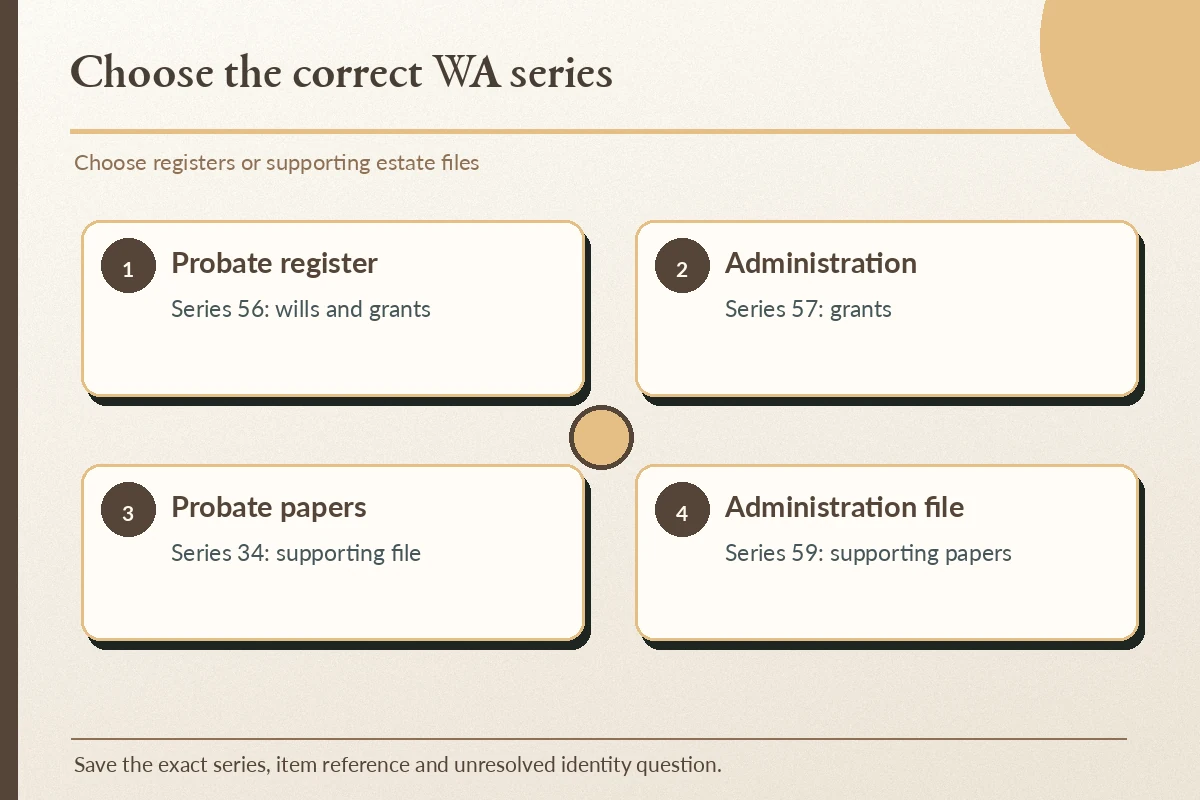
Use the WA four-series crosswalk
SRO identifies Series 56 as registers of probate grants containing copies of wills, and Series 57 as registers of letters of administration, both 1832–1947. Probate files are Series 34; administration files are Series 59. Files may contain additional applications, affidavits and certificates depending on the case. A register copy and an original supporting file should not be cited as if they were the same physical source. Search the name in the SRO catalogue and record which series and specific item produced the result. A catalog hit is a locator: the record itself must still be viewed to verify a claim. Our guide “Tasmanian Wills and Probate Records” goes into more detail.
Know the index and microfiche paths
The SRO identifies an index in Consignment 3435 covering 1832–1939 and another in Consignment 5269 covering 1900–1993. The indexes overlap rather than forming a clean one-day handoff. They can provide a will or administration number, administrator or executor name and death date. The State Library’s genealogical guide explains that index entries may also distinguish probate from administration with prefixes and give the late address. When a record falls in the overlap period, a search in one index should not be treated as exhaustive proof of absence from the other. Capture the exact reference and source location. For the fuller picture, see our guide “Queensland Wills, 1857–1940”.

Check the 75-year restriction on files
The State Library of Western Australia says probate and administration files are restricted for 75 years, with permission from the Supreme Court required for access during that period, while register copies of grants have different viewing arrangements. Do not treat the opening of a catalog record as permission to reproduce a restricted file. Because an access calculation depends on the file and current policy, check the official item-level conditions rather than promising that a particular year is open without inquiry. Archives may supply microfilm, digitized items, a reading-room route or copying information; current fees and delivery options must be checked at the source. Our guide “South Australia Probate Records, 1844–1916” covers how to find wills and grants.
Read the full file for evidence, not family lore
According to the SRO court guide, probate files may contain a will, application, death certificate copy and statements of assets or liabilities; administration files can contain bonds, affidavits and evidence lodged to support a claim. The exact contents vary. A person named in a document can be a witness, executor, administrator, beneficiary, creditor or child: label their role as recorded. An estate asset schedule may establish claimed property interest but not continuous residence or unquestioned title. Be careful with valuations, which belong to a particular date and administrative purpose rather than functioning as modern market estimates.
Separate death, application and grant dates
Place death date, will-signing date, application date, grant date and possible later estate events on distinct lines. For an illustrative fictional family, a will signed in 1882, a death in 1890 and a grant in 1891 are not contradictory: they represent separate stages. This invented example is not a real archive entry. If a grant year precedes the reported death, recheck handwriting, record type and namesake identity before changing the family tree. The timeline can also expose a will signed during an earlier residence or a later estate action concerning land. Keep document-derived statements and researcher inferences in different columns.

Match the right deceased among similar names
Search full names, initials, variant surnames and possible married names, then compare place of death, last address, occupation, executor or administrator and documented relatives where available. Many index entries will not contain all of these details. If two deceased people share a name, a probate number and unique location are stronger than a repeated surname. Do not conclude that a person is your ancestor merely because a file names a known family address without checking its date. Test candidates against civil death registrations, marriage records or property transactions created independently. A will can be a useful family lead, not a substitute for reconstructing a documented chain of relationships. For the next step, our guide “NSW Deceased Estate Files, 1880–1958” explains how to find property and death duty clues.
| SRO series | Type of record | What to verify |
|---|---|---|
| 56 | Register of probate grants | Will copy and grant date |
| 57 | Register of administrations | Person appointed and grant |
| 34 | Supporting probate file | Wills, affidavits or asset claims |
| 59 | Supporting administration file | Applications, bonds and evidence |
Look beyond the estate when no grant is found
Not every death generates a surviving probate file in the SRO collections. Search the alternate administration route, then revisit date and jurisdiction. An estate handled outside WA or in later records held by the Probate Office may be outside the particular historical series. A no-result name search may reflect spelling or an incomplete catalogue description. Record the exact index and range searched before moving to the next source. Newspapers, deeds, rates, death certificates and court notices may provide leads, but their silence does not prove there was no estate or no will. A useful negative conclusion names its tested holdings rather than claiming universal absence. Our guide “Victoria Wills and Probate Files” covers a related question.
Write a defensible probate citation
Capture State Records Office of Western Australia, the exact Series 34, 56, 57 or 59 reference, relevant consignment or microfiche index, item number, name, date, image or page and access method. If only an index entry was inspected, say “index entry” in the citation. In your findings separate an explicit relationship term from an inference based on a shared address or bequest. Consider privacy and colonial context when describing property, especially the different histories of traditional Aboriginal ownership and colonial legal title. Reproducible, restrained claims are more valuable than a large tree built from unverified beneficiary names. For the next step, our guide “Western Australia School Admission Registers” explains how to find pupils and parent clues.
How We Research
We cross-checked WA SRO historical court descriptions, its named indexes and State Library WA access guidance. The article distinguishes a register from a supporting file, and a granted legal role from family relationship evidence. Dates in the sample are hypothetical.
More Records and Archives Guides
Official sources and archival guidance
WA State Records Office explains 1832–1947 probate and administration grants and series 34, 56, 57 and 59 (www.wa.gov.au).
SRO identifies two microfiche indexes Cons 3435 and Cons 5269 and the information they provide (www.wa.gov.au).
State Library WA describes records and a 75-year access restriction on files (www.slwa.wa.gov.au).
SRO explains catalogue access, microforms, digitization and reading-room facilities (www.wa.gov.au).
Independent historical research information, not legal, estate or land-title advice. Respect current archival restrictions; this guide has no paid or affiliate recommendations. See our GenHis affiliate disclosure.
SRO identifies the historical court probate and administration records beginning in 1832, with principal grant series through 1947.
Series 34 contains supporting probate files; Series 56 contains registers of probate grants with copies of wills.
Series 59 is the supporting administration-file series; Series 57 contains registers of grants of administration.
No. The State Library notes a 75-year restriction on files; check item-specific access and any required court permission.
No. Transcribe any explicit relationship and corroborate it with independently created evidence.