
The National Archives lists BD 29 among photographic material in the records of the Ministry of Housing and Local Government’s Wales Office, with series dates of 1943–1975. The presence of photographs among administrative files does not make the series a complete street-by-street archive of completed homes. Start with the Welsh locality and file description, identify what the photograph was meant to illustrate and check the document’s stage in a project. An image can preserve the condition of a street or building at a specific moment, but not automatically establish when construction finished, when residents moved in or whether a proposed scheme was carried out. This guide separates those claims.
Identify the Wales Office File Before Dating a Property
BD 29 is a Wales Office administrative record series, not a name index of former tenants. Locate the historical local authority, town and any estate name before relying on a modern postcode. Search the catalogue within BD 29 by place and housing terms, then record the full piece reference and the description level. A file may combine papers and photographs for an administrative purpose that is only partly described online. The subject of one photograph may not be the subject of every document in the folder.
Use a site worksheet with historic parish or borough, street or proposed estate name, approximate date and candidate file titles. Note whether the record is a planning paper, correspondence, a progress report or a photograph mount. A failed keyword search does not prove that a neighborhood lacked housing plans; archived material may be described by the central office topic rather than a street name. Record the search route and revise the place spelling only with documented evidence.

Do Not Confuse a Design Drawing With a Built House
A drawing can show the desired arrangement of houses, streets and services before physical work took place. It may include later amendments, alternative proposals or cancellations. Do not describe every outline on a plan as a surviving building. Check whether the sheet carries a proposal, approval, revision or as-built label. If no status is provided, report it as a drawing and preserve uncertainty rather than assigning a completion date.
Make two parallel timelines: the paper decision sequence and the physical site sequence. A council approval is a recorded decision, not direct evidence that foundations were excavated. A photograph of partly built walls is evidence of visible work, not of occupancy. A later council estate map may show buildings that were eventually present without dating the first residents. Each transition needs its own source and date.
Read Site Photographs Without Assuming Their Dates
A series-level date span of 1943–1975 describes archival coverage; it cannot date an individual negative to a single day. Prefer a dated original caption or a dated document that clearly includes the photograph. A stamp showing when the department received a print may postdate the scene. Record the image’s original file context and distinguish photograph date, project stage and administrative filing date when possible.
For identification, compare street width, rooflines, doorway count, neighboring landmarks and topography with period maps and independent images. The camera may show only a portion of a development; several near-identical housing blocks can appear in different parts of an estate. If a caption says “new houses,” resist translating that into “newly occupied houses.” There could still be unfinished interiors, unconnected utilities or no one living there yet.

Compare BD 29 With Nearby Welsh Planning Evidence
BD 28 holds photographs associated with Welsh planning applications for residential or mineral development during 1949–1973, according to The National Archives photo guide. BD 29 belongs to a different administrative provenance. The overlap in place or period is not a promise that the same building appears in both, and the two series should not be drawn as successive stages of a single compulsory process. Choose each record only when its file title and question fit your project.
A planning image may depict an area proposed for change, whereas a housing-office image may support a different administrative decision. Build a source table listing creator, intended purpose, date, photographed feature and what remains unproved. If two photographs seem to depict the same road, check orientation and landscape changes before pairing them as a before-and-after sequence. An unverified visual resemblance is not sufficient to establish one property.
Find Evidence of Completion and Actual Residents
Completion can mean different things: structural work finished, a local authority accepted the project, services were connected, or a family took possession. Define the event you mean before looking for records. A building control certificate, local authority minutes or documented handover might answer a construction question. Household residence belongs to a different category of evidence, such as a dated directory or an appropriate register, subject to privacy and access limitations.
Avoid turning ownership into occupancy. A public authority may own an estate while individual homes are vacant, let or under repair. A plan may label a building number that was later renumbered, complicating person searches. Before naming an occupant, connect the address in the exact year and verify that it was the same physical dwelling. Do not identify a family through a street scene without a separate person-level record.
Cite What Was Viewed and Identify Remaining Gaps
For each BD 29 find, record the department, full piece reference, caption, page or image, claimed date and whether the original file or only a catalogue description was examined. A reproduction removed from its correspondence can lose the very note that explains its purpose. Preserve neighbouring pages when permitted and do not crop away the caption before recording it. If access was restricted or an image could not be viewed, state that limit explicitly.
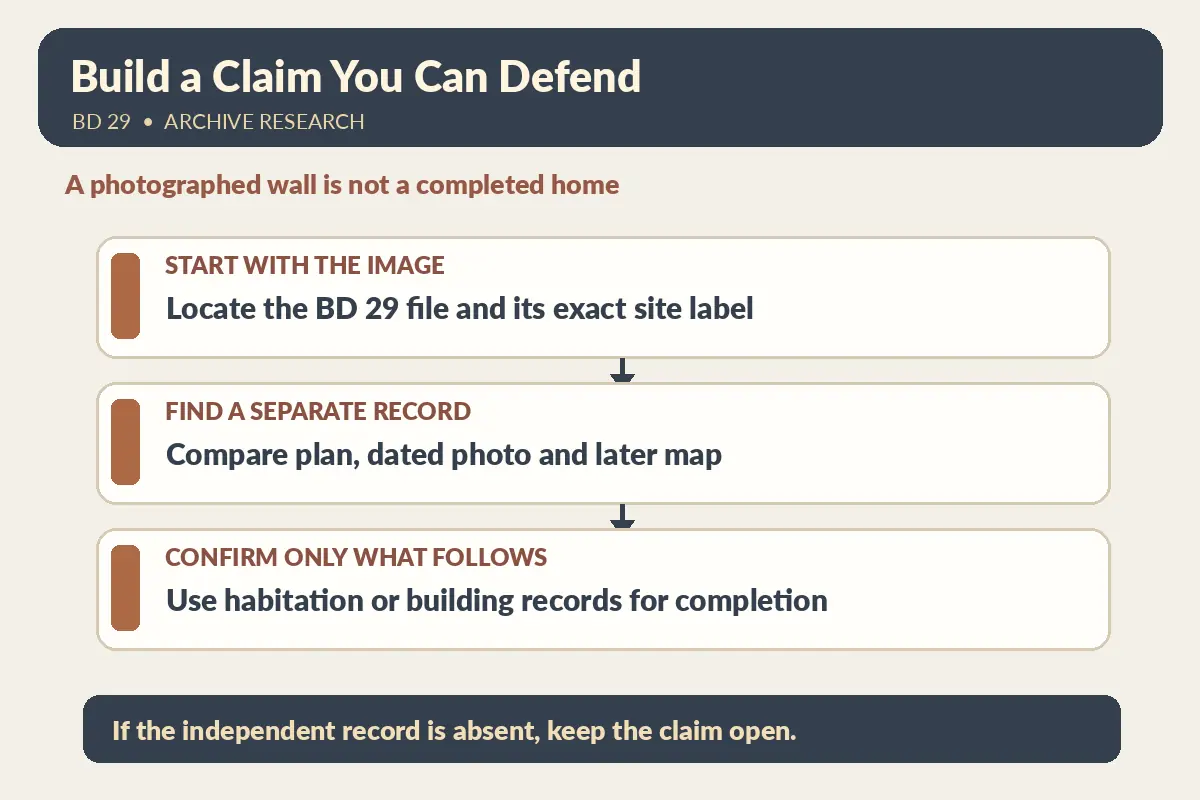
A reliable property summary might say that a particular BD 29 file contains a photograph identified with the estate at a documented stage. It should not jump to a definitive building completion or first-tenant date unless an independent record supports those events. List the next question and the document type that could answer it. A smaller, well-defined result gives families and local historians a better starting point than a confident but unsupported house narrative.
More House and Local History Guides
How We Research This Historical Record Series
We used the official The National Archives guide to photographic collections to establish BD 29 as an archive reference, its creator and what sorts of pictures the series may contain. The guide expressly warns that many photographs are hidden inside paper files, catalog descriptions may not name individual images, and not every record is online. Our method distinguishes a guide-level description from the unseen contents of any particular piece. Readers should use the archive’s Discovery search instructions, inspect the complete file when possible, and retain the difference between the file title, any original caption and their interpretation.
The illustrations are original explanatory artwork rather than facsimiles of any named archival record. The three research aids show alternative starting routes, an evidence-limits table and a conditional corroboration path, not a claim that each pictured item survives. A further research source supports this specific limit: lists BD 29 as Wales Office Ministry of Housing and Local Government photographic material with a 1943–1975 series span. The National Archives citation guide describes how to retain department, series and piece identifiers. If a record was not accessible, report the exact catalogue level reached; never claim an unviewed photo reveals an unnamed person or an unrecorded event.
We also reviewed the supplied GenHis topic inventory for existing BD 29 coverage and separated this article’s question from related guide pages. The recommended cross-check depends on what the reader actually has: a date, address, individual name, event or design. A missing photograph, a closed piece and an unindexed file are not evidence that an event never happened. Disclose missing evidence, document future checks and do not infer legal, professional, engineering or biographical outcomes from one picture. See the affiliate disclosure for site transparency; no archive source here represents a commercial endorsement.
No. It is an administrative file series containing photographs among other papers, not a resident register.
No. Approval and construction are separate events with different evidence.
They have different administrative origins and functions; select the one whose file scope matches your question.
Only to the extent that a reliable caption or related records clearly establish the photographed stage and date.
Search historical local authority and estate names, check series-level entries and document the coverage gap.