
British Excise officers’ entry papers in CUST 116 can help identify someone who sought or entered an excise appointment between 1820 and 1870. They do not, on their own, establish every district in which a man later worked or prove that every candidate remained employed for decades. The practical solution is a three-document test: identify the entry paper, look for the officer’s postings in Excise Board minutes, then test continued work with contemporary salary records. This route matters especially when the same surname occurs in several revenue districts.
Decide Whether Your Ancestor Worked for Excise or Customs
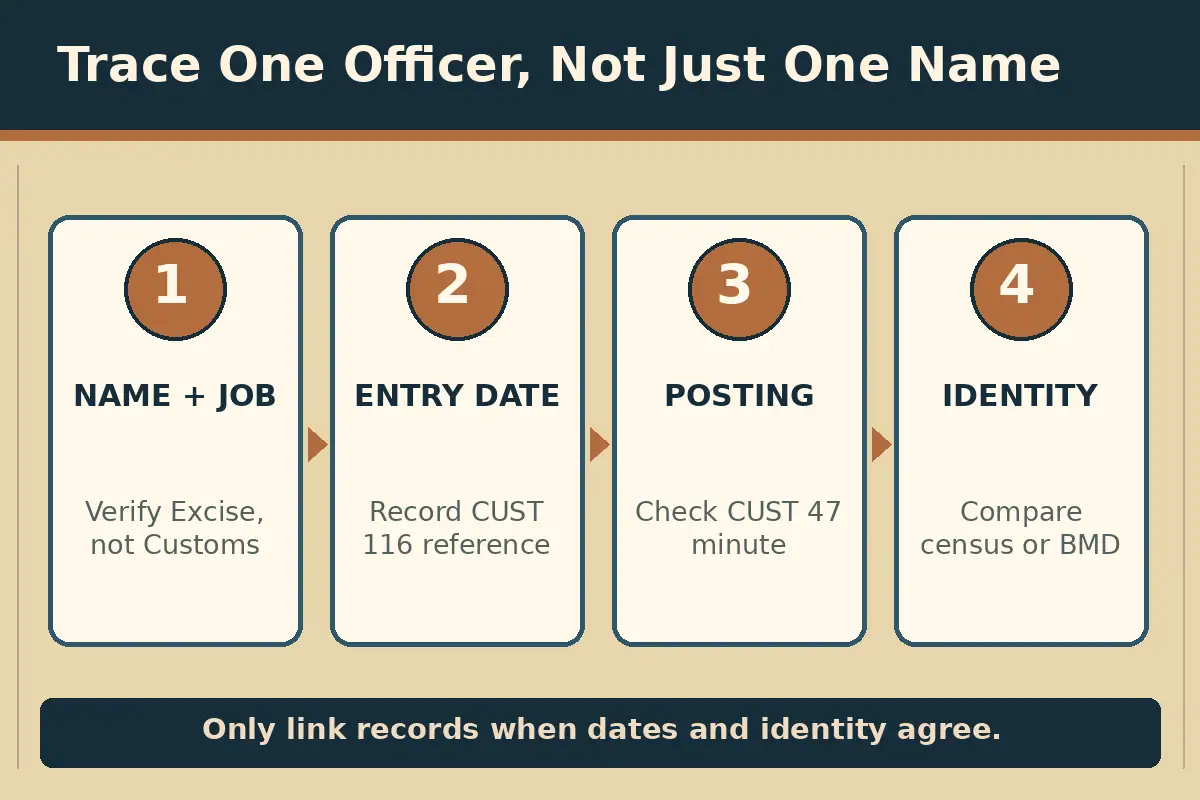
Begin with the occupation exactly as written in a census, marriage register, directory or family letter. An ‘excise officer’ assessed duties on commodities produced or consumed within the country; a ‘customs officer’ usually worked in the revenue system connected with imported and exported goods. Administrative arrangements changed across the period, and casual family descriptions may be imprecise. Record the year and location as well as the job title before choosing a record series. Searching every tax-related series indiscriminately creates false matches among men with common names.
The National Archives’ Excise and Inland Revenue guide identifies CUST 116 as the entry papers of Excise officers, 1820–1870. Its separate Customs officers guide sends researchers to different appointment warrants and Board minutes. Keep a two-column working note headed ‘wording found’ and ‘record system to test.’ If the occupation is simply ‘revenue officer,’ test both possibilities rather than choosing one from the surname alone.
Search CUST 116 by Full Name and Period
Use Discovery to search CUST 116 with a full-name phrase, then relax the first name, initials, spacing and surname spelling. The archive advises using quotation marks to narrow a personal-name search. Note the complete piece reference, catalogue description and original date range. Some files may have brief descriptions; a successful catalogue result is a location tool, not a transcription of the underlying application. Inspect the original image or request the file where access permits before recording family facts.
On the document, distinguish statements supplied by the applicant from later official endorsements, if present. Transcribe reported birthplace or residence only when the particular item actually gives it; the guide does not promise uniform fields for every entry. Note the signature, intended position, recommendation, reference names and dates when legible. An application date may precede actual service. A reference or recommender may belong to an employment network and is not automatically a father, brother or other relation. Keep the applicant’s wording and the administration’s decision in separate columns.
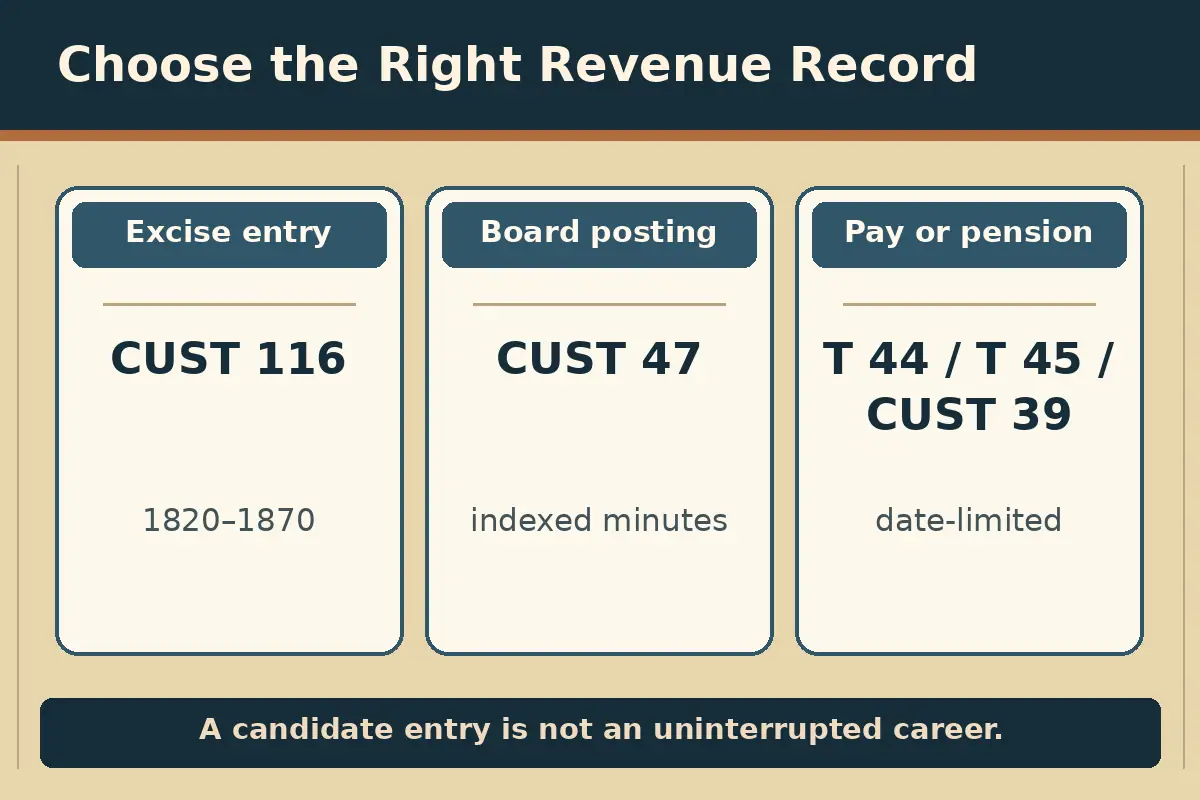
Follow Appointments and Discipline in CUST 47
Excise Board minute books in CUST 47 document first and later postings and may note praise or censure. Unlike a one-time entry paper, minutes can trace a sequence of official decisions; they are not continuous day-by-day service histories. The National Archives states that originals are internally indexed and that name indexes for individual volumes can be viewed online. Select a date range based on the entry paper or the next known residence, search an appropriate volume index, and then inspect the corresponding minute, rather than citing the index as if it were the minute.
Log each minute with its date, administrative place, action, and exact volume or page. If the officer transfers from one station to another, the change supports employment in an institution, but not necessarily a new home address on the transfer date. A censure is a recorded administrative action; it should not be amplified into a criminal charge. Conversely, failure to find a minute may reflect imperfect indexes, a wrong date window, a spelling variant, or missing volumes. Record every unsuccessful volume and spelling checked so the absence is not misrepresented as a dismissal.
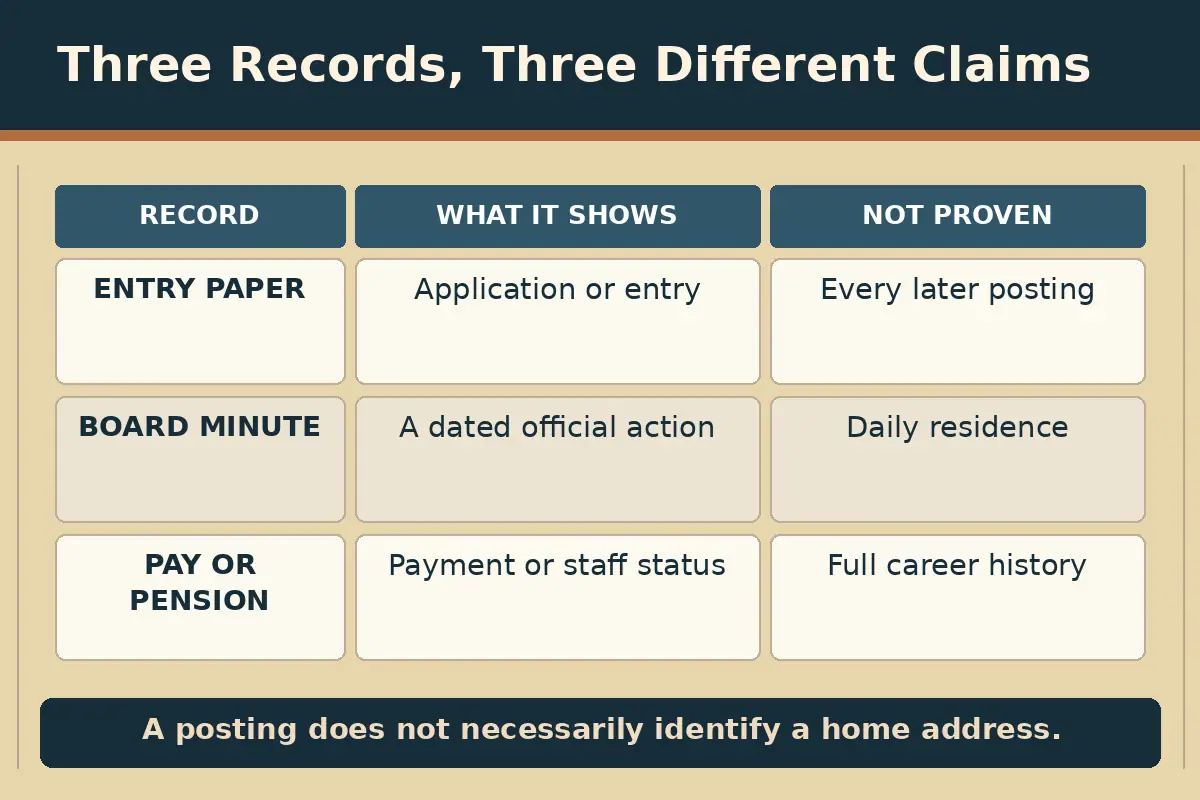
Test a Career Against Salary and Pension Evidence
Excise pay lists provide a different kind of trace. The National Archives directs researchers to T 44 for England, covering 1705–1835, and T 45 for Scotland, covering 1708–1832. These ranges only overlap the early part of CUST 116; do not imply that they form a complete pay sequence through 1870. Select the correct country and accounting period, then compare the named officer, post and any available remuneration with the entry and minutes. Different spellings and payment intervals can obscure a match.
For a later career or retirement, CUST 39 contains staff lists and pensions but is not name-indexed, so browse the relevant years rather than assuming a blank search box means no entry. The distinction between appointment, paid service and pension is crucial: even a successfully located pension does not establish a precise last day of work unless the document says so. Record the kind of payment, the period to which it refers, and the receiving person. If a list names an officer but not a place, use contemporaneous directories and census returns only as independent identity checks, not replacements for official payroll.
Resolve Namesakes and Conflicting Districts
Make a comparison table for every plausible candidate with name, reported age, locality, occupation wording, spouse or household, and series reference. Do not force a district transfer merely to connect two same-name items. A persuasive link may involve an entry paper with a matching signature, a dated appointment in CUST 47 and an independent civil record near the next posting. If those features do not agree, retain two candidates. An unusual name is still not enough to prove identity where the record dates are widely separated.
Be particularly cautious about administrative place names. A named port in a customs minute, a salary district, and a house listed in a census are not necessarily the same geographical unit. Put each original phrase in quotation marks in your working transcription, with the record date beside it. Historical county boundaries, towns and duty areas may not match modern addresses. When the chronology seems impossible, inspect the original rather than assuming the person held overlapping posts or moved instantaneously. A missing payroll interval is a research gap, not proof of unemployment.
More Records and Archives Guides
How We Research Excise Employment Claims
We first identify which revenue service the record describes, then choose the series by date and function: CUST 116 for entry, CUST 47 for Board decisions, T 44 or T 45 for period-specific pay, and CUST 39 for relevant later staff or pension lists. For every useful reference we retain the catalogue identifier, inspection method, page or folio and a short transcription of the original wording. The result is a reproducible employment timeline whose supporting records can be retraced by another researcher.
The primary archive guidance is linked above and should be rechecked for current access and reproduction arrangements before ordering. If an index lacks a person, we note whether the original series was browsed and which years survive. Our method never converts an application into a completed appointment or a job title into proof of family relationship. Reader disclosure: see GenHis affiliate disclosure; no paid research provider is required to follow the archive-first workflow described here.
Not by themselves. An entry paper may show an application or administrative entry; corroborate an appointment in CUST 47 and, where available, payment evidence.
Many CUST 47 volumes have internal name indexes, with some indexes downloadable. The matching original minute still needs inspection.
Check the different customs record system rather than assuming he belonged to Excise; job descriptions in family sources can be approximate.
No. The described English lists end in 1835 and the Scottish lists in 1832, so they only overlap the earlier CUST 116 period.
No. A staff or pension entry can support an administrative relationship; corroborate an address with independent contemporary records.