
The FBI record group at the National Archives includes original cartoons relating to the Bureau, designated H and HM, dated 1934–1972. The RG 65 guide names artists such as Herblock, Rube Goldberg, Charles Schulz, Ding Darling, Hy Rosen and Enright. It describes 863 images in the H/HM grouping and separately lists a 1949 anniversary album coded HA. This is a collection of historically significant artwork; it is not an official index of every cartoon an artist published or proof that the FBI endorsed each viewpoint.
Start with RG 65 section 65.10 and use the NARA still-picture guide to interpret the designators. A cartoon about an agency may have been drawn for a newspaper, presented to an official or accumulated for an administrative purpose. Those are different provenance stories. The item’s original markings and publication history—not just the fact of NARA custody—must determine which story you tell.
Do Not Merge H, HM and the Separate HA Album

NARA groups the original FBI-related cartoons under H and HM, with a broad 1934–1972 range. It lists the 14-image HA anniversary album separately, connected to J. Edgar Hoover’s twenty-fifth year as director in 1949. Keep these distinctions visible in notes and illustration captions. An HA image should not be cited as H/HM merely because both belong to RG 65, and the anniversary purpose should not be projected onto unrelated critical or humorous drawings.
Begin an item worksheet with group, series code, artist signature if legible, date or date range, original title, acquisition note and physical format. Where an image is unsigned, do not attribute it to a famous cartoonist merely because the style resembles published work. The series description gives examples of artists represented, not a verified artist list for every object. Ask the archive for exact item data before selecting a definitive byline.
Separate the Cartoon’s Message From an Agency Position
Political cartoons are argument, satire and commentary rather than neutral photographic records. A character’s speech bubble or a caricature of an official reveals the maker’s presentation, not necessarily an event as it happened. Likewise, the presence of a drawing in FBI records can indicate collection or presentation without showing endorsement. Identify the intended audience, possible original publication, and period controversy before interpreting the image as a statement of policy.
For a cartoon referring to wartime spies or public fears, date its publication separately from the period it depicts. Avoid using a joke to assert that a real person committed an offense or that an agency agreed with the allegation. When the original artwork lacks contextual notes, compare with contemporary newspapers and archival correspondence only if those sources can be independently located and matched. A caption should label interpretation as interpretation.
Trace Artist Attribution Through Original and Published Versions

An artist’s signature, a newspaper masthead, a syndication credit and a later exhibition caption can be different kinds of information. Record each one verbatim and note who supplied it. If the same drawing appeared in print, publication date and page number can help anchor a chronology. Do not copy a convenient web image and claim it is identical to the preserved original without comparing composition, lettering and any changes between versions.
An original cartoon may include corrections, marks or annotations that a published reproduction omits. Those features are valuable for art history but should not be silently reconstructed. A smaller newspaper clipping may also crop the original. Use the unique item number and physical description if available; the big RG 65 series range alone does not identify a drawing precisely enough for source criticism.
Check Reproduction Rights Instead of Assuming Public Domain
Federal archival custody does not automatically turn privately created cartoons into works free of copyright. A work by an independent cartoonist can retain rights even when an original drawing is held by a public institution. Ask NARA about the reproduction provided, then independently assess the copyright status and any rights holder before republishing a full cartoon. This is especially important for drawings connected to named twentieth-century artists.
For an educational article, describe the artwork and link to an authorized archival catalog item rather than reproducing a high-resolution copy when the rights are unclear. Attribute claims precisely and avoid confusing historic newspaper reuse practices with modern permission. An original explanatory illustration that does not imitate a copyrighted cartoon may help show archival workflow without claiming to reproduce the collection artwork.
Write a Caption That Distinguishes Custody and Meaning
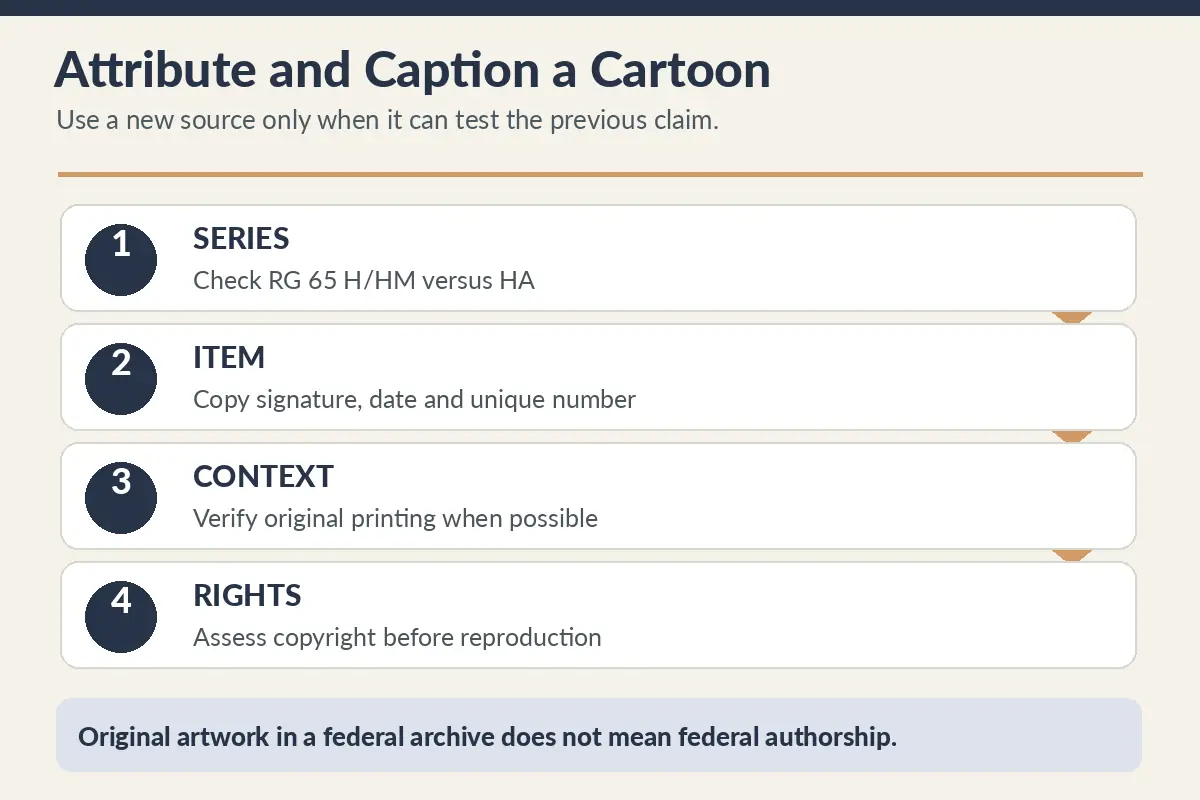
A careful caption can say “cartoon preserved among FBI-related original artwork in RG 65 H/HM,” followed by the verified artist and date if known. It should not say “FBI cartoon” in a way that sounds as if the Bureau created or authorized the drawing. If the cartoon refers to a law-enforcement investigation, treat its content as commentary until reliable administrative or court sources establish the relevant facts.
For family historians, the cartoon can show a public attitude during a period when a relative lived, worked or served, but it is not evidence that the relative saw it. If a family member clipped it from a newspaper, that clipping may support circulation in a particular household only when its provenance is established. Keep the individual household story separate from the archival collection’s broader cultural context.
Worked Example: A Signed Cartoon in a 1940s Scrapbook
Imagine finding a signed newspaper cartoon about wartime secrecy in a grandparent’s scrapbook. A similar drawing appears in an online RG 65 search. Compare the drawing, signature, printed date and any original annotations before assuming it is the same work. The scrapbook supports a family association with the clipping; the archival original may illuminate the artist’s process. Neither fact proves that the FBI created the cartoon or supported its message.
A secure citation would identify the scrapbook’s own provenance, the newspaper source if recoverable, and the separate RG 65 item description. If copyright status is uncertain, paraphrase the argument and link to the holding institution rather than republishing the image. This preserves the difference between a family artifact, a printed copy and a retained original artwork.
More Family Story and Preservation Guides
How We Research and Document These Sources
We checked the archive’s explicit distinction between H/HM cartoons and the separate HA album and did not treat the list of named artists as item-level attribution. We have not verified a complete index for all 863 images. The NARA description supports custody and general content dates, not automatic publication or ownership histories for each artwork.
We separate four questions in every illustration note: who created the object, what the message says, why the archive holds it, and what rights apply to reproduction. Our own explanatory graphics are original diagrams, not facsimiles of archival cartoons. Review the affiliate disclosure for the site’s general policy; this research guide does not endorse any commercial image vendor.
No. NARA describes original FBI-related cartoons, including works by named independent artists.
No. NARA designates that 14-image anniversary album HA, distinct from H/HM.
Only if the specific item independently supports the attribution; the general guide lists artists represented in the group.
No. Archival custody is not proof of endorsement, creation or agreement.
No. Copyright and reproduction rights must be assessed separately for an individual artwork.