
A vivid picture of an eighteenth-century uniform is not necessarily an eighteenth-century picture. The National Archives describes 195 color lithographs of U.S. Army uniforms representing 1774–1908, by Henry Alexander Ogden, dated 1909, within War Department General and Special Staff records, RG 165. The images carry the archival series labels HOA, HOB and HOC. They can help explain historic military dress but cannot identify a particular soldier or prove that an ancestor served in the pictured unit.
The crucial research move is to keep three clocks separate: when the uniform is represented as being worn, when the artwork was produced or published, and when a family photograph or service document was created. The Library of Congress also holds Ogden uniform prints with their own item dates, including artwork illustrating the War of 1812. A shared artist does not make those items identical to NARA’s 1909 group. Cite the exact print, not just the famous artist’s name.
Read the 1909 Collection Description First
NARA’s RG 165 Guide gives a concise description: 195 color lithographs of U.S. Army uniforms from 1774 to 1908, created by H. A. Ogden in 1909, under the series identifiers HOA, HOB and HOC. Those labels help locate a print, but they are not regimental service-file identifiers. The collection sits in a staff records group; its purpose is visual historical documentation, not named personnel accounting.
Before drawing conclusions about a sleeve braid or belt, find the specific original caption and image identifier. The general series date and artist identify the collection, but the individual plate may depict an earlier branch or period. If a web image circulates without provenance, search the Catalog for its caption and compare it to the full sheet. A cropped illustration missing a plate title may also be missing important context about what the artist intended.
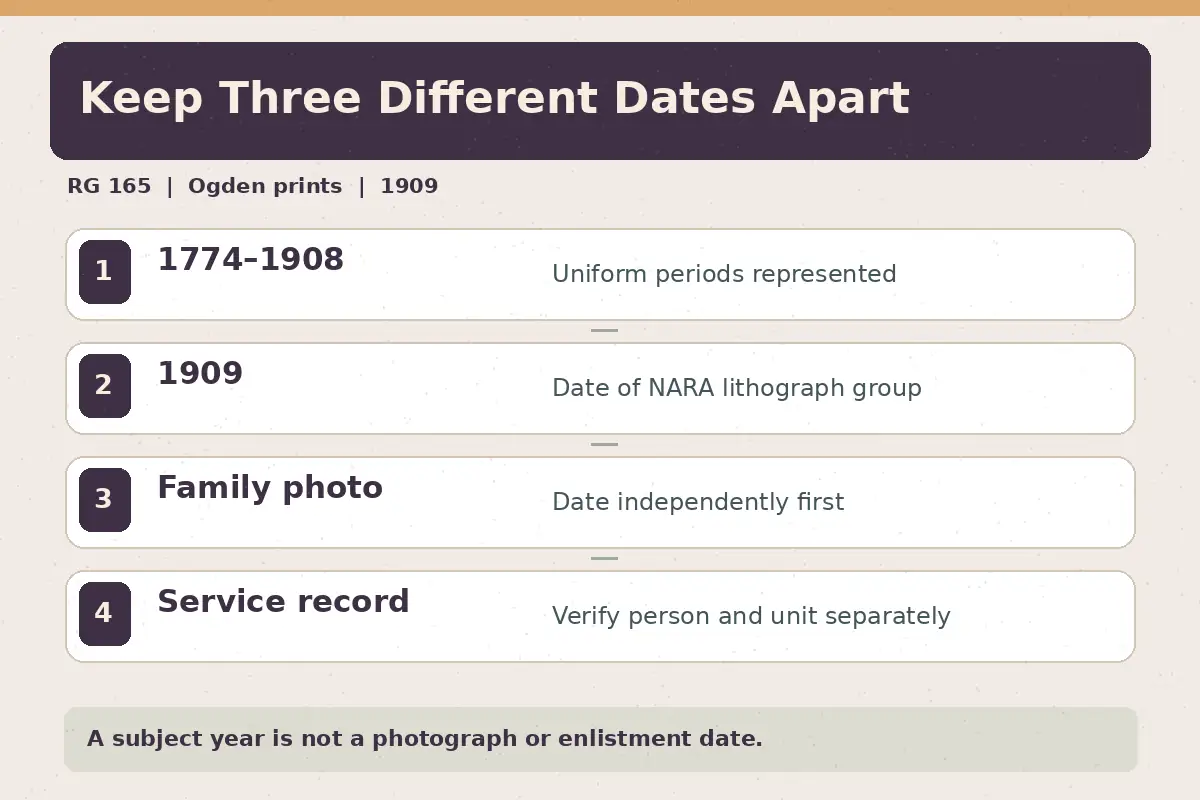
Separate Subject Date, Artwork Date and Family Date
The printed sheet may have a 1909 production date while portraying a uniform associated with the eighteenth or nineteenth century. Neither date is necessarily the date on which your ancestor wore something similar. If a relative’s photographed jacket looks alike, first date the photograph independently by its studio address, photographic process, inscription and known family chronology. Then see whether the uniform elements are consistent with that independent range.
Build a comparison with three columns: depicted uniform period, documented publication date of the print, and documented date or range for the family image. When one column is unknown, leave it blank. Do not use the print to manufacture the missing value. Uniform changes varied by branch, rank, local circumstances and the availability of equipment. A reconstruction may simplify a complicated historical transition into one visually clear model.
Treat a Historical Illustration as Interpretation
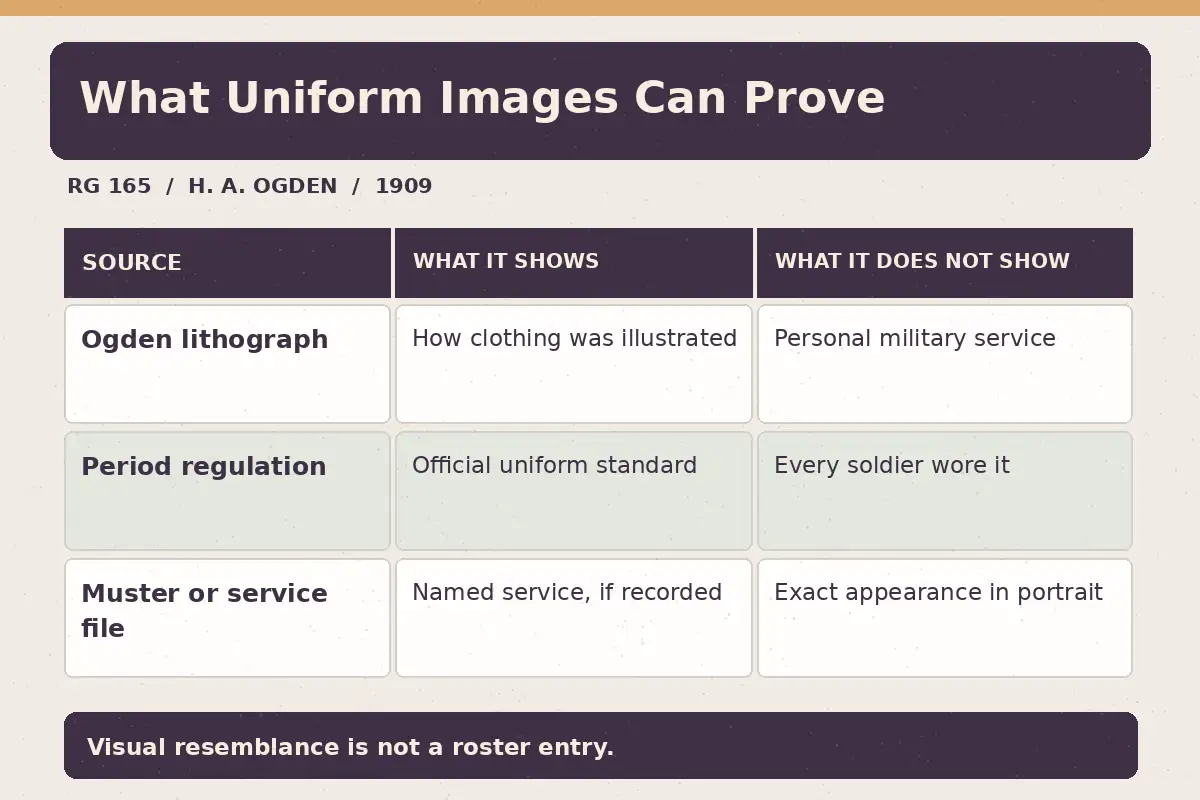
Ogden’s drawings are valuable because they assemble details and render them legibly, but they are still later representations of past military dress. A plate’s colors may reflect an artist’s sources, production process and the conventions of a commemorative series. It is not an unmediated photograph of a soldier standing before the painter in 1780. Even a carefully researched plate needs comparison with period regulations, surviving textiles, dated contemporary images or museum documentation when an exact garment claim matters.
Watch for uniforms assembled to illustrate a type rather than a named person. Similar shapes and colors can appear across forces and decades. A cuff, facings, headgear or insignia may suggest a branch or era, but a single detail rarely identifies a precise company. Put stronger weight on the service record’s branch, unit and dates, then use clothing references to interpret the historical setting. Visual similarity is a hypothesis, not an enlistment entry.
Compare NARA Plates With Library of Congress Prints
The Library of Congress catalogs separate Ogden works, including a chromolithograph titled “United States Army and Navy uniforms—War of 1812.” Its item-level description names the artist and identifies a broad creation window. Another LOC discussion, published in June 2026, examines historical military uniform illustrations. These resources can help distinguish editions, plates and subjects, but their catalog references should not be substituted for NARA’s HOA/HOB/HOC series identifiers.
Where two images appear to show the same uniform, compare inscriptions, subject headings, publisher information, image crop and plate design. A duplicate digital file may be a later reproduction; a similar Ogden composition may be a separately issued print. Capture the individual repository’s call number or local identifier. That will help a researcher avoid attributing a family-owned clipping to the wrong institution or assuming every Ogden picture is part of the 1909 NARA set.
Use the Print to Ask Better Service Questions
If family lore names a unit, find an independent military record first: muster roll, enlistment register, discharge, pension application or contemporary letter as appropriate to the date. The historical print may help explain how a documented rank or branch was represented, but it does not supply the person’s name or establish combat service. A soldier’s exact appearance on a particular day cannot be reconstructed from a generic color plate without additional evidence.
For an undated family portrait, list specific visible elements—headgear, coat cut, rank marks, buttons, weapons, equipment—without assigning an immediate unit. Compare them with a period-correct reference and independent family timeline. When details conflict, retain the possibility of borrowed clothing, theatrical dress, a later re-enactment or mistaken identification. You may discover that the image is commemorative art rather than a direct family artifact; that is a useful historical finding.
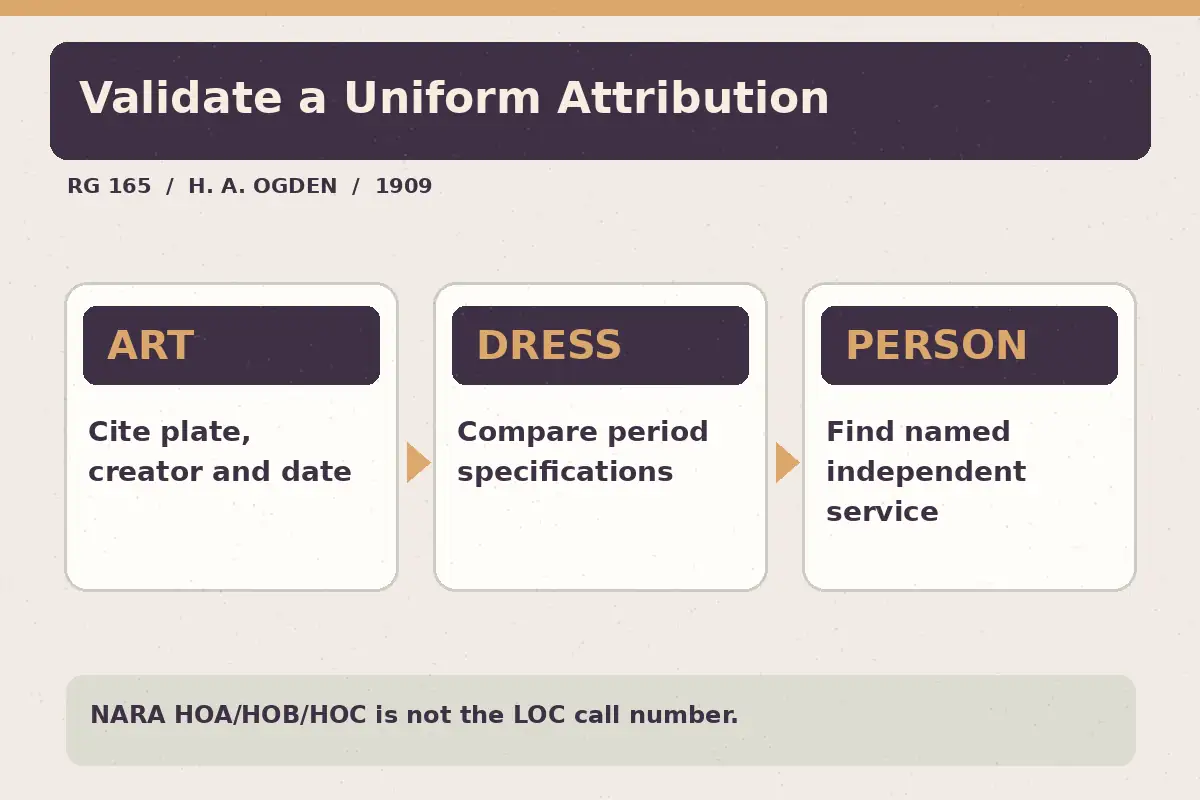
Cite the Image Without Misstating Its Evidence
A strong citation includes the creator, print title or plate caption, year of publication if documented, repository, record group and HOA/HOB/HOC identifier for the NARA item when known. For a Library of Congress comparison, cite its own title and item number rather than RG 165. State whether you saw the original print, a complete digital surrogate, or a reproduction whose cropping and color may differ. A print’s subject-period label belongs in the description, not in place of the creation date.
In the final family narrative, write something like “the documented soldier served in a unit whose uniform has been illustrated by Ogden,” only if the unit and date align independently. Avoid “Ogden portrayed my ancestor,” unless the image truly names that individual. A carefully labeled uniform illustration enriches a story without pretending to be a roster, portrait or eyewitness scene.
More Family Story and Preservation Guides
How We Research Military Uniform Illustrations
We checked NARA’s RG 165 holding description against Library of Congress catalog information and its June 2026 discussion of uniform illustration. The article retains NARA’s exact collection-level facts—195 lithographs, 1774–1908 subjects and 1909 date—without assuming every LOC Ogden print belongs to the same series. We have not identified any individual soldier by appearance.
We interpret the pictures as historical images whose evidentiary weight depends on date, creator, caption and comparison with contemporaneous records. See the RG 165 Guide, LOC’s separate Ogden item, and the site’s affiliate disclosure. This method does not require commercial ancestry subscriptions.
The NARA lithographs are dated 1909 but depict uniforms associated with the period 1774–1908.
They are labels for the RG 165 Ogden lithograph series in the NARA guide, not soldier identification numbers.
No. Service must be supported by personnel or other individual historical evidence.
No. The repositories catalog distinct items and collections; use each item’s own identifier.
No. Use the photograph’s provenance and independent chronology before comparing specific clothing features.