
The National Archives describes 140 Army disease-prevention posters dated 1942–1944 in RG 112, records of the Office of the Surgeon General (Army), as still-picture series P. The subjects include prevention of venereal disease and other diseases. The official RG 112 guide verifies the series and date range; it does not report that each design was displayed at a particular base or viewed by a named soldier. Posters explain what authorities wanted audiences to hear. They do not directly count patients, diagnose individuals, or establish the effects of a campaign.
For family historians, museum captions, and medical-history researchers, the right question is usually what the poster said, how it framed risk, and which institution assembled it. The wrong shortcut is to quote a dramatic warning as statistical proof of an outbreak. A responsible reading also recognizes that some wartime imagery used fear, stereotypes, or stigmatizing language. Such material can be studied and accurately attributed without endorsing its framing or turning an anonymous figure into a supposed patient.
Identify Series P and the Actual Printed Design
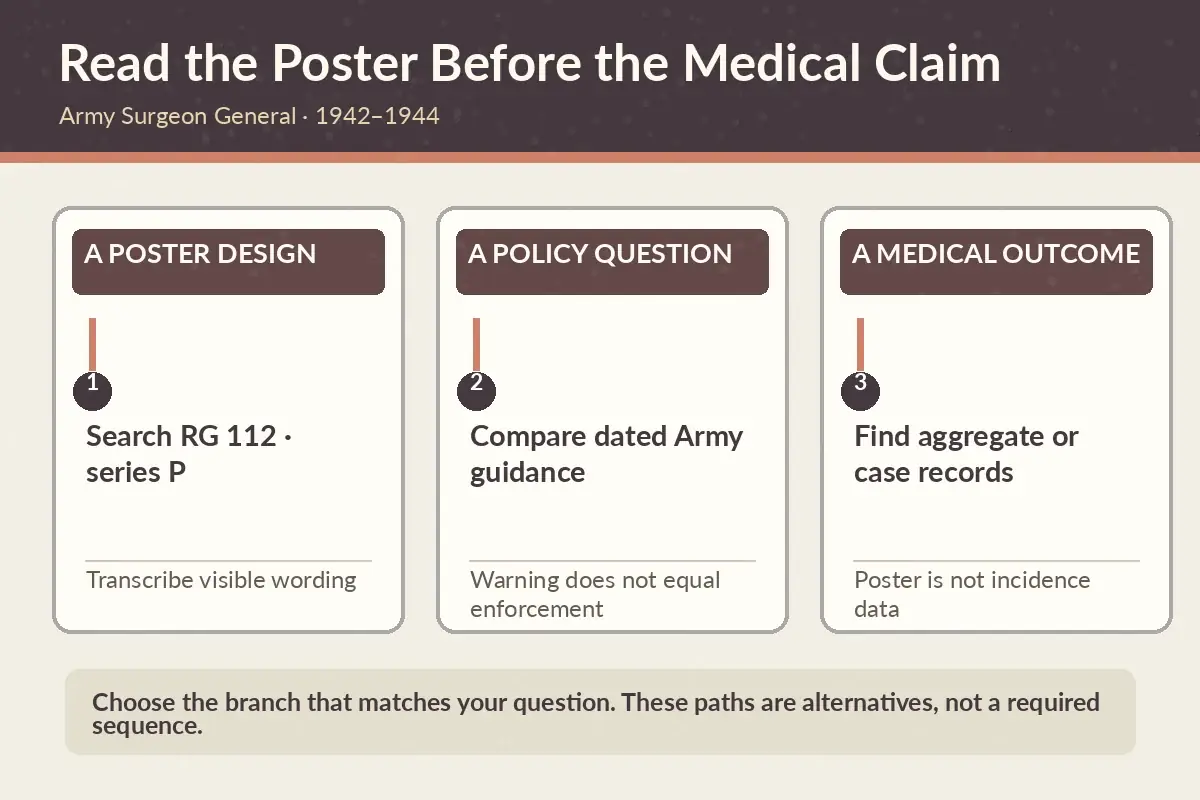
Start with RG 112, the still-picture listing, and the series designator P. NARA’s entry covers the 140 posters as a group and gives 1942–1944 as the period. Search the National Archives Catalog with these terms and the specific wording, scene, or symbol if it is known. Write down a catalog identifier when one is available; if the guide is the only source found, say so. An online thumbnail may be a crop or color-adjusted reproduction rather than a complete artifact showing its publisher, attribution, or original dimensions.
Inspect the margins, small-print credits, production or sponsoring office, slogan, and any printing date. An archival series date range cannot prove a precise issue date for every copy. If a later reprint is encountered, distinguish the graphic design from the physical print and its date. A different image of the same warning may belong to a separate collection. Do not assign a service branch, medical unit, or named artist without a credit or supporting accession record.
Distinguish Prevention Language From Observed Disease
A message like “prevent infection” is evidence of a preventative appeal; it is not evidence of a case at a particular post. Record the actual claim or instruction on the image, then categorize it: medical advice, behavioral exhortation, moral appeal, recognition warning, or facility instruction. Those categories help explain the visual rhetoric without assuming the audience complied. Even a poster explicitly mentioning a disease does not establish that the disease was present at the pictured location, because many posters were made for broad distribution.
If your historical question concerns disease prevalence, search for the relevant Army Medical Department statistics, sanitary reports, epidemiological summaries, or a defensible local comparison. Those records have their own definitions, covered populations and reporting biases. A rise in reporting may not mean the same thing as an increase in underlying illness. Write a sentence explaining what the poster establishes before adding a second sentence about what an independently cited statistic establishes. Never let the poster silently serve as both sources.
Protect Individuals From Unsupported Inference

The generic people drawn on wartime posters may represent stereotypes rather than identifiable models. Their appearance is not proof of a real person’s diagnosis, occupation, identity, or misconduct. For a named servicemember, a station assignment could show where the person was serving, but not whether they saw a particular poster or received treatment. Personal health information is sensitive; access, consent, and privacy considerations may restrict patient-level sources, especially for people whose records remain protected.
Historical disease messaging sometimes blamed or caricatured groups in ways that are inaccurate or harmful. If you must reproduce such imagery in scholarship, contextualize its purpose and limitations instead of borrowing its accusations as fact. A precise caption might read: “Army health-prevention poster in RG 112 P, dated within 1942–1944 in the series guide; intended posting location unconfirmed.” That is materially different from a claim about a soldier or a population.
Compare the Poster to Contemporary Army Instructions
RG 112 contains much more than illustrations. The guide identifies orders, circulars, correspondence, sanitary reports, technical and medical units, and other administrative records. These may help establish that a message fitted a formal policy at a documented time, but related holdings do not automatically mention the exact poster. Search by relevant department, year and subject. If a memorandum orders a distribution, preserve that document’s date and audience; if no such directive is found, use “poster in the collection” instead of “posted at every camp.”
When comparing a 1942 design with later recommendations, do not impose modern medical language on the original image. Explain what the period message actually advocated and identify anachronisms in your discussion. Different diseases require different evidence and should not be collapsed merely because they were filed in the same series. A poster advocating disease prevention is a piece of public communication; a clinical finding, medical survey, and individual case file each carry distinct evidentiary weight.
Preserve Ethical Captions and Reproduction Details

NARA’s still-picture guidance can help locate reference images and determine how to request reproductions. Record RG 112, series P, the item identifier if available, printed slogan, visible office or artist, medium and caption as it appears. Keep the full image and its context when evaluating visual claims. A re-created illustration should be called an illustration, not an original government poster. A copy held by a federal archive does not automatically settle every third-party rights issue.
Before publication, have a second reader check the transcription and whether quotations imply an unproven disease outcome. Remove assumptions such as “all soldiers saw this” unless contemporary distribution evidence supports the breadth of the claim. The final product can still be compelling: it can show how military public-health messaging was constructed, dated, and archived while clearly reserving medical claims for sources able to sustain them.
More Family Story and Preservation Guides
How We Research and Verify the Original Record
The factual starting point for this article is the official record-group inventory: RG 112 still pictures section lists 140 prevention posters dated 1942–1944, series P, concerning venereal disease prevention and other diseases; the listing is not a disease-incidence table. We checked its language on the series and resisted extrapolating unlisted item dates, complete digitization, individual identities, or legal outcomes from an inventory alone. We also consulted the applicable NARA format-specific research guidance. Our diagrams are interpretive editorial illustrations rather than copied archival images; their labels are designed to route a researcher toward the original evidence. Nothing in this overview implies that we examined every individual item in the described holdings.
For an item-level citation preserve the archival record group, series, item number if available, any printed date, the version actually consulted and any relevant annotations. A researcher unable to view an original should use NARA research and visit instructions to request access details instead of reporting observations never made. For transparency, see our affiliate disclosure. No paid archival partnership or access guarantee is implied. The practical standard is to identify the intended health message while avoiding unsupported assertions about particular soldiers or disease rates.
The official guide lists 140 posters about disease prevention, dated 1942–1944.
No. It documents an official message, not cases or incidence rates.
Not from the poster alone. The figure may be illustrative or generic.
The series description does not establish distribution to every base; use a dated order or receipt to support that claim.
Check the item’s rights and reproductions information rather than relying solely on its archival custody.