
The National Archives lists a concentrated 1949 photographic series about the 48th anniversary of the U.S. Army Nurse Corps: 149 images in RG 112, designated SGN. These photographs can help explain a commemorative event, visual culture and institutional memory. They are not a roster of every Army nurse and cannot by themselves establish a photographed person’s complete military career. Begin with the scene and its original caption, then use separate event records for attendance and personnel documents for service dates or assignments.
An anniversary is a specific occasion, not evidence that all the people pictured performed the same wartime duty. The guide’s label places SGN among still pictures of the Office of the Surgeon General (Army). Its creator and archival custody must be distinguished from the administrative offices that held individual service files. A ceremony might include current nurses, retired personnel, military leaders or guests; the series-level description does not specify every participant. Do not assign a role from a uniform, a seating arrangement or a familiar face without a name source.
Choose the Correct Source for Your Question
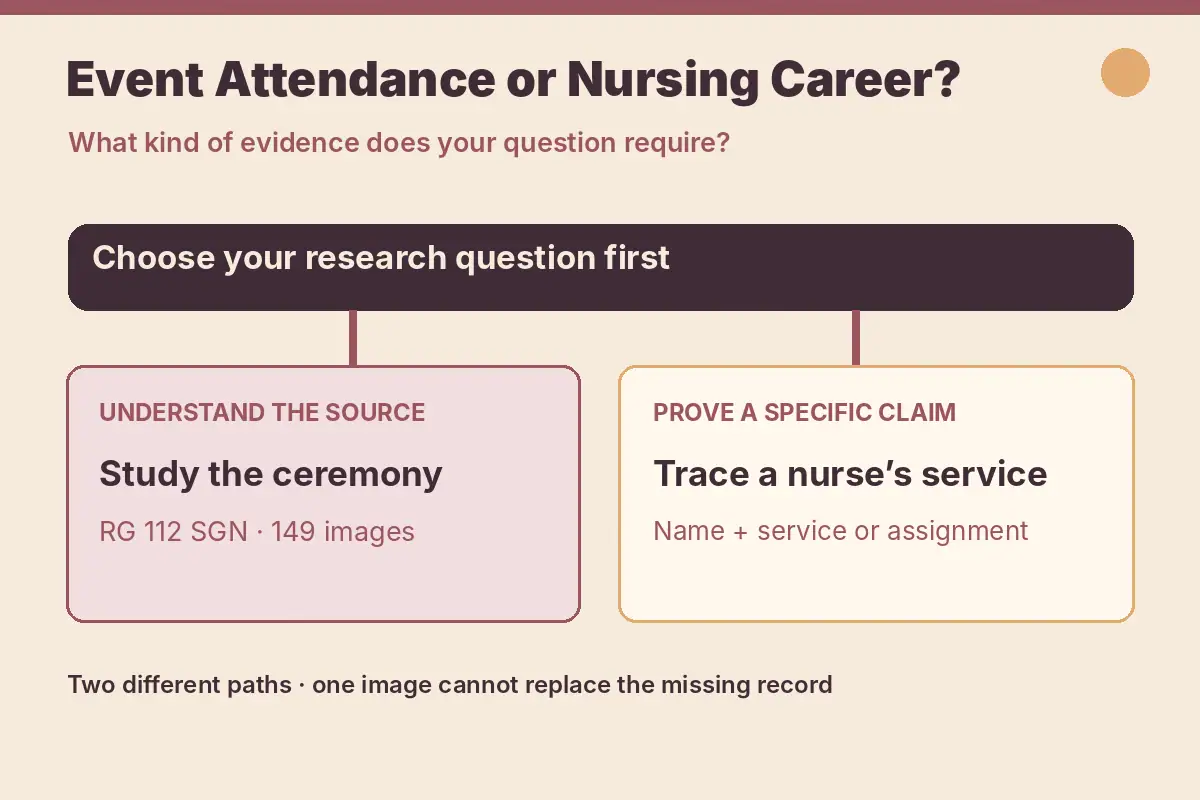
The 48th-anniversary designation and year 1949 are supported by NARA’s guide. Neither proves the date of every negative or print; a caption or individual item record is needed for that level of precision. The number of images does not mean 149 distinct attendees, nor that the event occurred at 149 places. Some photographs may show the same people or moment from multiple angles. Preserve frame numbers and caption associations when reviewing sequences; a cropped reproduction can conceal a podium or sign necessary to identify an occasion.
Search by “Army Nurse Corps anniversary,” RG 112 and SGN together, not just by the person’s surname. Where an image has no accessible caption, ask for the correct item identifier and accompanying list if one exists. The National Archives guide describes the series, not the status of digitization for every frame. If the online catalog offers one representative picture, that is not necessarily the entire group. Record the archive title and the date it gives rather than inventing an album number from a modern website filename.
The official NARA description specifies 149 photographs for RG 112 SGN, with the coverage 1949. That is a boundary for archival discovery, not a substitute for an item-level caption, a proof of full digitization, or a guarantee that every object in the group describes the same person or event. A useful first search combines the record group, the letter designation and the subject, then follows the catalog hierarchy to an actual object or folder. Write down its exact citation instead of creating a plausible-looking inventory number.
Keep the Original Caption and Historical Date Separate
For a named nurse, compare a photograph with a dated invitation, news article, event program, or other contemporaneous source that identifies participants. A person’s name printed in a program may show their expected role but is not necessarily proof that they attended or appeared in any particular image. Conversely, a face recognized by relatives may be worth investigating but remains an identification hypothesis until supported by provenance and an independent contemporary document. Keep the witness to identification and the record confirming service as separate citations.
Then turn to the actual career question. When did this nurse enter military service? What units, hospitals or posts appear in official documents? Was the person still serving in 1949? Those questions need documented assignments and dates, not simply a ceremony image. An anniversary photo can be excellent contextual material for a verified biography, especially when uniforms or colleagues are identified, but it cannot fill gaps in a service timeline. Avoid converting a public celebration into proof of an overseas posting or a particular award.
Compare a Picture With an Independent Record

A concise evidence table should distinguish what is visible in SGN, what a surviving event notice explicitly names, and what a personnel record establishes. Keep dates and ranks in the form used by each source. Individuals can change rank or surname; an apparently matching name is not enough to merge two careers. If sources conflict, record both claims and the reason one has greater authority. When privacy restrictions or missing service papers prevent a conclusive match, say precisely which questions remain unanswered.
The common but unsafe shortcut is that attendance at a 1949 anniversary ceremony proves a complete military nursing career. For a question about a named nurse and the assignments of that person, test the proposed link against service records, assignment orders, named event programs and contemporaneous press accounts. Keep a record ledger with separate columns for original wording, image date as stated, archival identifier, direct content, inference, and independent confirmation. Never allow a caption copied into two websites to act as two independent sources. If the original item is inaccessible or the inscription is unclear, retain that limitation rather than filling it with a family story.
Build the Evidence Chain Before Naming a Person

An accurate caption might say that a photograph is part of the Army Nurse Corps 48th-anniversary celebration series, RG 112 SGN, 1949, with individual subjects only where verified. An original modern diagram should be labeled as explanatory artwork rather than archival photography. Tell the narrower story first: the event, the scene, and what a surviving photograph can support. Only add a career narrative when the service evidence actually supports it.
Test the working question directly: “Can an SGN anniversary photo document a particular Army nurse’s service?” One archival image may supply context while a second type of document supplies names, dates or an administrative decision. Note when the second source is genuinely independent, whether it covers the same location and date, and what conclusion each document can support without assistance from the other. A search failure is not evidence that a person never existed, that a facility never operated or that an event did not occur; it is evidence only about the records and access routes actually checked.
Write a Credible Caption and Preserve the Research Trail
Prepare a publication caption in three parts. First identify the archival source as RG 112, series SGN, and copy the real item identifier when available. Second state exactly what the original item itself shows or says, including the limits of its date and geographic scope. Third introduce any additional inference with a citation to the corroborating source. If you use an artist-made historical illustration instead of an archival image, label it as modern explanatory artwork. Avoid presenting an invented historical stamp, identifier, family connection or image label as part of the primary record.
Preserve the original description in your research notes even after correcting outdated terminology or a likely caption error. For public writing, use clear modern language and explain unusual historical labels only when necessary to understand the source. Keep an audit trail of changed identifications and retain rejected alternatives, particularly when place names, units, taxonomic terms or personal names recur. An accurate statement of uncertainty is often the most valuable part of historical research: it lets another researcher understand what must be found next.
More Family Story and Preservation Guides
How We Research the Archive and Its Evidence Limits
We checked the National Archives RG 112 record-group guide for the cited series, medium and date range. We also consulted this complementary archive or collection guide to interpret custody or the separate research question. The NARA getting-started guide explains how to move from a topic to surviving records. Photographs provide a different kind of evidence from name indexes, administrative records and contemporary accounts. Our graphics are newly drawn explanations rather than facsimiles. Sources and access arrangements can change. Read our affiliate disclosure.
The archive calls these photos the 48th-anniversary celebration of the Army Nurse Corps, not a general annual roster.
NARA identifies 149 images in the 1949 SGN series.
No. The image cannot on its own establish a nurse’s earlier assignments or military status.
A program may establish a scheduled or named role, but a specific photographic identification still needs supporting evidence.
Use actual personnel or assignment records and dated institutional sources appropriate to the named individual.