
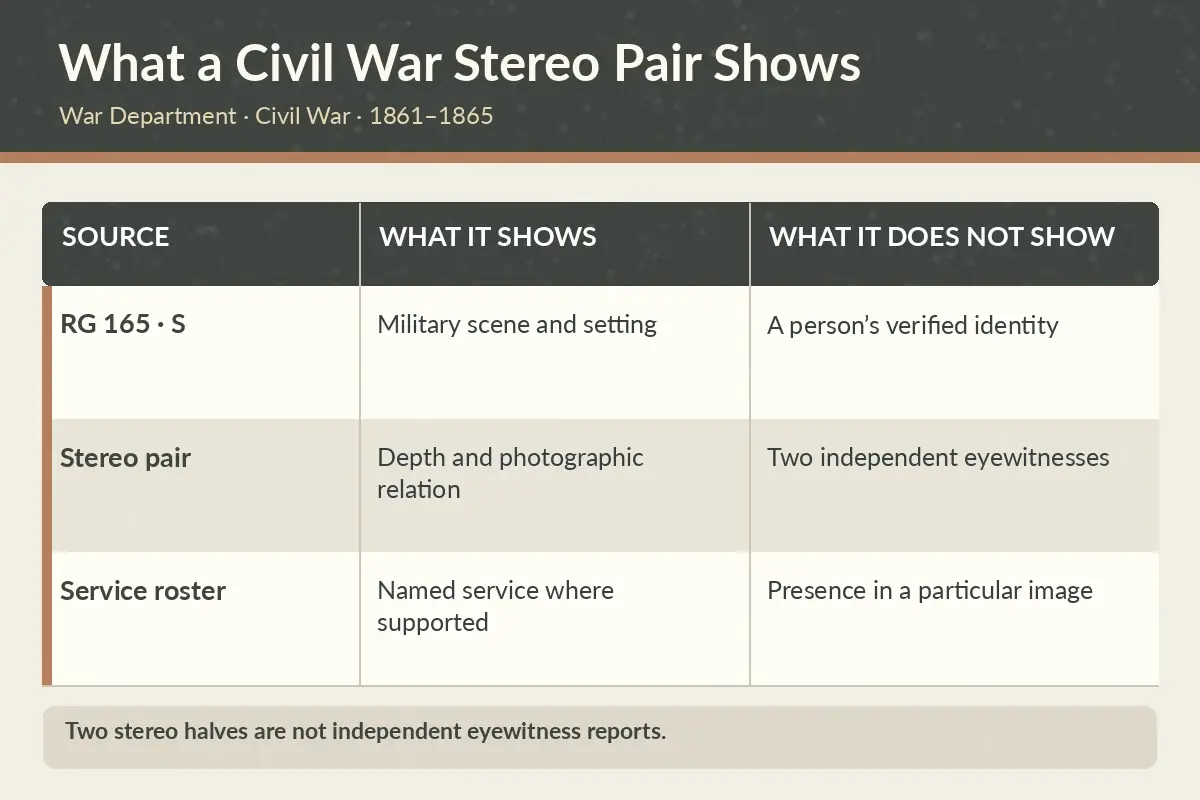
The National Archives identifies 321 stereoscopic photographs of Civil War military activities and installations in RG 165, series S, dated 1861–1865. Some images were made by Sam Cooley, but the official guide does not attribute every view to him or name every person shown. A stereoscopic image typically places two slightly offset views together so they can be experienced in depth. Those views are not two independent eyewitness accounts. The RG 165 inventory is the starting point for a careful study of place, photographic technique and attribution.
Family researchers sometimes encounter one cropped half of a stereo pair on a website accompanied by a specific battle date or soldier’s name. A caption may have been added long after the exposure, and a camp scene may not show an active battle. The goal is to return to the complete record, identify what can be seen, distinguish the item’s date from its caption history, and look for corroboration before connecting an unlabelled figure to an ancestor. Photographic detail is powerful evidence, but it does not identify everyone in the frame.
Confirm That the Two Views Belong Together
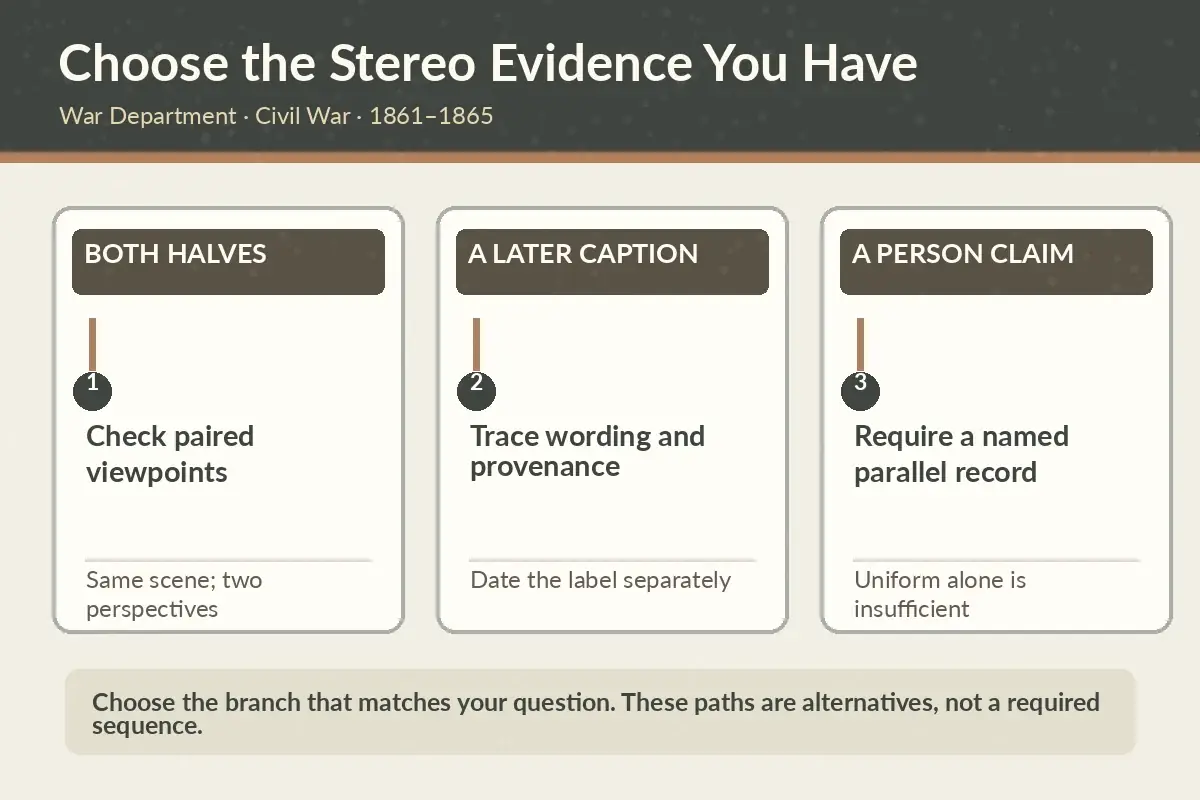
Locate the complete stereograph rather than relying on a single cropped image. Both halves should depict essentially the same scene from nearby camera positions; their slight horizontal offset creates the depth effect. Record visible mount edges, handwriting, printed numbers, captions and any alterations. A reverse side can sometimes contain evidence not included in a front-only reproduction. If one half has been repaired, toned, mirrored or cropped differently, describe that change rather than treating it as evidence of another exposure.
The series designation S is an archival guide, not a claim that every image exists as a neatly digitized two-up card. Search RG 165, Civil War, stereoscopic and the known location or photographer in the NARA Catalog. Copy the item-level identifier when present. When a caption appears only in a modern catalog entry, distinguish catalog metadata from writing on the original mount. A stereo pair provides complementary optical views but should count as one photographed subject, not as two independently corroborating witnesses.
Distinguish Camps and Forts From the Moment of Battle
The guide describes military activities and installations, a broad category that can include camps, equipment, earthworks and everyday movement. It does not say that all 321 images depict combat. A row of tents or a group around artillery can be documented accurately without claiming a particular battle was in progress. Read the scene for buildings, uniform features, terrain, shadows and visible inscriptions. Such cues support hypotheses about place and period, but lighting or clothing style alone rarely establishes an exact exposure date.
Compare the view with independently dated maps, campaign records and other images from the same site where available. A fortification can survive after a battle, and an abandoned camp may be photographed later than the event associated with it. If a museum or commercial copy labels an image with a famous engagement, look for the original caption and a chain of attribution. Report disagreements as disagreements; do not silently choose the most dramatic title.
Keep Photographer Credits and Later Captions Separate
The RG 165 listing says the series includes some work by Sam Cooley. That wording matters: a collection containing photographs by an identified maker does not make him the author of every card. On your worksheet, include distinct fields for the credited photographer, where that credit appears, the date of the credit, original printed legend, later handwritten notation, and modern catalog title. An attribution from a nineteenth-century mount is different from a twentieth-century collector’s guess.
A surprising amount of apparent precision may come from caption history rather than the image itself. For example, a place and year written beneath a card may be strong leads, but names of individual soldiers still require evidence outside the visual resemblance. Check whether similar copies survive in another institution and whether their captions agree. One copy may be reversed or assigned a new title in a publication. Those differences are clues to provenance, not an invitation to invent a definitive story.
Identify a Soldier Without Facial Guesswork
Suppose a family archive says an ancestor served in a unit shown at a certain camp. A service record may establish membership in the unit, and a stereograph may show the camp, but that combination alone does not place the ancestor within the group. Search muster rolls, letters, diaries, rolls of prisoners or casualties, unit histories and contemporaneous named photographs according to the question. Record the dates each person was present; a regiment’s station is not identical to every member’s location on a particular day.
Identification becomes stronger with an original named mount, documented personal album, written contemporary label, or chain of possession supported by independent documents. Uniform details can narrow a timeframe or role but often cannot distinguish two people of similar appearance. Avoid publishing speculative names as image alt text: descriptive alt text should report visible people, setting and uncertainty rather than assigning identities the photo does not establish.
Create a Verifiable Image Citation

NARA’s still-picture instructions explain reference access and reproduction routes. Cite RG 165, series S, item or local identifier, title and any photographer attribution as stated, along with the consulted version. Preserve the fact that you saw a digital scan or a print rather than an original mounted stereograph if that was the case. If the photograph appears in a book, keep publication and plate information separate from the original archival citation.
For a publication, caption the image first as a subject: who or what is visibly present, where it is documented to be, what approximate date is supported, and which source supplied that identification. Next, explain the family hypothesis only as far as a named primary record takes it. The decisive distinction is between a confirmed soldier’s service and the unproven presence of that person in a visually plausible scene.
More Family Story and Preservation Guides
How We Research and Verify the Original Record
The factual starting point for this article is the official record-group inventory: RG 165 lists 321 stereoscopic photographs of Civil War military activities and installations, including some by Sam Cooley, dated 1861–1865, series S; it does not identify every figure in every image. We checked its language on the series and resisted extrapolating unlisted item dates, complete digitization, individual identities, or legal outcomes from an inventory alone. We also consulted the applicable NARA format-specific research guidance. Our diagrams are interpretive editorial illustrations rather than copied archival images; their labels are designed to route a researcher toward the original evidence. Nothing in this overview implies that we examined every individual item in the described holdings.
For an item-level citation preserve the archival record group, series, item number if available, any printed date, the version actually consulted and any relevant annotations. A researcher unable to view an original should use NARA research and visit instructions to request access details instead of reporting observations never made. For transparency, see our affiliate disclosure. No paid archival partnership or access guarantee is implied. The practical standard is to use a stereo pair to analyze a scene without assuming it captures a battle instant or proves the identity of an unnamed person.
The guide lists 321 stereoscopic photographs in series S, dated 1861–1865.
No. They are paired optical views of essentially one scene, not independent witness accounts.
No such conclusion follows. NARA says some images are by Sam Cooley.
No. Unit membership or a nearby posting is not positive individual identification.
Yes. Record mount wording, later annotations and catalog descriptions separately.