
State Records of South Australia identifies the Destitute Asylum admission registers as series GRG28/5, spanning 1870–1924. Entries may report an applicant’s age, occupation, residence, ship of arrival, relatives and dates of admission or discharge. Start with its surname indexes, but note that the prominently published index coverage is 1870–1873 and 1881–1909. For 1874–1880, the archive directs researchers to Destitute Board minutes, not to an imaginary complete admissions index. A person appearing in a relief register is not proof of a particular family relationship, illness or long-term institutional residence.
Know which agency made the register
The Destitute Board administered relief and the asylum; its paperwork recorded applications and decisions rather than composing a comprehensive genealogy of those admitted. The archives describe provision for people unable to work because of age, disability or illness, and for some expectant mothers. Some residents were supported by paying relatives. Categories used at the time can be stigmatizing. When you write about an individual, use precise descriptions such as an admission entry or an application for aid, rather than treating the institution’s historical label as a permanent identity or medical diagnosis.
Separate series dates from online index dates
GRG28/5 is catalogued as 1870–1924 and contains eight registers. That does not mean a fully searchable name index covers every one of those years. State Records lists indexes particularly for 1870–1873 and 1881–1909, with pages organized by surname, while indexes are being progressively added to ArchivesSearch. A search interface might show some years but not others. In your research log write both the record series date span and the specific index span searched; they answer different questions about what the archive holds and what a website currently exposes.

Use the name index to retrieve the volume
Search the alphabetical index and ArchivesSearch for the applicant, checking phonetic spellings, maiden names and errors in handwritten names. Copy the index’s admission year, volume and entry number. Those are the practical locators for a digitized image, a Research Centre copy or a record request. The archive directs readers to selected digitized volumes at FamilySearch, which may require free registration, and to its own research arrangements. When a register page is found, inspect surrounding entries and page headings; a clipped index snippet does not establish how a field was originally labeled.
Route the missing 1874–1880 years correctly
The official destitution guide specifically advises searching the Destitute Board’s minutes, GRG28/1, for 1873–1880 when the admission index does not provide the expected route. The GRG28/1 catalogue warns that the minutes themselves have gaps, including 1873–1874, and some access limits apply. This is not a guaranteed substitute for a missing individual admission. Search by the likely application date and place, note the volumes or periods actually surviving, and use local council relief minutes when geographically appropriate. A missing surname cannot establish that the person received no assistance.
Read the entry as an applicant account
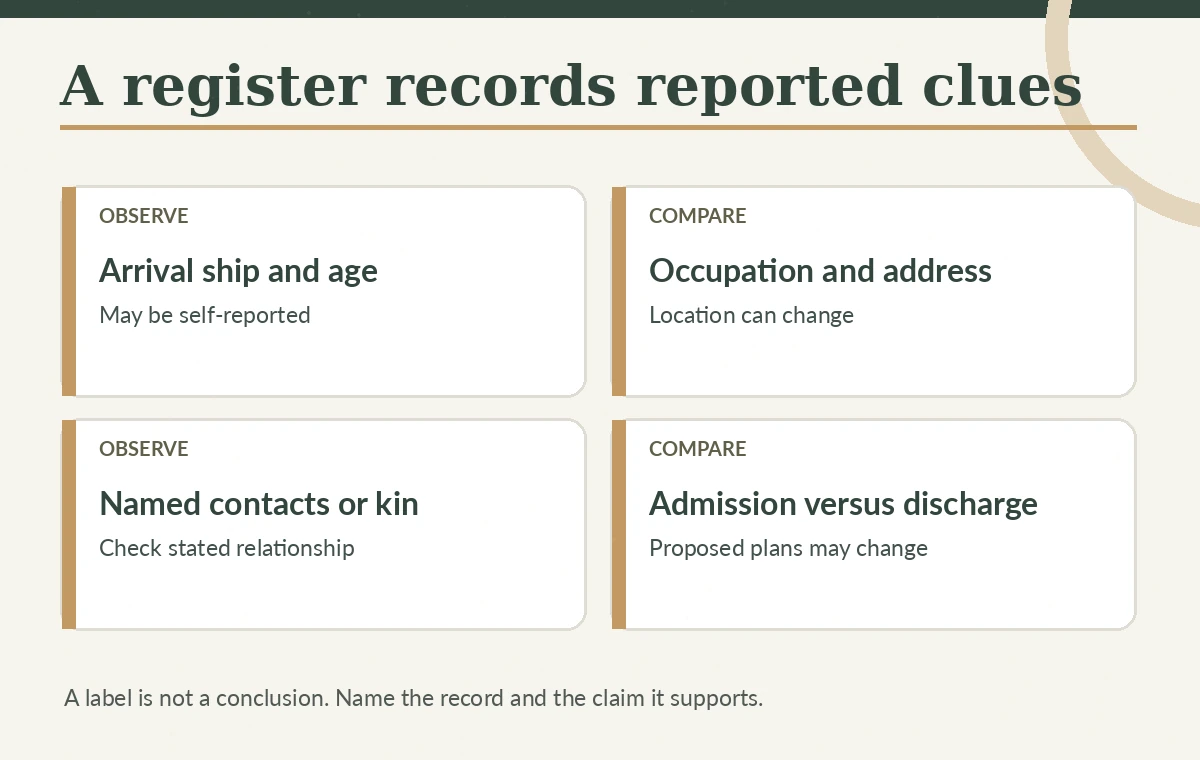
The series description lists possible fields including age, nationality, religion, last residence, occupation, arrival date and vessel, relatives in South Australia, reason for admission, discharge date and proposed destination. The presence of a field in a series description does not guarantee every entry supplies it. Separate what the applicant or clerk reported from facts confirmed elsewhere. An arrival ship may be remembered incorrectly; an age may be rounded; an individual called a relative might need independent parentage or marriage evidence before the exact connection is accepted.
Create an admission and discharge chronology
Transcribe the actual admission date and any discharge date in separate fields. If the entry offers a proposed destination or placement, do not record the plan as an event that definitely occurred. A later admission may be a repeat stay, a second person with the same name or a rewritten administrative entry. Note page numbers and any cross-references. Compare admissions with children’s school records, directories, newspapers or electoral rolls to learn whether the household moved. Gaps between two institutional dates are unknown time, not necessarily continuous confinement.
Compare the earlier relief series without merging them
GRG28/4 describes a different register of destitution cases dating from 1846–1857, with its own application dates, trade information and relief remarks. It is useful for an earlier-generation family hypothesis, but it is not an early volume of GRG28/5. Similarly, entries about infants or lying-in homes can belong to related specialized series and require their own citations. Before combining records, check the agency, creator, series identifier, date and person described. The distinction matters especially where an adult applicant and children in care appear in different recordkeeping systems.
Avoid making health and family claims from labels
A historical reason for admission can reflect a person’s circumstances, an administrator’s judgment or the wording available on a form. It is not a modern diagnosis. Names of relatives may show who was contacted, paid for care or supplied information, but a kinship term can be imprecise. Do not presume abandonment or blame from an absence of named relatives. These are sensitive welfare records, often about women, children and people facing poverty; use careful attribution and explain an administrative label without repeating stigmatizing language unnecessarily.
Solve a same-name test with independent records
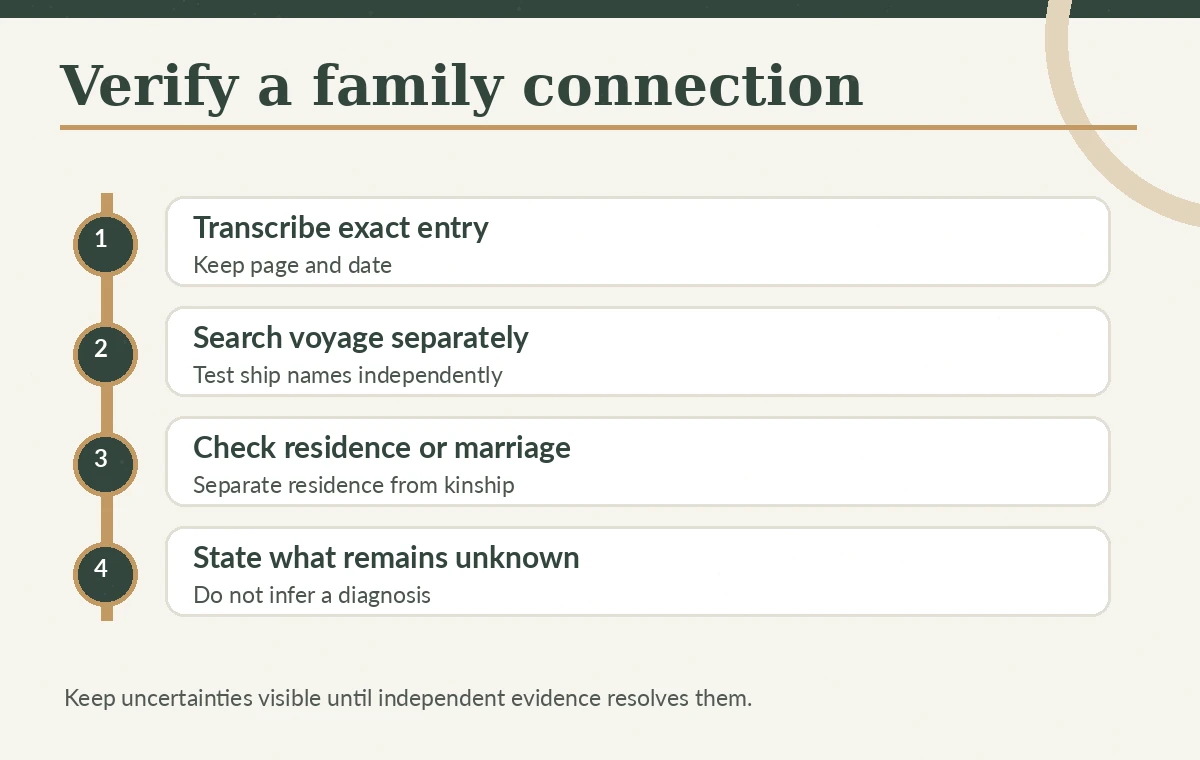
Imagine, solely as a teaching example, two hypothetical applicants called Ellen Carter in Adelaide and a nearby district. One entry names a ship and a trade, and the other includes a different recent address. Compare these clues against independent passenger and residence evidence. Write confirmed, compatible, conflicting and unknown beside each statement. A named relative in a register could help direct a search for a marriage or baptism, but it cannot by itself establish the complete family structure. Preserve both candidates until a cross-record match supports one.
Respect access restrictions and cite the exact page
State Records cautions that destitution-related records may have century-long access restrictions; GRG28/5 is described as open after 100 years, while related files can differ. Do not bypass restrictions or imply all records can be viewed from home. For a full citation give State Records of South Australia, Destitute Board, GRG28/5, volume or item, applicant, admission date and page or entry number, with the image service and access date. Record the precise index and image you used, then select one independent record to test the strongest family claim. For the next step, our guide “South Australia School Admission Registers” explains how to find pupils and families.
| Source route | What you can seek | Main limitation |
|---|---|---|
| GRG28/5 | Admission and discharge detail | Index span is not series span |
| GRG28/1 | Board discussions and relief | Minutes have gaps and access rules |
| GRG28/4 | Earlier destitution cases | Different period and record purpose |
| Passenger record | Independent voyage or arrival | Not proof of a related entry |
How We Research
We checked the issuing archives’ public research guides and series descriptions, identified what each search route does and does not establish, and separated index data from original documents. All named example people in this guide are explicitly fictional. The coverage, access and jurisdiction cautions come from the custodians’ descriptions, not assumed completeness. Consult current item access conditions before ordering or sharing sensitive material.
More Records and Archives Guides
South Australian Destitute Asylum registers and archival catalogues
State Records overview: public indexes, 1874–1880 alternative, and sensitive-record access (www.archives.sa.gov.au).
Official GRG28/5 series description, 1870–1924, eight registers and recorded fields (catalogue.archives.sa.gov.au).
GRG28/1 Destitute Board minutes, gaps and partially open status (catalogue.archives.sa.gov.au).
Earlier 1846–1857 destitution cases, not the same as asylum admissions (catalogue.archives.sa.gov.au).
Editorial note: This independent historical research guide provides no legal advice or paid referral recommendation. No commercial partnership is claimed. Follow applicable privacy and archive access rules. See our affiliate disclosure.
State Records describes GRG28/5 as 1870–1924; published indexes cover narrower periods.
Try the Destitute Board minutes, GRG28/1, and document their survival gaps rather than expecting a complete GRG28/5 name index.
Some entries include an arrival ship and date, but treat these as reported clues to verify independently.
No. Access decisions vary by series, and many sensitive files have century-long restrictions.
No. Admissions reflect administrative relief decisions, not a complete or impartial account of family care.