
Start With the Event Date and the Photograph’s Custody
The National Archives describes 44 RG 48 RSC photographic prints showing damage to the U.S. Capitol. The images accompanied a report to the Architect of the Capitol in 1899. A separate institutional history dates the gas explosion and ensuing fire in the Capitol’s original north wing to November 6, 1898. These are not competing dates: one dates the incident, while the other dates a report that used photographs. A researcher should preserve both in the first citation. Do not invent an “1899 Capitol fire” because the photo series appears under that year.
Write the complete series and item identifier, any supplied caption, the report date and the particular damage visible in the image. Look for warped doors, plaster loss, structural openings or soot only if unmistakable; an old black-and-white print can also show shadows, restoration work or exposure artifacts. The series label does not specify that every photograph was exposed on the day of the explosion. If the date of an individual negative is absent, say that the photo documents damage represented in an 1899 report, not that it depicts an exact minute of November 6.
Place a Damage View in the Correct Part of the Building
The Capitol is not a single undifferentiated interior. The Architect of the Capitol identifies the original north wing as the location of the 1898 explosion and fire. To place an RSC frame, compare labeled floor plans from the period with windows, corridors, arches, stair locations and identifiable materials. Do not assign a photographed doorway to a famous chamber merely because the setting looks historic. Renovations have changed many views since the nineteenth century. A modern floor plan can help orientation but may omit walls and rooms that existed in 1898.
Maintain separate confidence levels for the building, wing, room and wall or ceiling detail. A report caption might support the room name while the visible image supports damage to a ceiling; neither automatically verifies all later captions printed online. If several prints appear to show the same area, compare sight lines and unusual structural features before numbering them as a chronological progression. They could be separate viewpoints taken in a single session. Show a room identification as tentative until a contemporary plan, report or annotation resolves it.

Do Not Collapse Damage, Repairs and Fireproofing
The Architect of the Capitol states that rebuilding and fireproofing of roofs over the Statuary Hall wing and original north wing was completed by 1902. This provides a useful later endpoint in an institutional chronology. It does not establish that each item pictured in RSC was repaired in 1902, or that the project scope matched every damaged surface. A photograph may have been made before temporary stabilization, after debris removal or as part of a survey. Look for dated contracts, appropriations, architects’ notes and acceptance records to distinguish authorized work from completed work.
An old photograph can reveal what construction work left exposed, yet it cannot alone date electrical rewiring, heating alterations or fireproofing in an unseen attic. A drawbridge between a damage picture and a completed building should be built from documents: original condition, specified intervention, recorded work, and independently dated later view. Mark which evidence speaks to each phase. A construction plan says what was proposed, a contractor record says what was contracted or paid, and a later photograph may show a result. These are related but not interchangeable.

Research Workers Without Naming Unlabeled Figures
Damage photographs can be valuable background for the occupations of engineers, builders, laborers, firemen and Capitol staff around 1898–1902. They are not employee rolls. A person standing next to damaged plaster could have been an inspector, photographer, official, visitor or work crew member. Use payrolls, contractor files, office correspondence or directories to establish a named person’s relationship with a Capitol project, and date their presence as closely as the written evidence allows. A surname in an appropriation report cannot be attached to an uncaptioned figure by proximity alone.
If a family history mentions an ancestor helping to rebuild the Capitol, identify whether the claim refers to the north wing, the Statuary Hall wing or another building campaign. The Capitol underwent extensive modernization before and after the 1898 incident. A reference to “the Capitol repairs” could mean a different project or year. Ask relatives for the original source of a story, preserve job titles as recorded and compare the named employer to the relevant contractual party. A plausible occupation and an authentic photograph are not yet a verified biographical link.
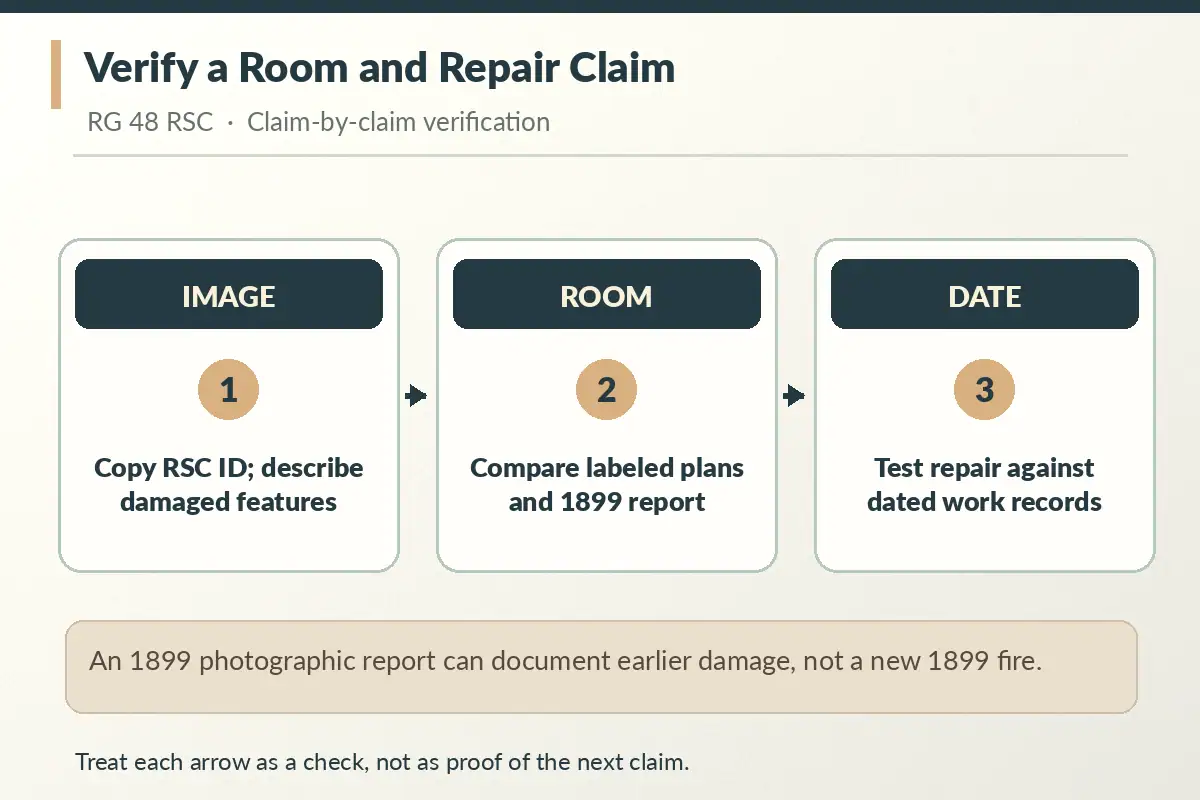
Build a Room-Level, Date-Level Image Citation
A useful evidence ledger has columns for RSC local identifier, reproduction source, original caption, suspected room, visually established condition, proposed incident relationship, report date and independent repair evidence. Store your uncertainty, not only your final choice. NARA asks still-picture researchers for a record group, series and unique identifier when requesting information. A web screenshot without that reference is difficult to verify when the page is reorganized. If the original print or report survives with marginal numbering, ask about it before deciding how a photograph fits the series.
A cautious family-history caption might read: “An RG 48 RSC print in a photographic group accompanying the 1899 Capitol damage report illustrates conditions associated with the earlier November 1898 fire; this particular room identification is unconfirmed.” If a room and date can be verified, replace only those qualified parts. Do not claim that the entire structure burned, that all roof repairs were completed in 1899, or that a photographed tool proves who used it. The citation should make it possible for another researcher to reach or revise the same conclusion.
To make a before-and-after comparison, use two independently dated images and ensure they depict the same viewpoint and structural features. A nineteenth-century engraving, later postcards and present-day photographs may distort scale or omit alterations. Treat the architectural history as a framework rather than as a room-by-room photograph index. The central research value of this series lies in its unusually clear chain: a documented 1898 event, a photographic report from 1899, and subsequent work described by the building custodian. Each record answers a different question. Preserving the chain is more instructive than choosing one date for every image or using an unidentified figure to tell a repair crew’s biography.
More House and Local History Guides
How We Research This Evidence
This guide is based on the National Archives record-group description and a second official source, checked November 16, 2026. We checked the exact series labels and collection dates against the custodian rather than guessing from a generic subject search. For item-level inquiries, follow NARA’s still-picture reference guidance: retain the full local identifier, including series and divider information where applicable. The series description does not establish that every item is digitized, that an individual photograph has an exact date, or that any pictured person is identified. There are no paid links or unverified products in this guide; see our affiliate disclosure.
The Architect of the Capitol dates the north-wing explosion and fire to November 6, 1898; the RG 48 RSC photographs accompanied a report in 1899.
Forty-four photographic prints of Capitol damage.
No. Check the original caption, contemporary plans and dated work records for the specific room and intervention.
The Architect of the Capitol states work on the north-wing and Statuary Hall wing roofs was completed in 1902.
Not without reliable item-level identification plus independent records connecting that person to the work.