
Look for the Unit, Fort or Airfield First
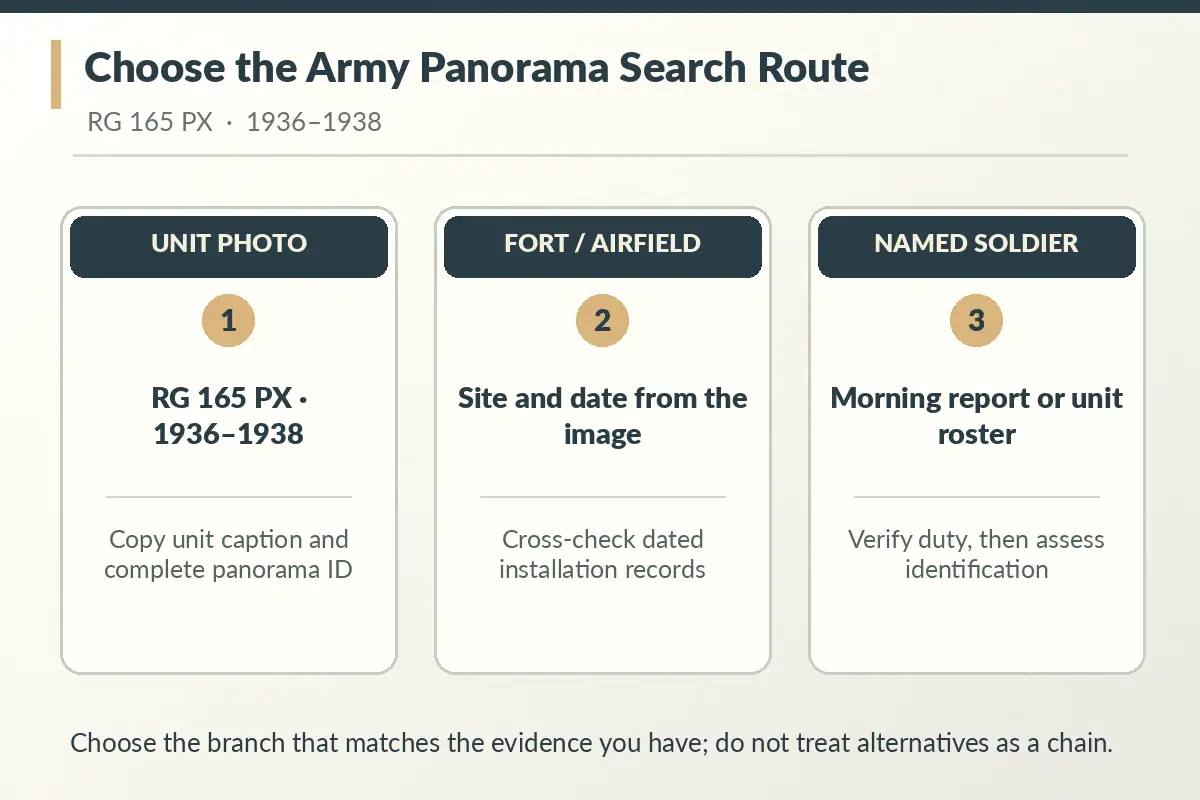
NARA describes 140 panoramic photographs of United States Army units, forts and airfields in RG 165 PX, dated 1936–1938. This is a valuable prewar visual source for studying where units assembled and what installations looked like. It is not a master name index. A panoramic print may show dozens or hundreds of people at low resolution, making an individual identification especially unreliable. Begin with the image’s exact record-group and series reference, catalog caption, full scene and recognizable structures before trying to assign a relative’s name to a small figure.
The series date range does not give an exposure date to every photograph or prove a pictured unit remained at a fort throughout those years. Military formations could pose for inspections, ceremonies, training events or publicity photographs. Keep the stated unit designation separate from a guessed location. If an airfield is shown, note runways, hangars and nearby terrain without assigning an operational function to a building from appearance alone. Preserve uncertainty about whether two similar views belong to the same place or day until negative identifiers or contemporary captions connect them.
Read Wide Photographs Without Manufacturing Names
Panoramas can distort scale near the edges and may contain stitching or perspective anomalies. A figure’s position in a formation does not tell you their rank, unit assignment or service number. Check whether an original print contains writing along the bottom, a handwritten unit label or a dated event caption. Photograph size, scan quality and crop can affect what appears legible. If the image was digitized in sections, seek the complete print before using a partial copy to identify a location. Do not invent a unit from shoulder insignia that cannot be reliably read.
Use a three-level classification: firmly identified location or unit from the original caption, probable attributes supported by visible features, and unverified identities. Even when a regiment is named, the panorama might include attached personnel, visitors or subordinate groups. A large post image could be an installation survey rather than a formal unit portrait. Write the role of the photograph—building context, unit assembly, or combined view—as a working hypothesis. That prevents the familiar error of treating every person visible at a military post as someone serving in the same company.
Check the Service Evidence in the Correct Date Window
NARA describes Army morning reports and unit rosters covering 1912–1968 as archival records, with access through the National Personnel Records Center’s archival research procedures. That span includes the 1936–1938 PX period. A roster may establish that a person was listed in a particular unit on a relevant date, while a morning report may explain movements and duty-status changes. Neither proves the person stood in a panoramic picture taken that day. Ask for the exact unit designation and report period rather than requesting “all Army photos of my grandfather.”
Transcribe the unit name as printed in the archive record, including company, battalion and regiment components when known. Units were renamed, reorganized and moved, so a later WWII designation may not match the 1937 caption. Compare dates of service and transfers with the actual image date if it can be established. A person’s military file could support a posting at the fort even when the roster for the exact date is unavailable, but state the degree of certainty accordingly. Roster evidence supports membership; identifying a face needs a dependable separate caption or close contemporary identification.

Locate the Installation Without Misdating Its Buildings
Airfields and forts changed rapidly in the interwar period. A hangar visible in a 1936 photograph may have existed before a later runway extension; a parade ground may later have been replaced by workshops or housing. Use period Army post plans, airfield layouts, building inventories or contemporary maps as independent location evidence. Do not use a modern satellite view to infer a historic building number without checking a dated plan. Keep a separate table of the post’s historical name, its contemporary administrative command and later name changes.
If you are researching a family address associated with a fort, differentiate on-post quarters, nearby town lodging and a soldier’s unit headquarters. The fact that a relative was stationed at an installation does not show where they lived or which visible building they entered. Search quartermaster records, station directories, directories of married personnel, postal addresses or relevant household sources only where available and appropriate. A panoramic photograph is best for understanding scale and spatial setting; it rarely substitutes for a residence record. Label orientation estimates as estimates.

Create a Reproducible Panorama and Personnel Crosswalk
For each image, record RG 165 PX, full local identifier, item title, apparent post or airfield, stated date, unit designation, distinguishing structures and any ambiguities. Link it to a separate table for dated roster or morning report references: unit, reporting date, person’s documented name and exact wording of the entry. NARA’s still-picture guidance emphasizes retaining the series and item number. Save a copy of the original caption rather than making the comparison depend on an image file renamed by an online collector. Record whether your panorama is an original photographic print, a scanned copy or a cropped derivative.
A careful conclusion could say: “This RG 165 PX panorama shows a fort and Army unit described by NARA within the 1936–1938 series. A separate roster documents the ancestor in a named company during part of that interval; no figure in the image has been independently identified as the ancestor.” If a dated, named photograph becomes available, add it as a distinct corroborating source. That is a much stronger result than drawing a circle around a tiny face or assuming every member of the company posed for the photographer. The landscape remains useful even without individual identification.
Panoramic images are most valuable when treated as spatial evidence: they show relationships among barracks, roads, formation areas, hangars and terrain that smaller portraits omit. To compare a panorama with maps, record the direction of view and the buildings you can confirm, not an invented GPS point for the camera. A matching mountain ridge might support a geographic hypothesis, but similar terrain alone is rarely decisive. For genealogy, maintain two separate timelines: where the unit was documented and where the individual was documented. Combine them only for dates the records can sustain, and keep any identification of people within the panorama as a third, harder question.
More Place and Jurisdiction Guides
How We Research This Evidence
This guide is based on the National Archives record-group description and a second official source, checked November 16, 2026. We checked the exact series labels and collection dates against the custodian rather than guessing from a generic subject search. For item-level inquiries, follow NARA’s still-picture reference guidance: retain the full local identifier, including series and divider information where applicable. The series description does not establish that every item is digitized, that an individual photograph has an exact date, or that any pictured person is identified. There are no paid links or unverified products in this guide; see our affiliate disclosure.
One hundred forty photographs of Army units, forts and airfields, dated 1936–1938.
No. Original captions and independent person-level records are required; small faces are unreliable.
Yes. NARA describes archival Army rosters and morning reports that cover those years.
No. A dated assignment is not a household or quarters record.
Provide RG 165, PX, the local identifier and any known item, folder, caption or date information.