
For many family historians, a Western Australian cemetery search produces a name, cemetery and date but leaves the useful question unanswered: where did this information come from, and what other original paperwork survives? The Metropolitan Cemeteries Board (MCB) maintains records of interments, entombments, cremations and memorials dating from 1899 across six named metropolitan cemeteries. It also offers original Funeral Application Forms for eligible older records, subject to availability and fees. The key is to distinguish a name-search listing from actual interment, a memorial inscription and the historical application describing the funeral.
Check whether the cemetery belongs to the MCB collection
The WA Government’s cemetery search describes metropolitan records for Karrakatta, Fremantle, Pinnaroo, Midland, Guildford and Rockingham. The board’s stated start date of 1899 does not mean each cemetery has a complete uniform register beginning on that day. The Metropolitan Cemeteries Board took responsibility for Guildford and Midland in 1989, and acknowledges some historical data may be incomplete. Begin by confirming the locality of the death and the likely burial or cremation site. Our guide “Fremantle Cemetery Records” adds more detail on this.
Do not assume a rural WA grave will be listed in the metropolitan database. Where the likely location lies elsewhere, check the local cemetery operator or the State Records Office’s burial series rather than repeating the same MCB name search. The National Library’s cemetery guide points researchers to broader WA registers in the State Records Collection. Record which cemetery system was actually checked. Our guide “Western Australia Cemetery Records” goes into more detail.
Search the name register without committing to a match
Start with the surname and then vary initials, given names and likely transcription forms. The WA Government’s search description makes surname the mandatory input and other names optional. A result with a plausible death date may still belong to a namesake. Compare the cemetery, event date, age if present and any separate address or family information. Keep a screenshot or carefully transcribed record identifier without copying unrelated living-person details.
Be precise about the event field: burial, cremation, entombment and memorial entries are different administrative acts. A memorial may commemorate someone whose remains are not buried at that exact location. A grave position does not, on its own, identify the person who arranged the funeral. Write the record type alongside the name before adding it to a family tree.

Understand what a historical funeral application can add
MCB states it can provide original Funeral Application Forms for records more than 25 years old, although Fremantle material may be limited. The applications can name a last address, funeral director, date of funeral and death, age, applicant for the funeral and clergy, with fields varying and private details potentially redacted. These original forms are different from a modern search-result page, so record both the discovery source and requested document.
The person’s last reported address may guide a directory or electoral-roll search. The applicant’s name is a strong lead to investigate, but not automatic proof of marriage, parentage or another family relationship. A funeral director was a service provider, not a household member. Interpret each field according to its administrative purpose, and never invent a relationship that the application does not state.
Check the eligibility and cost before making a request
The board’s genealogy guidance defines the over-25-year application route. Its website also describes available memorial or headstone photographs and potential fees. Do not present either service as universally free or guaranteed; check the current request instructions, availability and price immediately before proceeding. Some materials may be redacted for privacy. A cemetery record can be discoverable online while its original application remains unavailable.
Record exactly which individual you want, the cemetery and identifying event date, then use MCB’s official request channel. Do not invent a direct download link to an application or ask a cemetery to search every person with a common name at once. An approved request supplies evidence about that particular record, not a blanket history of the family.

Separate a memorial photo from proof of interment
A photograph of a headstone records an inscription and a physical object at the time photographed. It does not necessarily prove the person was interred beneath it, and a shared marker cannot by itself establish a genetic relationship between all names shown. The MCB website discusses cemetery renewal, historical markers and maps; a marker’s present position or absence may have changed since the original funeral.
Compare the name-search record, any funeral application and cemetery map or section evidence. Keep the separate propositions visible: death occurred, funeral arranged, remains interred or cremated, and later memorial displayed. A missing modern headstone does not erase the original recorded funeral. If a grave was renewed or changed, use the board’s documented procedures instead of guessing what happened to remains.
| Record or clue | Best use | Limit to remember |
|---|---|---|
| MCB name search | Locate cemetery record | Name hit may be namesake |
| Funeral application | Original administrative details | Availability and redactions vary |
| Headstone image | Read surviving inscription | Not proof of interment |
| Civil death certificate | Test deceased identity | Informant facts need appraisal |
Work through a fictional similar-name case
Suppose a fictional William Price died in 1925, while a family story places another William Price in Perth in the 1920s. A name-search result at Karrakatta is only a candidate. Test the recorded death date and age against civil death registration, then request a historical funeral application if eligible and available. If that form gives a last address, compare a contemporary electoral roll or directory before making the identification.
An applicant sharing the Price surname may be a relative, business associate or unrelated administrator. Treat that person as a lead until independent evidence links them. The example names are entirely fictional. Its purpose is to show how to move from an index hit to two separate identifiers without assuming that any matching name belongs to your ancestor.
Handle incomplete collections and historical changes
Some MCB records are incomplete, and cemetery responsibility has changed over time. If a relevant burial is absent, ask whether that cemetery and period are covered before drawing conclusions. Earlier or regional records may be held by local councils, churches, cemetery trusts or State Records Office series. Keep the specific searched collection and date range in your log.
Distinguish a missing entry, a redacted application, a nonexistent surviving form and an unknown cemetery. Those conditions require different next steps. Try a death notice or funeral advertisement as a locality clue, then return to the appropriate burial registrar. Obituaries and memorial websites can introduce names but are not substitutes for cemetery administration records.
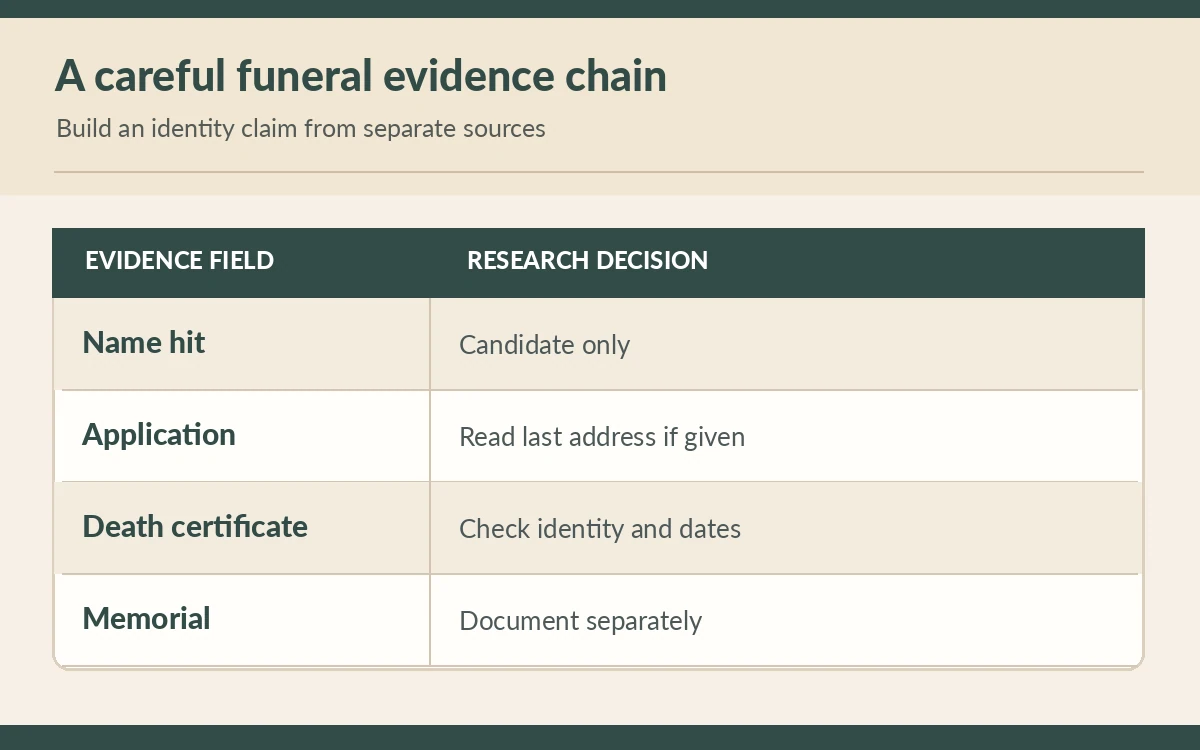
Cite every stage of the funeral evidence chain
For the online register, retain the cemetery name, displayed event type and date, exact entry identifier when provided, database provider and access date. For an original funeral application, cite the form title, application or event reference, repository and the relevant fields. Cite an image of a monument separately with a date and photographer or source. This prevents an online memorial page from accidentally being represented as a historical burial certificate.
Be careful with grief-related information, living applicants and private addresses. Respect redactions, follow the provider’s permitted uses and avoid announcing an unverified family relationship. A disciplined conclusion can document a funeral record and its limitations while leaving disputed kinship unresolved.
How We Research WA Cemetery Records
We cross-checked the WA Government search page with Metropolitan Cemeteries Board genealogy and cemetery-renewal guidance and the National Library cemetery guide. The six metropolitan cemeteries, 1899 database start and over-25-year application eligibility are provider descriptions, not promises of complete coverage. William Price is a fictional case; services, fees and item access should be rechecked before ordering.
More Records and Archives Guides
Primary Archives and Research Guides for WA Cemetery Records
WA Government: name searching and metropolitan cemetery coverage dating from 1899 (www.wa.gov.au).
Metropolitan Cemeteries Board: funeral application eligibility, record types and incomplete holdings (www.wa.gov.au).
MCB: renewal, historical markers, and funeral application research details (www.wa.gov.au).
National Library: broader WA burial records through the State Records Office (www.library.gov.au).
Editorial disclosure: This article has no sponsored recommendation or paid affiliate placement. Our site-wide policy is explained in the GenHis affiliate disclosure. Historical records are imperfect and access restrictions can change. Consult the original record, avoid unsupported accusations and protect personal information about living people.
The named metropolitan collection includes Karrakatta, Fremantle, Pinnaroo, Midland, Guildford and Rockingham.
MCB describes historical records dating to 1899, with gaps and different cemetery histories.
MCB generally offers applications for records more than 25 years old, subject to availability and rules.
No. A memorial inscription alone does not establish a family relationship or interment.
No. Check official current request instructions, prices, redactions and cemetery-specific limitations.