
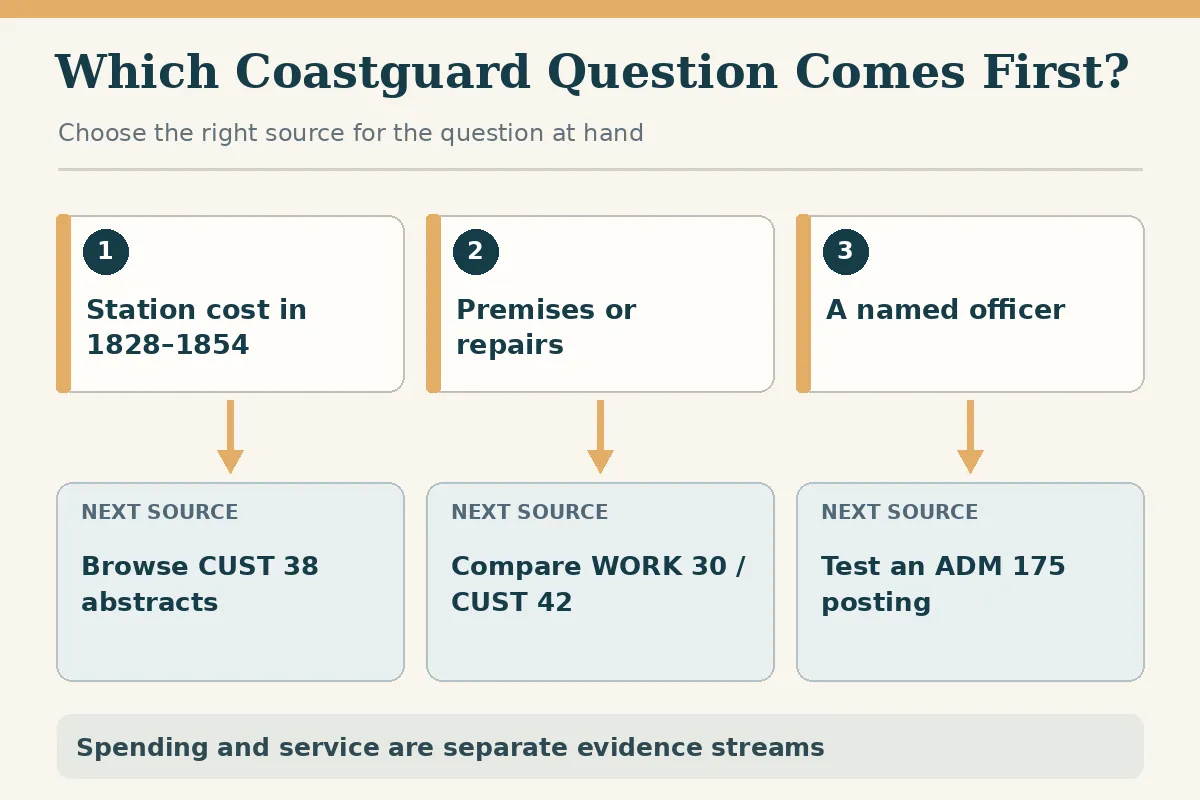
The annual coastguard abstracts in CUST 38 offer a route into the cost of protecting a particular stretch of coast. The National Archives identifies abstracts for 1828–1854, as well as accounts of expenses for 1855–1857. These papers can support research into spending on salaries, allowances, rents, traveling, boats, stores and buildings. They do not automatically list the people stationed at a particular watchroom, and an entry for rent does not prove who lived on the premises.
The most useful starting point is not a family surname but a coastal station, a year and a precisely defined question. Are you trying to establish that a building was paid for, that a station operated in the decade, or that a particular ancestor served there? These are three different claims requiring different evidence. Keep the station’s changing names, the type of expenditure and the scope of each account on a single research sheet before drawing conclusions.
Choose the Accounting Period and Coastal Unit
Start by writing the locality as it appears in a dated map, directory or family letter. A nearby harbor, beach or customs district may have supplied a different accounting label from the modern village name. Search the Discovery catalog for CUST 38 and inspect piece descriptions, especially year ranges, before planning a visit. Treat 1828–1854 annual abstracts and the related 1855–1857 expense material as distinct coverage statements: do not imply that every year or station has a line in precisely the same form.
If the locality is absent from the catalog summary, a negative keyword search does not settle the matter. Annual material can be arranged by administrative district and contain local details that the catalog does not index. Record the year, any superior district and the precise volume examined. Build a coverage ledger with three labels: examined, not examined and apparently outside the surviving scope. This prevents an unsuccessful online search from being misreported as evidence that a station never existed.
Read the Money Columns Without Naming Employees
CUST 38 is especially useful for separating classes of cost. One table might distinguish salaries and allowances from rent, travel, boats or stores, while another may summarize spending at a higher geographical level. Transcribe the actual heading, period, currency and unit of account before comparing figures. Do not treat a total for salaries as the number of officers: wages can vary by rank, time employed and eligibility for an allowance. Nor does a repair expense tell you the date the work was completed.
For each line, use a record with fields for amount, expenditure description, year, geographical label and whether the amount was paid, estimated or accounted for in another way. Do not assume all columns mean cash disbursed until you have checked the book’s title, headings and notes. A station ledger may help explain why a particular building appears on a contemporary plan. It is still not a tenancy agreement, a household census or a nominal establishment return.
Connect Rent, Premises and the Physical Station
Suppose an account includes rent for a coastal post near a named village. That is a clue to an administrative expense and perhaps to premises under the service’s control. It does not locate a precise parcel or identify an occupant. The National Archives also points researchers to WORK 30 for station plans, CUST 42/66 for an 1857 schedule of coastguard deeds and leases, and ADM 7/7–39 for building repairs and equipment. These sources answer different questions and are not mandatory steps for every site.
Trace any building claim from the original expenditure wording to a plan or lease with a clear reference. Match distinctive features, neighboring roads and changes of name before placing the property on a modern map. If the plan is only a proposal, record it as proposed. If the lease describes a parcel but not occupancy, keep ownership, rental liability and residence separate. A building may have functioned as a watchroom, officers’ cottages or stores at different dates.

Use ADM 175 for Named Coastguard Officers
To investigate a named officer, change source type. The coastguard officers guide identifies establishment books and registers in ADM 175, with access routes through Findmypast and digital copies available from The National Archives. A posting in those records may help test whether the person was at the locality in question. Compare county, station, service dates and any transferred appointment; a common surname and the right coast alone are not enough for identification.
The chronological mismatch matters: an ADM 175 posting from one year must not be silently attached to CUST 38 expenditure from another. Place every entry on a timeline with its own source and verb. “Accounted for” is not “appointed,” “posted” is not “resident,” and “paid rent” is not “owned.” A census, civil registration or directory might confirm a household near the station, but even then it should be treated as its own evidence rather than as an implicit footnote to the annual accounts.
Worked Example: Test an Apparent Station Expansion
Imagine two surviving abstracts show a higher building expense in the later year. The tempting story is that a new coastal station was constructed. A sound research log instead records that expenditure increased and lists competing explanations: repair, altered rent, different geographical scope, a purchase of stores or an incomplete comparison. Identify whether the entries belong to the same accounting unit and whether notes define the categories in the same way. Without that, even the comparison of amounts may be misleading.
The next useful source would be a dated plan, building correspondence, lease or other independently created local evidence. Cite the piece reference, heading, page or folio and the wording of the expense. If the later map depicts a building, compare its survey date with the accounting dates. A map and an abstract may support a reconstruction of the site without showing which employee was there, and neither proves that money authorized was actually spent on the proposed structure.

More House and Local History Guides
How We Research Coastguard Accounts and Staff Claims
Our research process begins with the official coastguard station and administration guide and its description of the CUST 38 coverage. We then inspect the catalog metadata for a specific year and location, preserving the exact reference and any missing or overlapping years. The source is assessed for what its administrative function permits: costs and resources first, and only cautiously geographical implications.
A family assertion receives a second test through the coastguard officers guide and appropriate individual records. We keep unverified names and buildings out of definitive captions. The resulting case note states the claim, account reference, independent corroboration, unresolved alternative explanations and next search. A missing item means that this search did not settle the question, not that the station or person did not exist.
Editorial and access disclosure: archive catalog links are research references rather than paid endorsements. Please read the GenHis affiliate disclosure. Check each archive’s current copying and access conditions before ordering, and do not assume an index result is the full source.
Not by itself. A total or expense category is not a nominal service register; use appropriately dated ADM 175 material for a named posting.
No comprehensive place-name index is promised. Inspect the relevant volume, district structure and its actual surviving coverage.
It may show an expense or lease liability but cannot by itself establish the resident or a family relationship.
Start with the documented 1828–1854 annual abstracts and consider related expense accounts for 1855–1857 only as their piece descriptions warrant.
Record what you searched and what was absent. Try district variants, plans, lease papers and personnel sources without claiming the station did not operate.