
Find the Surviving Taxpayer Return, Not a Modern Population Census
Pennsylvania’s septennial census returns are a distinct state source, not a replacement for an every-person federal census. The Pennsylvania State Archives dates its Septennial Census Returns to 1779–1863 and places them with the General Assembly records, RG-07. Few original returns survive. Most available examples identify taxpayers and their occupations, rather than every spouse, child, tenant or worker in a household.
The useful research question is therefore narrow: does a surviving county return name a probable taxpayer in a certain period, and can that named person be distinguished from contemporaries? It is inappropriate to use an unlisted spouse or child as proof of absence or to treat a taxpayer entry as the equivalent of a householder count. Begin with a known county and date, then ask whether a return exists at all.
Use the Series Range as a Search Boundary, Not a Promise
The first trap is mistaking 1779–1863 for guaranteed coverage of every Pennsylvania locality at uniform intervals. The State Archives explicitly says that only a small number of original returns survive. Make an availability grid by county, applicable return year and repository before searching for a person. The absence of a county in a convenient online index can indicate lost returns, holdings elsewhere or unindexed images, not a person’s absence.
The published research guide notes that some returns may be found with county material. Record both the General Assembly series and any county holding named by the catalog. This dual search matters when state-level series descriptions and local record custody diverge. Do not fill a missing year by assuming the preceding and subsequent tax lists contain the same people or by inventing a continuous seven-year schedule.

Work From County and Year to the Original Page
Start at the Pennsylvania State Archives census research guide, select the Septennial Census Returns entry and note RG-07. The guide lists digital images through Ancestry Pennsylvania or Ancestry.com; access conditions can differ by account and location. Search only after confirming the county and year are represented, then open the underlying image. Copy the page title, county, year, exact spelling and neighboring entries instead of relying on a modern transcription.
If the digital catalog shows no image for the county, consult the Archives description or staff for alternate copies and county collections. Log the search string, database, film or folder reference and any missing image links. A hit in an extracted name list can lead to an original return, but an index name is a retrieval aid rather than a complete record citation. Never invent a volume number merely because one is expected.
Identify Exactly Who Was Counted in the Return
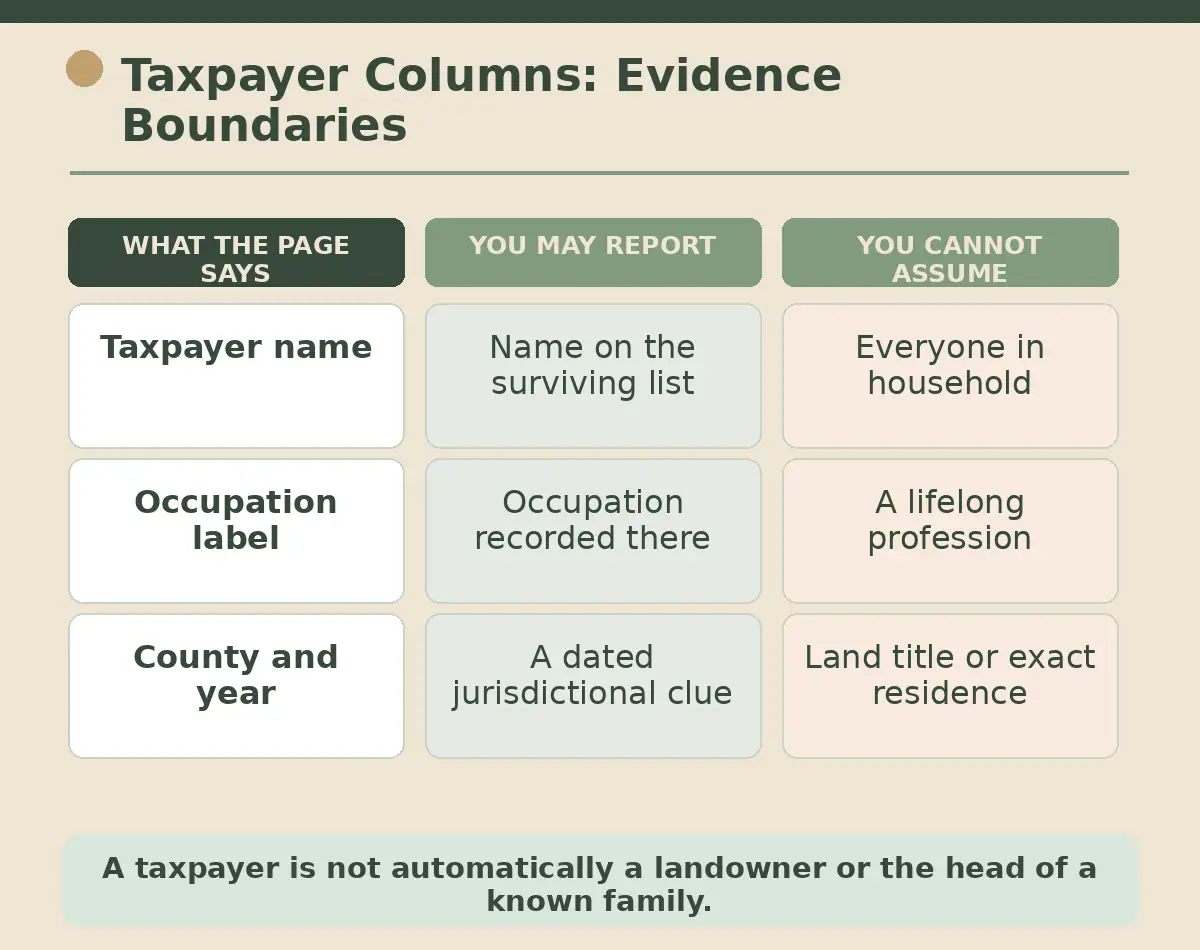
Many surviving Pennsylvania septennial lists chiefly preserve a taxpayer’s name and occupation. That is a valuable economic and community clue, but the list is not a complete roll of household inhabitants. A surname shared by a parent and adult child could produce one, two or no entries depending on liability and record survival. Read any headings and column labels on the page rather than assuming every return has identical fields.
A named occupation identifies the classification reported in that list, not necessarily a lifelong profession or exclusive source of income. Likewise, a taxpayer need not own the land where that person lived, and a nonappearance need not indicate poverty, migration or death. Treat one listed person as one historical administrative observation; test property title, household structure and residence against deeds, local tax records and independent censuses.
Compare Septennial Returns With Other Tax and Residence Evidence
Use a side-by-side dated log containing name variant, township or county, occupation, tax classification and exact archival citation. Place separate annual county tax assessments beside the septennial return, but do not merge different lists into a fabricated comprehensive census. County boundaries and township names can change, so verify the historical jurisdiction at each document date before deciding that two references concern a move.
If a person disappears from a later return, look for an estate administration, deed, directory or parish record rather than assuming death. A family member may have assumed tax liability while other residents remained. A consistent occupation and locality across independent records can strengthen a same-person hypothesis, but similarity of occupation by itself does not prove kinship or tell you whether the people shared a home.
Separate County Survival From Search Failure
There are three distinct outcomes: a relevant return survives and a person is found; a relevant return survives but a defined search yields no match; or the return itself cannot be located. Only the second outcome provides narrow negative evidence about the surviving material. The third does not. The Archives’ warning that few originals survive should appear in your research notes before an apparent no-hit is interpreted.
Check handwriting variants, alphabetic arrangement, township placement and any pages omitted by a digital index. If the person’s county is unknown, first establish location from land records, probate, church registers or federal enumerations and search only plausible counties. Do not silently treat a statewide search screen as encompassing absent returns, nor declare a family unrecorded in Pennsylvania on the basis of one interface.

Use a Four-Column Namesake Test for Taxpayers
Compare proposed identities using four columns: original name form, dated locality, listed occupation and a corroborating outside record. Record conflicting clues openly. For example, two men with the same name in nearby counties might both be artisans; one deed or probate packet may tie only one to the target household. Keep two distinct research profiles until documents connect the identity to a known spouse, property or reliably identified child.
A surname cluster could suggest a neighboring family or work network, but the returns usually do not state relationships. Similar names within one township do not automatically represent a father and son. If another source calls someone an owner, note that the septennial taxpayer return alone does not establish ownership. The point is to strengthen a specific historical identity claim while preserving its evidentiary limits.
Cite the Creator, Year and Surviving Record
A retraceable citation should give the Pennsylvania General Assembly record group RG-07, the return’s county and year, the page or archival locator if visible and the holding institution. If retrieved through Ancestry, include that access route as an additional layer. Do not cite a generic Pennsylvania census collection when you can give the particular preserved image; the collection title alone does not establish which person or county page you actually saw.
For a year that is absent from surviving state or county returns, document the source of that coverage conclusion. Next actions should depend on the original question: federal household returns for composition, local annual tax assessments for fiscal status, or deeds and probate for title and heirs. These substitutes answer related but not identical questions, and they must be labeled as separate documents.
More Records and Archives Guides
How We Research Pennsylvania RG-07 Census Returns
We check the Pennsylvania State Archives census guide for RG-07 coverage, screen the relevant county and year for actual survival, and inspect the original return rather than copying an index-only claim. We transcribe the reported taxpayer and occupation while avoiding inferred spouses, children, property ownership or an invented full county population.
Identity matching then uses independent deeds, tax and civil sources with dated jurisdictions. An unsuccessful search is scoped to the surviving return and pages actually viewed. Access routes are given plainly, not as implied recommendations of subscription products. See the GenHis affiliate disclosure for site policies; no commercial account is required to understand or apply the record interpretation.
The surviving returns generally name taxpayers and occupations; they are not complete named household censuses.
The State Archives lists Septennial Census Returns, 1779–1863, with major survival gaps.
The Pennsylvania State Archives lists them under Records of the General Assembly, RG-07; some material may be held with counties.
No. Tax liability, property title and household residence are separate questions.
The return may be lost, stored elsewhere, not indexed, or the person may not fall within those recorded.