
Historical property tax records let you observe a name or tract in a government assessment series across surviving years. They can fill gaps between other records, but they are not equivalent to deeds, household censuses or an uninterrupted ownership history. The method below shows how to find the appropriate local roll, preserve exact assessed categories and build a comparison grid that leaves missing years and uncertain identities visible.
Define what the tax office actually assessed
A historical tax roll is evidence that a particular government recorded a taxable person, parcel, household asset or other assessment category at a particular time. It is not automatically a deed, a census or a statement of legal kinship. Early lists may record real estate separately from personal property; some jurisdictions counted livestock, poll taxes or occupations; other lists provide only a name and amount. Read the headings printed or written on the original volume before interpreting any number.
The Library of Congress recommends starting with the local office responsible for property assessments and then tracing the location of older holdings. For a concrete example of how narrow coverage may be, New York State Archives describes assessment rolls for 1799–1804 that identify taxable residents and values but not buildings or movable details. Its description also notes geographic exclusions and no name index. Do not transplant that New York design to every American tax roll.
Trace the taxing district before searching a surname
Begin with the documented address, township or county of the person in the relevant year. A family could remain in one house while its assessment office or district name changed through administrative reorganization. Look up the district’s historical boundaries, then find the series created by its collector or assessor. Tax books often follow precinct or township divisions instead of the names of counties familiar today. A broad statewide search may overlook volumes described only by local series titles.
Searching requires more than entering one surname. Check variant spellings, initials, the head of household as recorded in that era, and the order of names on a page. If the collection is digitized but unindexed, browse nearby pages and preserve a note of the volume and location scanned. When you find a cluster of similar names, use known neighbors and independently dated documents to narrow the identity rather than adding every matching tax payer to the family tree.

Build a continuity matrix with source-specific columns
Use one row for each inspected tax year and columns for person as written, district, assessment class, stated amount, roll date, volume and page. Add a confidence column for identity and a separate column for changes that require explanation. This layout captures both stable facts and discontinuities. Avoid filling a missing year by carrying the previous assessed amount forward; an unobserved year is not a documented year.
Consider a hypothetical pair of tax entries for Elena Brown in the same precinct in 1876 and 1878. The second assessment is higher. That observation does not prove she purchased more acreage or built a house. A revised tax rate, reassessment, changed property description or a second Elena Brown could explain the difference. Record “assessment increased in surviving rolls,” then compare deeds, maps or a building permit if the jurisdiction preserved those records.

Interpret absences and dramatic value changes cautiously
A missing name can be the most tempting event to overinterpret. It might represent death, relocation or sale, but also exemption, different ownership classification, indexing error, a destroyed roll or an administrative boundary shift. Check the preceding and succeeding pages and years, whether the assessor used a new district structure, and whether the person appears under a spouse’s or estate’s name. Do not write a migration story from one unmatched search result.
Historic assessed amounts cannot be converted directly into personal wealth or modern market value. Local governments could assess different property classes at different rates or alter the taxable base. A rise in assessment is an item to investigate, not a ready-made biography. Take special care with historical classifications of enslaved people, who were sometimes cruelly listed as taxable property: document these sources with humane language and never imply they were property in any moral sense.
| Tax-roll observation | Supported statement | Additional record needed |
|---|---|---|
| Name assessed in 1878 | An assessment records a named taxable entry | Deed for title |
| Higher valuation in 1879 | Recorded assessment increased | Building or parcel records for cause |
| Name absent in 1880 | No matching entry in inspected roll | Check district and adjacent years |
| Similar surname in other township | A candidate entry exists | Independent identity information |
Find older rolls through a repository chain
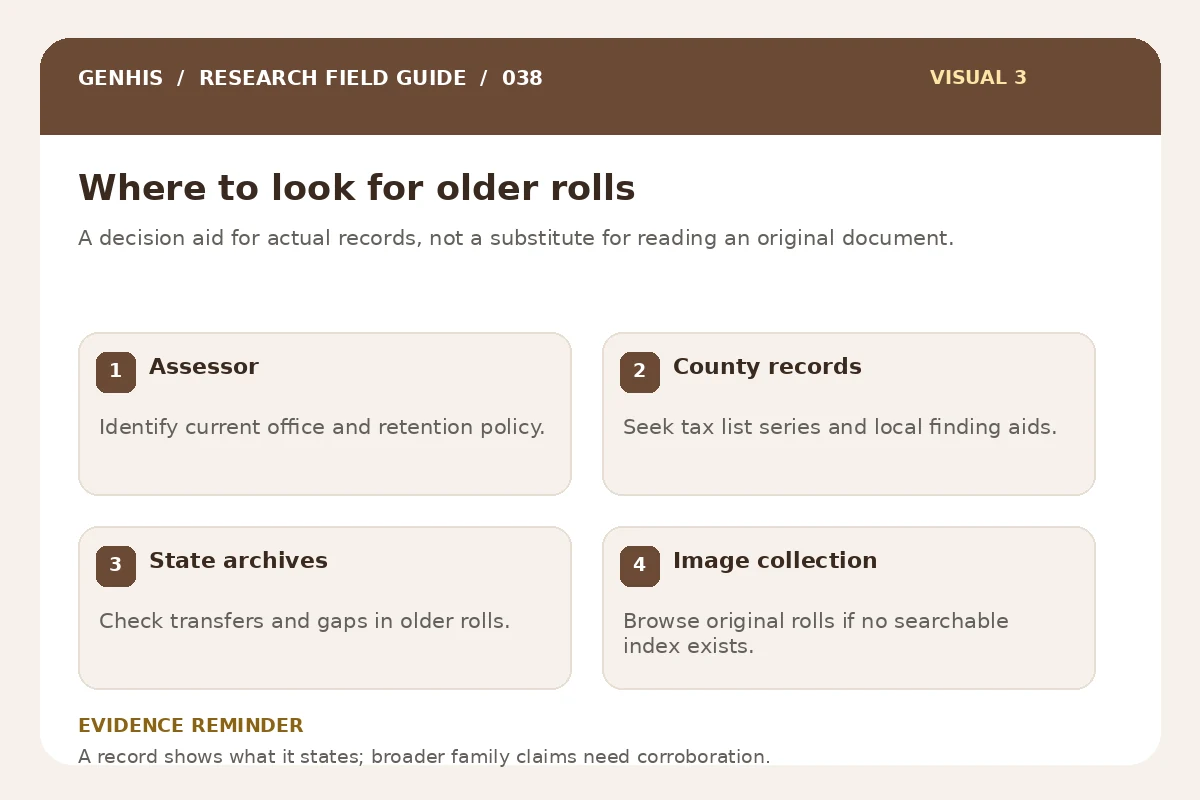
Start with a present-day assessor or county clerk only to identify the creating office and retention route. Ask a narrowly framed question: do property or personal tax assessment rolls for this town and decade survive, and if so are they indexed, microfilmed, scanned or transferred? Follow the answer to the state archive, county record center, historical society or relevant manuscript collection. Catalog terms may include assessment, tax duplicate, collector list or fiscal rolls, depending on region.
Before claiming a negative result, read the collection description. The New York State Archives example excludes one county and is arranged by county and town without a name index. A failure to find a name there has no evidentiary bearing on a different locality, a different time or an unsearched microfilm roll. Keep a search log that names the consulted collection, its actual coverage, the specific volume and pages, and the reason you stopped.
Turn repeated assessments into defensible family-history clues
Correlate a sequence of assessments with probate inventories, recorded conveyances, city directories and census records. A tax entry can support a person’s presence in an administrative population, while a deed may establish a conveyance of a described tract and a census may support household residence. These are different assertions. If the owner, payer and occupant appear to be three different people, the discrepancy is worth preserving rather than forcing a single identity. Our walkthrough on how to use historical city directories for family research sets out each step.
Your final tax-roll worksheet should state which years were actually observed, what changed, which identity matches are provisional and which repositories may hold missing material. Cite jurisdiction, creating office, exact series, assessment year, place, volume and page or image. The result is a tested continuity argument, not a fictional uninterrupted residence. Even a sparse list can be valuable when its evidentiary boundary is written as clearly as its apparent clue.
How We Research: jurisdiction, source provenance, and uncertainty
We evaluated the Library of Congress guidance on assessment records alongside the New York State Archives description of a specific surviving tax-roll series. That comparison reveals why column headings and repository boundaries must be read on the original source before any assessment is interpreted. The Elena Brown example is a hypothetical case about competing explanations, not a verified change in an historical tax bill. We avoid converting recorded assessments into modern market prices or into claims of uninterrupted legal ownership.
Authoritative record sources and repository limitations
guides.loc.gov — repository reference. Library of Congress identifies local property tax offices and cautions that older files may be archived elsewhere. This description establishes its own record scope, not an unlimited archive of tax payments throughout the country.
www.archives.nysed.gov — repository reference. New York State Archives documents example assessment-roll fields, locality coverage and missing indexes. This description establishes its own record scope, not an unlimited archive of tax payments throughout the country.
www.ancestry.com — repository reference. Ancestry research guide illustrates differences among jurisdictional tax-list series and survival. This description establishes its own record scope, not an unlimited archive of tax payments throughout the country.
www.familysearch.org — repository reference. FamilySearch explains how to identify collections including browse-only images and coverage restrictions. This description establishes its own record scope, not an unlimited archive of tax payments throughout the country.
More Records and Archives Guides
Privacy, disclosure, and the limits of this guide
A historical assessment is not a legal tax bill for today or a reliable estimate of current property value. This educational guide does not provide tax, title or legal advice; archive access and reproduction rules depend on the office concerned. We have not claimed a partnership or fee from the authorities linked in the article. The GenHis disclosure page explains broader site practices. Do not republish identifiable records about living property owners.
Not necessarily. An assessment identifies the person or property recorded under that jurisdiction’s taxation rules. Compare the relevant deed and local law before making an ownership claim.
Yes. Surviving annual or periodic local lists may show recurring names and taxable property across years, but they do not independently prove where a household lived.
Possible explanations include district changes, exemptions, altered recording practices, loss of a volume, death, movement or a different spelling. The cause requires other evidence.
Identify the historic taxing authority, then ask the current assessor, county archives, state archive or local historical repository whether the particular series survives.
Usually not without contextual study. Tax rules, exemptions, assessment ratios, currency and property definitions may change. Compare only values documented on like-for-like bases.