
For postwar Welsh school planning, The National Archives identifies BD 7 and ED 216 as routes to local education authority development plans. These records can show how an authority proposed to change the school network, but a planned building, merger or expansion is not proof that it happened. A plan also does not identify a particular child as a pupil. Start with the historical county or local education authority and the relevant period; then compare the plan with later school and local records.
The National Archives’ elementary-school guide lists BD 7 and ED 216 as exceptions to the predominantly shared English and Welsh education series. Its secondary-school guide warns that some Welsh education records were destroyed during the Second World War and in flooding in Cardiff in 1960. The Archives also discusses postwar local-authority development planning under the 1944 Education Act. The loss and series arrangement must shape any conclusion based on a gap.
Find the historical Welsh education authority
Begin by locating the school or proposed site within the correct local education authority for the time under study. Welsh counties, district arrangements and school names have changed. A modern council boundary may not correspond to the authority that submitted the original plan. Record the name used on the contemporary document and use dated maps or administrative histories to cross-check the area.
For a school with more than one name, collect the earlier form, nearby parish or settlement and approximate date. A proposed secondary school may appear under a planning label rather than the name later adopted. Do not merge similarly named schools in neighboring districts. Keep a place-name and authority-name variant list to make the search reproducible.

Read BD 7 and ED 216 as planning evidence
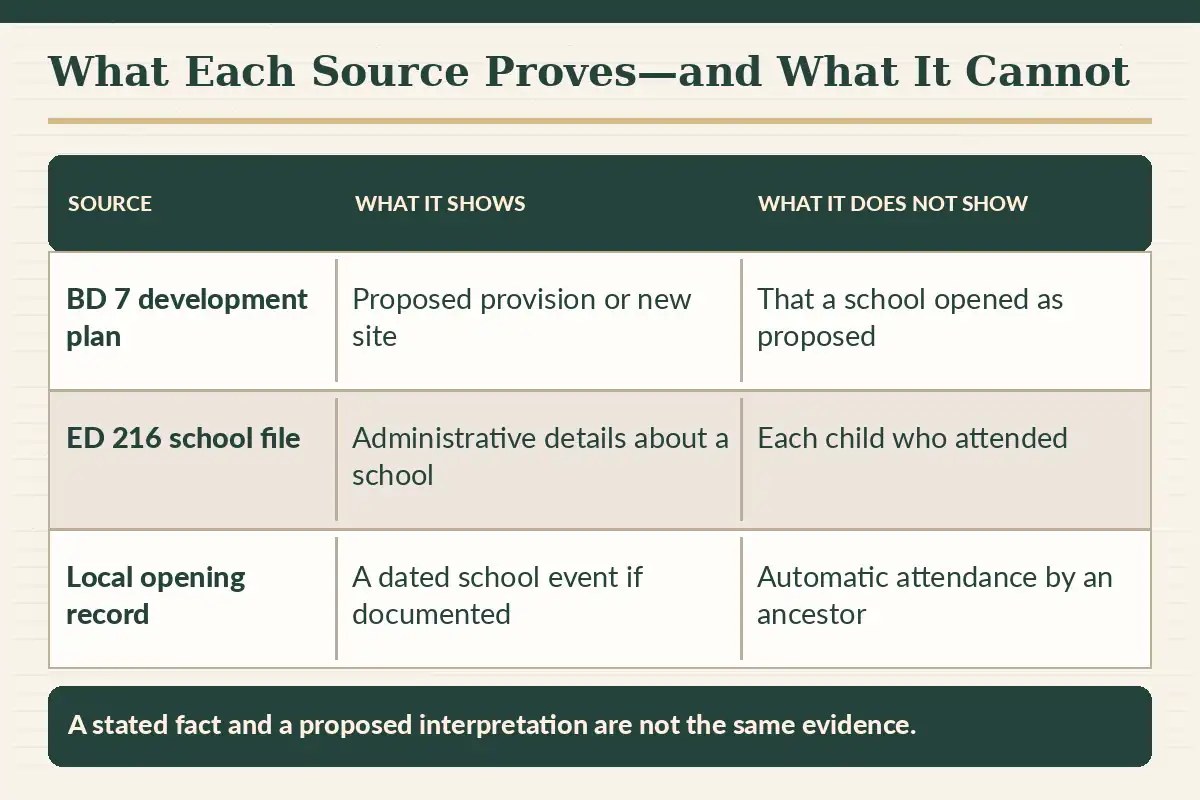
The National Archives places Welsh local-authority development plans in BD 7 and ED 216. A plan may discuss a new building, extension, closure, consolidation or revised catchment. Each proposal is a statement of intended provision at a particular stage of administrative decision-making. The presence of a design or proposed date does not mean the authority obtained funds or completed the project.
Identify whether the record is an initial submission, a revision, a departmental response or a later report. Preserve its original date and issuing body. If a file contains conflicting plans, describe them as successive proposals instead of selecting one and writing it as the outcome. The goal is a decision chronology, not a visually tidy but unsupported story of construction.
Test a proposed site against later school records
Once a planned school or building appears, look for independent evidence that the facility opened, changed use or was abandoned. Useful candidates can include local education committee minutes, dated school log books if held locally, contemporary newspapers and later maps. A planning diagram is one source; actual construction, occupancy and official school status are separate facts.
Compare the exact address or site boundary across sources rather than relying on a broad town name. A scheme may have been moved to another street, delayed or replaced. State the strongest verified stage: proposed, approved, built or open. Avoid claiming a construction year because a development plan mentions a target date.
Distinguish school administration from a pupil record
Files in ED 216 may give useful organizational information about Welsh schools, but The National Archives cautions that governmental school files were not chiefly created as personal pupil registers. A document noting the expected number of pupils or age groups is not a roll naming individual children. If a family recollection concerns a specific student, the plan supplies historical context rather than direct proof of attendance.
Search the surviving school’s archive, local education records or admission material subject to access and privacy restrictions. When individual records are unavailable, independent home addresses and dated school photographs may form clues, but they still need careful identity checks. A nearby planned catchment does not establish that a family enrolled a child there.
Make missing files part of the research argument
The National Archives secondary-school guidance notes that Welsh education files suffered losses during the Second World War and flooding in 1960. Consequently a catalogue gap may reflect destruction, non-transfer, different custody or different indexing, not absence of the school or decision. Record which repository, series, period and names have actually been searched.
If BD 7 has no relevant plan, try a suitably described ED 216 file and local archives. Do not assume that these two series are sequential stages that every school must have passed through. They are alternative and sometimes complementary finding routes. Describe an unlocated record as a research limitation, with a specific place to search next.

Write a dated school-development timeline
A useful final table has columns for proposal date, document author, proposed action, approval evidence, actual opening evidence and pupil-level proof. Use separate citations for every factual stage. A plan can be a primary source for what the authority intended even if the plan was never implemented, and the distinction itself may explain changes remembered by the local community.
Write a conclusion that keeps scope precise: “an LEA proposed a school at this location” requires the plan; “the school opened” requires an appropriate dated confirmation; “a named child attended” requires separate identification. That three-stage test prevents administrative ambition from being mistaken for family biography.
Build a traceable evidence worksheet
Start a claim-specific ledger with the full archive reference, repository, record level, historical creator, date, geographic scope, exact name and role, and whether you saw the original or a description. For each relevant field copy the literal evidence and add a separate inference column. Use historical Welsh authority boundaries and the postwar planning period; BD 7 and ED 216 are not pupil registers. If an index is incomplete, the right conclusion is that the search is incomplete, not that an event could not have occurred. Save every no-result search with its terms and coverage.
Compare with a record created independently of the first whenever possible. A school drawn on a proposed development map is not proof of construction, opening, or enrollment. If two websites repeat one archival description, they are not two independent witnesses. Work with genuine conflicts rather than silently changing dates, spelling or personal identity until an ancestor fits. A good final sentence states what was directly documented, what remains an interpretation, and one specific record that could change the result.
More Place and Jurisdiction Guides
How We Research and Check These Records
We checked official archival guidance on 2026-11-03. The National Archives identifies BD 7 and ED 216 as Welsh LEA development-plan series and explains the distinction between national education files and local school evidence. This verifies the described source route; it does not assert that a particular family member appears in the series.
We checked official archival guidance on 2026-11-03. The Archives discusses LEA planning under the 1944 Education Act and notes significant wartime and 1960 flood losses affecting Welsh school files. This verifies the described source route; it does not assert that a particular family member appears in the series.
We checked official archival guidance on 2026-11-03. The official schools guide explains that administrative school files are not principally individual pupil records and often require local research. This verifies the described source route; it does not assert that a particular family member appears in the series.
The images are original explanatory illustrations, not archival facsimiles. No paid endorsement or affiliate arrangement is implied. See our affiliate disclosure.
The National Archives identifies BD 7 and ED 216 as relevant series.
No. Seek independent construction or opening evidence.
Generally not; research surviving local school and admission records separately.
Some files were lost in wartime and in 1960 flooding, and others may be held locally.
Use the historical LEA and place names for the document date, with variants as needed.