
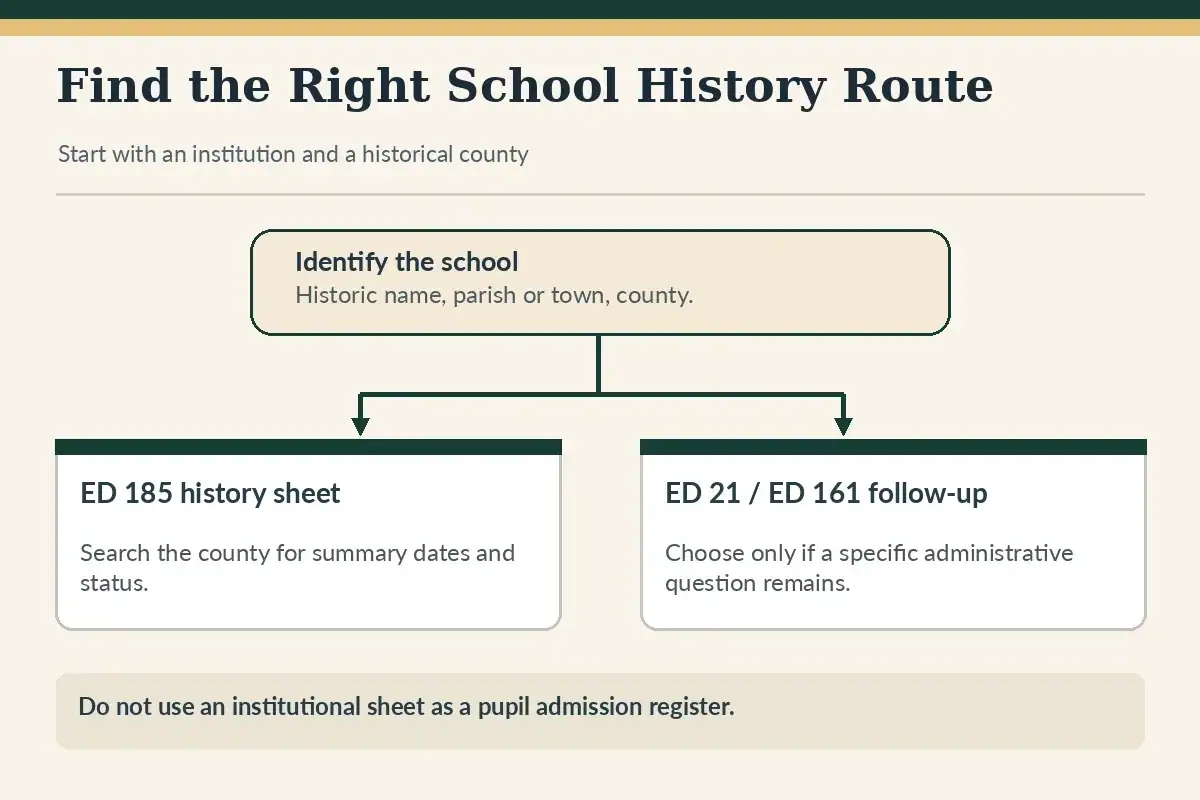
ED 185 is a starting point for reconstructing the administrative history of a school, not for proving which children attended it. The National Archives says the Board of Education introduced school history sheets in the 1920s for local-authority-maintained schools in England. These summary records can include a school’s establishment date, status, size and the sex and ages of pupils. The recommended initial search is by county.
Suppose a family story says an ancestor “went to the village school before the war.” Before looking for a named pupil, identify the school as an institution: its contemporary name, county, parish or town, and whether the local authority maintained it. A twentieth-century building name may describe a school that was reorganized, merged or renamed. The school history question and the pupil attendance question therefore require different documents.
Start With County, School Identity and Administrative Name
Search ED 185 by the English county named in the school’s historical location, then compare school names and nearby place labels in the catalogue. The archive guide expressly recommends a county search for this series. Record the original reference and the description displayed by Discovery. If a historic school has multiple names, enter them as dated alternatives. Do not assume a modern academy or combined school is legally the same institution as a predecessor with a similar sign.
Make a concise identity sheet: county, town or village, denomination where documented, governing or maintaining authority, date range and exact recorded name. A photograph of a school building can help with location, but is not a substitute for evidence of administrative continuity. If the first county search fails, test spelling variants, boundary changes and neighboring districts; write down which catalogues were actually searched.
Treat Establishment, Recognition and Reorganization as Different Dates
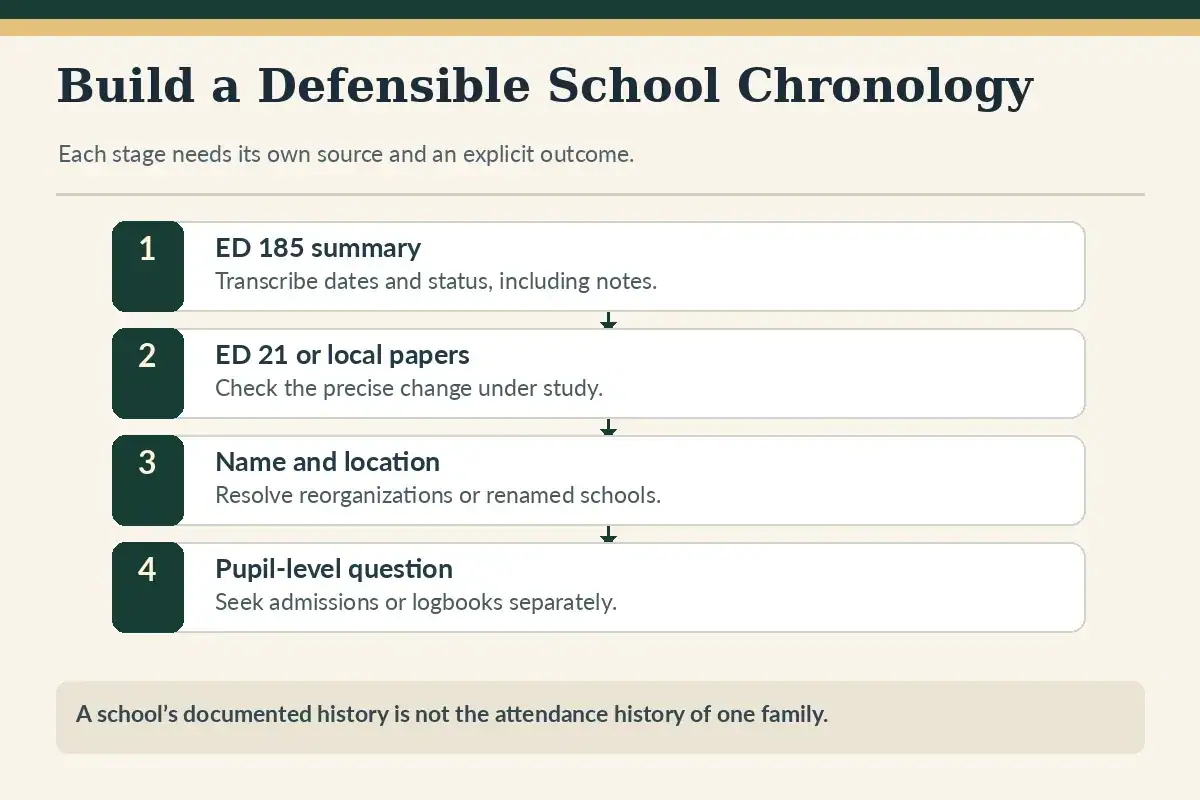
A school history sheet may give an establishment date, but the word must be interpreted in the context of the form and any later annotations. A school could occupy an older building, change management or acquire a new status. Do not collapse those events into a single “founded” year. Build a chronology with separate columns for the stated event, date recorded, date of the underlying event and precise source reference.
A sheet compiled in the 1920s can summarize an earlier history. Thus it is not automatically contemporary evidence for every date written on it. When establishment is disputed, cross-check the school file in ED 21, a local school board minute book or a documented county history. Explain whether an earlier date rests on the school’s later administrative summary or on a record created when the event occurred.
Use Reported Size, Ages and Sex Without Inventing Enrollment
The National Archives identifies school size and the sex and age range of pupils as examples of information summarized on ED 185 sheets. These are characteristics of institutional provision, not a list of all pupils present on a particular day. If the sheet says a school served girls and boys aged seven to eleven, that is useful historical context. It does not prove that a named child in the village was enrolled.
Likewise, a reported size or category should not be converted into a complete attendance count without verifying the field’s definition. Some figures may refer to accommodation or an administrative return rather than physical presence. Transcribe the original headings and notes before treating any figure as headcount. If the question is about a specific ancestor, look for surviving admission registers, logbooks or local authority material held elsewhere, and observe access restrictions for more recent records.

Compare ED 185 with ED 21 and ED 161 Only for a Specific Question
An ED 185 summary can lead to a targeted follow-up. The National Archives describes ED 21 as school files with correspondence on premises, trusts, inspection and organization for grant-supported schools, largely covering 1857–1945. If the sheet indicates a disputed move or reorganization, an appropriately dated ED 21 file may explain it. ED 161 school digest files are a different route for many primary schools established before 1966, often concerning later twentieth-century administration.
ED 161 files have been heavily weeded, so thin surviving contents should not be mistaken for a quiet school history. Before ordering a file, write one question that its document type could answer. A letter about a roof extension is evidence of administrative action, not evidence that every child living nearby attended the school. Distinguish a proposal for expansion from a completed change visible in later records.
Reconstruct a School Timeline Without Reconstructing an Imagined Class
For an illustrative, fictional Rose Lane School, suppose a later history sheet reports an opening date and a change to mixed provision. Create two timeline entries with the source date and any uncertainties. Now suppose a photograph shows a class labeled “Rose Lane, 1932.” The photograph might help date a group of pupils only if its caption or independent provenance is reliable; it cannot make the history sheet into a roster.
Use a three-column evidence matrix: institution fact; exact supporting record; person-level evidence still required. A school name can be corroborated in county directories and historical maps; a child’s attendance needs an admission, log, transfer or equally specific record. Treat a gap in ED 185 as an archival limitation rather than proof the institution never existed. Preserve the reference for each failed search to prevent repeating it later.
More Place and Jurisdiction Guides
How We Research School History Sheets and Related Files
The factual description of ED 185 comes from The National Archives’ elementary and primary schools research guide. That guide also distinguishes the roles of ED 21 and ED 161 and warns that relevant school material is not generally available online. Use Discovery advanced search to limit a search by county, date and archival reference, then confirm the holding repository.
Rose Lane School is an illustrative fiction, not an identified historical institution. Our procedure separates a retrospective administrative note from an original pupil register and does not claim unrestricted access to student details. Before paying for commercial images or copying, consult our affiliate disclosure.
It is the record series for school history sheets introduced in the 1920s and searched by English county.
Not as a general rule; the source summarizes the school rather than individual attendance.
No. Check the form and independent contemporary material before equating administrative dates.
ED 21 holds relevant correspondence, where a suitable surviving school file exists.
Check historic county, name changes, series coverage and records held by local archives before reaching a conclusion.